
Advertisement
Co Presented By
Co Presented By


Sections
Niti Aayog boss Amitabh Kant says inter-state development disparities holding India back; this is what he means
The rate of development varies widely across states in India, building a picture of an unequal nation

 A file photo of Niti Aayog CEO Amitabh Kant.[/caption]While the gross state domestic product (GSDP) data are equivalent to entire developed nations (e.g. Maharashtra and Finland), others are more than 84 times smaller. Similarly, states such as Gujarat have primary school dropout ratios significantly below the national average (0.83 vs 4.34), while others are more than five times higher (Assam’s is 15.46).India currently ranks 131 out of 188 countries on the HDI, lowest amongst BRICS nations in the most recent 2016 rankings.The HDI measures key dimensions in human development: a long and healthy life, being knowledgeable and having a decent standard of living. The index can be used to question national policy choices and assess how countries with similar gross national incomes per capita can end up with different human development outcomes.Infant mortality rates highlight healthcare inequalityThe rate of children dying before reaching their first birthday is more than fives times higher in states such as Madhya Pradesh (54), Assam (54) and Odisha (51), compared with the best-performing states of Goa (9), Manipur (10) and Kerala (12).As we said, this means some parts of India (Goa and Kerala) are attaining average infant mortality rate (IMR) that are the same as European nations, while the states with the highest IMR equal those of significantly less developed, often disaster/war-stricken and unstable countries.
While India has reduced IMR, deaths per 1,000 live births, by 68 percent over 41 years — from 130 in 1975 to 41 in 2015-16 — according to National Family Health Survey 2015-16 data, India’s IMR is still worse than poorer neighbours Bangladesh (31) and Nepal (29), and the African nation of Rwanda (31), IndiaSpend reported in March 2017.IMR is seen as a useful measure of general population health, health systems and programmes. It reflects the influence of a population’s economic development, general living conditions, social well being, rates of illness, and the quality of environment on the causes of infant mortality.The wide discrepancy in IMR between states in India indicates a high level of disparity between access to healthcare, sanitation levels and education of women — all factors shown to have an impact on the survival rates of infants, IndiaSpend reported in March 2018.Economic disparityMaharashtra, India’s economic powerhouse and home to 112 million residents at the time of the 2011 census, has a GSDP of $243 billion per year (Rs 16.5 lakh crore), according to RBI data, equivalent to Finland ($251 billion), home to 5.5 million people.Maharashtra’s GSDP is 5.5 times higher than Bihar, which has a population of 104 million and a GSDP of $44 billion per year (Rs 3 lakh crore), smaller than the North African country of Libya ($50.9 billion), home to 6.2 million.While state GSDP rankings do not mirror those of infant mortality rates shown above, levels of discrepancy are equally high within this economic indicator. The top five states (Maharashtra, Uttar Pradesh, Gujarat, Karnataka and Tamil Nadu) have, on average, 84 times higher GSDP levels than the lowest five states (Manipur, Nagaland, Mizoram, Sikkim, A & N Islands), according to RBI data.As much as 73 percent of the wealth generated in India last year went to the richest 1 percent, an increase of Rs 20.9 lakh crore from the previous year and equivalent to the total budget of Central Government in 2017-18, according to a 2018 Oxfam report.Between 1980 and 2014, India had the largest gap of all countries between the growth of the top 1 percent of the population by income and growth of the full population, according to this 2017 working paper.Education attainment varies across the countryThe ratio of pupils dropping out in primary school varies widely across the country, from a peak dropout ratio of 15.46 in Assam, to a low of 0.65 in Himachal Pradesh.The states with the highest drop out ratios (Assam (15.46), Mizoram (10.1), Manipur (9.66) and Meghalaya (9.55) ) are found overwhelmingly in the North-East of the country, an area experiencing rapid growth, alongside some of the highest levels of poverty and unemployment, although some of these states (Sikkim and Mizoram) boast some of India’s best health indicators.India’s wealthier states tend to have the lowest levels of students dropping out, such as Karnataka (2.02), Maharashtra (1.26) and Gujarat (0.83).
| Primary Level Drop Out Ratio, 2014-15 | |
|---|---|
| State/ Union Territories | Primary Level Drop Out Ratio 2014-15 (%) |
| Assam | 15.46 |
| Arunachal Pradesh | 10.82 |
| Mizoram | 10.1 |
| Manipur | 9.66 |
| Meghalaya | 9.45 |
| Uttar Pradesh | 8.58 |
| Jammu and Kashmir | 6.79 |
| Andhra Pradesh | 6.72 |
| Madhya Pradesh | 6.59 |
| Haryana | 5.61 |
| Nagaland | 5.61 |
| Jharkhand | 5.48 |
| Rajasthan | 5.02 |
| Uttarakhand | 4.04 |
| Punjab | 3.05 |
| Chhattisgarh | 2.91 |
| Odisha | 2.86 |
| Sikkim | 2.27 |
| Karnataka | 2.02 |
| West Bengal | 1.47 |
| Tripura | 1.28 |
| Maharashtra | 1.26 |
| Gujarat | 0.83 |
| Goa | 0.73 |
| Himachal Pradesh | 0.65 |
| Bihar | Not Available |
| Chandigarh | Not Available |
| Delhi | Not Available |
| Kerala | Not Available |
| Lakshadweep | Not Available |
| Tamil Nadu | Not Available |
 Poverty lineUttar Pradesh and Bihar, states with low levels of annual per capita income ($643 or Rs 43,861 and $460 or Rs 31,380 in 2014-15), have the largest number of people living below the poverty line with 29 percent and 34 percent of the population earning below the required amount to meet minimum living conditions; 59.8 million and 35.8 million, respectively.Despite having higher GSDP, Madhya Pradesh, Punjab and Maharashtra follow with a large population (23.4 million, 23.2 million and 19.7 million, respectively) living at minimum income levels.Poverty line indicators are relative to each country and vary according to the monetary threshold of each country, decided as the minimum needed to achieve basic living standards.India had the largest number of people living under the international $1.90 a day poverty linein 2016, according to this World Bank report. This figure is more than 2.5 times as many as Nigeria, which has the second-largest population (86 million) of the poor worldwide.
 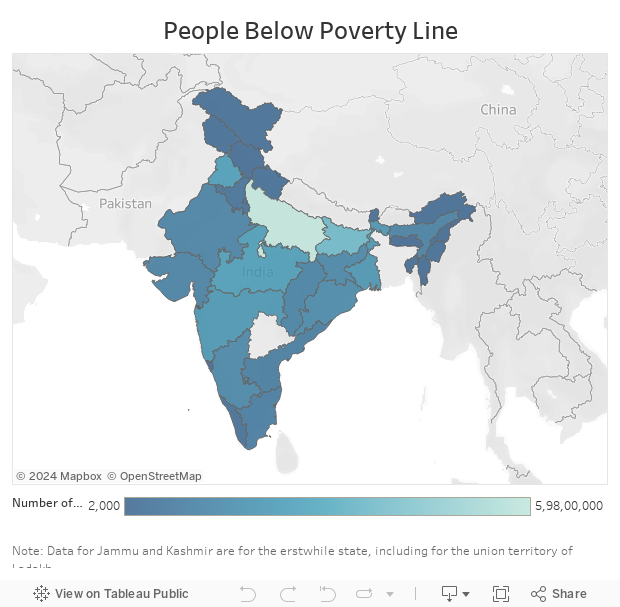 Source: Press Note on Poverty Estimates 2011-12, Planning Commission July 2013Note: Data of Andhra Pradesh includes Telangana(Sanghera, a graduate of King’s College, London, is an intern with IndiaSpend)(Indiaspend.org is a data-driven, public-interest journalism non-profit initiative)
First Published:Jul 30, 2018, 12:23:06 IST
Advertisement
Advertisement

Google burns cash for first time as AI spending pushes 2026 capex to $205 billion
Google parent Alphabet reported negative free cash flow of $5.9 billion in the second quarter for the first time since going public, as surging AI infrastructure spending pushed its 2026 capital expenditure forecast to as much as $205 billion
6 min read
Tesla sells more cars but makes less money: Why Musk’s AI pivot is squeezing profits
Tesla’s record Q2 deliveries failed to translate into higher profits as price cuts, falling regulatory-credit revenue and Elon Musk’s aggressive AI spending squeezed margins and pushed the EV maker into negative free cash flow
5 min read
No premium queues, 30-minute target: What changes for Indian passport applicants in UAE
Indian passport applicants in the UAE can now access passport, visa and attestation services through Alhind’s 16 centres, with no premium queues, a Dh19 service fee and a target of completing applications within 30 minutes
4 min read
Bharat Forge, Flying Whales sign pact to develop 60-tonne airships for India’s defence logistics
Bharat Forge has signed an MoU with Flying Whales to jointly develop and manufacture 60-tonne heavy-lift airships in India for defence logistics, strategic mobility and disaster response
3 min read
Air India to cut Delhi-Toronto flight time by 3 hours, resume non-stop services from August 1
Air India will resume non-stop Delhi-Toronto flights from August 1, cutting travel time by nearly three hours and deploying its new Boeing 787-9 Dreamliner on the route
2 min read
Advertisement
Advertisement