



US hopes BRICS bank will work with international financial bodies
The US has expressed hope that the new multilateral development bank planned by BRICS countries will work closely with existing international financial institutions and follow best of the practices.

Washington: The US has expressed hope that the new multilateral development bank planned by BRICS countries will work closely with existing international financial institutions and follow best of the practices.
"Many of the important details regarding the proposed BRICS Development Bank are not yet clear. We hope it will work closely with existing international financial institutions and follow best practices," White House Press Secretary Josh Earnest told PTI.
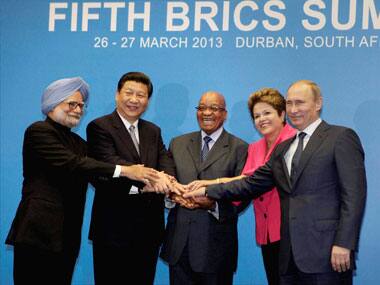
A unique institution of its own, the BRICS development bank would use $50 billion of seed capital. PTI[/caption]
He said the US understands that the BRICS nations -- Brazil, Russia, India, China, South Africa -- discussed their mutual economic interests at the recently-concluded BRICS Summit in Durban, including on development issues. Observing that the US enjoys good relations with the BRICS countries, both bilaterally and multilaterally, Earnest said the Obama Administration works with them regularly in a number of international organisations, including the G-20.
 More from Economy
"We welcome their constructive engagement on global issues," he said. This is the first reaction from the White House on the just-concluded BRICS summit, in which leaders of the five emerging economies came out with their joint action plan to address several global issues collectively, and also announced their decision to establish a development bank, which many see as a challenge to the World Bank.
While World Bank has welcomed the move, the International Monetary Fund (IMF) has been a bit cautious in its reaction. A unique institution of its own, the BRICS development bank would use $50 billion of seed capital shared equally between the five countries Brazil, Russia, India, China and South Africa. The New York Times, meanwhile has said for all the talk of solidarity among emerging giants, the group's concrete achievements have been few since its first full meeting, in Russia in 2009.
"This is partly because its members are deeply divided on some basic issues and are in many ways rivals, not allies, in the global economy," it wrote. "The alliance faces serious questions about whether the member countries have enough in common and enough shared goals to function effectively as a counterweight to the West," The New York Times said.
PTI

India’s trade surplus with US may cross $90 billion after tariff cuts, says SBI report
Inflation likely to be a big focus area for budget 2024, say sources
Explained: Will the Bank of Japan break tradition and raise interest rates?
UK enters recession, central bank admits
Explained: How the rising US dollar can affect everyone