



There goes your big rate cut hope: manufacturing slowed in March
PMI index shows activity slowed in March, inflation risks remain high<br /><br />

For those expecting a deep rate cut in the Reserve Bank's 17 April policy, the news is far from encouraging. The manufacturing sector showed slower activity in March, thanks to power outages and raw material shortages.
The HSBC Purchasing Managers' Index (PMI), an indicator of manufacturing sector activity, recorded a lower reading of 54.7 in March, as against 56.6 in February, showing that while there was expansion, it was at a slower clip.
"These numbers do not provide the RBI with a carte blanche to cut rates and suggest that it will have to approach the easing cycle very cautiously," says Leif Lybecker Eskesen, HSBC's chief economist for India & ASEAN, underscoring the growing concern that while the 2012 Union Budget did more than increase the tax burden and provide some basic lip service to fiscal consolidation, problems on the ground have begun increasing.
 More from Economy
[caption id="attachment_263461" align="alignleft" width="380" caption="For those expecting a deep rate cut in the Reserve Bank's 17 April policy, the news is far from encouraging. Reuters"]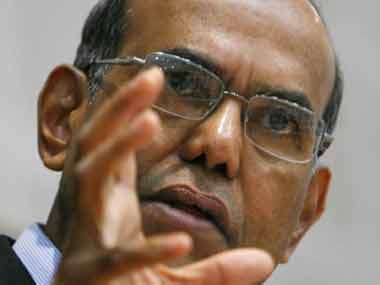 [/caption]
Worse, the PMI reading shows that output and new orders slowed down, partly due to power outages and raw material shortages. Capacity remains tight, with backlogs increasing. Inflation remains firm, input prices are accelerating and output price inflation runs high, indicating that the chances of RBI governor Duvvuri Subbarao announcing a substantial cut in rates this month are all but zero.
The PMI data shows output (56.3 vs. 60.5 in February) and new orders (58.1 vs. 62.8 in February) grew at a slower clip, while export orders (55.6 vs. 53.9 in February) accelerated.
Supply delivery times lengthened (48.8 vs. 49.3 in February) and backlogs of work (56.4 vs. 52.0 in February) rose underscoring the tight capacity. A pick up in employment (51.1 vs. 48.7 in February) did not help sufficiently alleviate the capacity constraints, Eskesen said in a statement.
Input prices (61.2 vs. 60.6 in February) picked up pace, while sequential output price inflation eased (54.1 vs. 56.6 in February). Both price indicators are above historical averages.
"While India faces broad capacity constraints, a key constraint is lack of power producing capacity and reliability of power production. Both explain why outages can have a big impact on output in a given month. The power sector in India is going through a tough period with many power companies facing difficulties due to the inability to sell at market prices and due to shortages of coal," he said.
Economists and policy watchers feel that while the Prime Minister's Office has moved to try and ease the problems for power producers, a lot more will need to be done. Besides, these capacity constraints are also leading to inflation remaining at elevated levels.
Elevated oil prices and other commodity prices are further adding to existing inflationary pressures. As reported by Firstpost, the possibility of fuel prices being hiked to reduce the fiscal deficit burden -together with the higher tax burden following the Union Budget - is expected to increase inflation further.
All in all, this cocktail of factors will tie Subbarao's hands even further in announcing a rate cut.
In fact, with this latest PMI figure, and the existing inflationary risks, it is unlikely that the RBI will announce a cut in April at all.
"While RBI may still cut in the April-June quarter, it is not given that it will be comfortable enough to begin the rate cutting cycle in April," Eskesen says.
Sourav Majumdar has been a financial journalist for over 18 years. He has worked with leading business newspapers and covered the corporate sector and financial markets. He is based in Mumbai.

India’s trade surplus with US may cross $90 billion after tariff cuts, says SBI report
Inflation likely to be a big focus area for budget 2024, say sources
Explained: Will the Bank of Japan break tradition and raise interest rates?
UK enters recession, central bank admits
Explained: How the rising US dollar can affect everyone