



Raising rates will bring down inflation: Here's why
If the RBI's anti-inflationary stand had been credible, it would work better than trying to be all things to all people

A few days ago, I wrote a blog post about India's inflation crisis. For five years now, in every single month, the year-on-year Consumer Price Index (CPI) inflation has exceeded 5 percent. Under these conditions, economic agents have little confidence that the Reserve Bank of India (RBI) cares about inflation.
[caption id="attachment_116025" align="alignleft" width="380" caption="Reuters"] [/caption]
They are now reporting double-digit inflationary expectations. Under these conditions, inflation will be persistent. By itself, inflation is not going to go back to the target range of 4 to 5 percent. This blog post made certain qualitative claims about fighting inflation under two scenarios: when the central bank has credibility and when it does not.
 More from Economy
I recently came across a fascinating paper which is about a similar situation: it is about the problems faced in Ghana recently, in fighting back an inflation. It gives numerical values which are interesting for us. Their inflation was a bit worse than ours - they were at 20 percent. But for the rest, this analysis illuminates what we face in India today. The paper is : A model for full-fledged inflation targeting and application to Ghana, by Ali Alichi, Kevin Clinton, Jihad Dagher, Ondra Kamenik, Douglas Laxton and Marshall Mills, IMF Working Paper, 2010.
Here is the main story. First, look at the projected trajectory for what happens to the short term interest rate and inflation under conditions of weak credibility of the central bank:
[caption id="attachment_116017" align="alignleft" width="380" caption="Table 1"]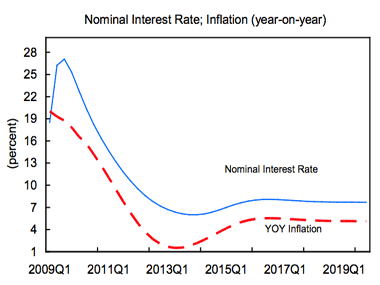 [/caption]
The nominal rate is required to go all the way out to 26 percent. Inflation responds slowly. It is projected to get to the target (with some overshooting at first) by 2016. The cumulative damage to GDP growth, in this process of exorcising inflation, works out to roughly 20 per cent of GDP. (This is the sum total of the output cost over all the years taken in wrestling this inflation down).
Compare this against the picture obtained when the central bank has high credibility:
[caption id="attachment_116019" align="aligncenter" width="593" caption="Table 2"]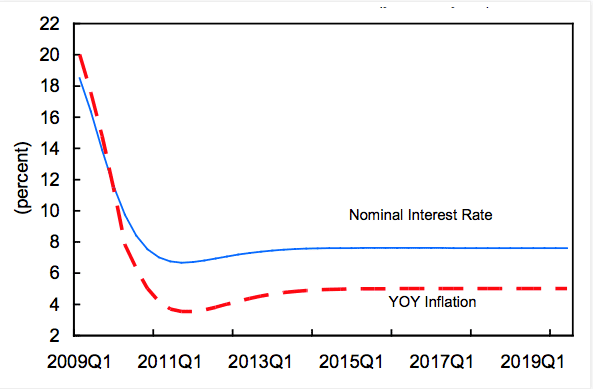 [/caption]
This is much nicer story. The nominal interest rate starts out high (18 percent) but inflation responds rapidly and the interest rate can also come down rapidly. By 2013, inflation is at the target. The cumulative damage to GDP growth, in this process of exorcising inflation, works out to only 4 percent of GDP.
This difference is striking. Lacking credibility, the central bank has to force a total output loss of 20 percent of GDP, and they get to target inflation by 2016. With credibility, the job gets done three years sooner, and at a cost of only 4 percent of GDP of output loss.
This is an essential insight into our inflation crisis today. In the end, raising rates will get the job done. No matter how bad is the monetary policy transmission, no matter how deeply ingrained inflationary expectations have become, raising rates will ultimately deliver price control. The choice that we face is between being bloody-minded about it, or simultaneously undertaking RBI reforms which involve zero output loss, and improve RBI's credibility.
Ajay Shah studied at IIT, Bombay and USC, Los Angeles. He has held positions at the Centre for Monitoring Indian Economy, Indira Gandhi Institute for Development Research and the Ministry of Finance, and now works at NIPFP where he co-leads the NIPFP-DEA Research Programme. His research interests include policy issues on Indian economic growth, open economy macroeconomics, public finance, financial economics and pensions. ajayshah@mayin.org</a> http://www.mayin.org/ajayshah</a> http://ajayshahblog.blogspot.com</a>

India’s trade surplus with US may cross $90 billion after tariff cuts, says SBI report
Inflation likely to be a big focus area for budget 2024, say sources
Explained: Will the Bank of Japan break tradition and raise interest rates?
UK enters recession, central bank admits
Explained: How the rising US dollar can affect everyone