



Is BRIC really a Bloody Ridiculous Investment Concept?
Is the idea of BRICs - Brazil, Russia, India and China - now past its sell-by date?

Looks like people are starting to throw bricks at BRICs now.
Earlier this week, a report by Societe Generale rubbished the investing concept of BRIC, coined by Goldman Sachs' Jim O'Neill a decade ago to represent the top four emerging economies that would drive the future of the global economy - Brazil, Russia, India and China.
Societe Generale thought the expansion of the term should really be "Bloody Ridiculous Investment Concept."
[caption id="attachment_146748" align="alignleft" width="380" caption="The idea of BRICs was also derided by Parag Khanna. Reuters"]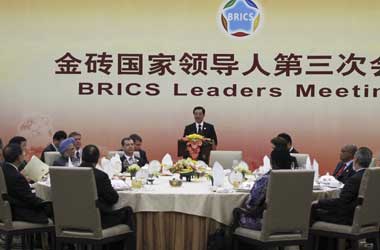 [/caption]
"Despite recent poor performance investors still seem to favour emerging markets (EM) and the BRICs," the report written by Albert Edwards noted."The problem I find is that investors are desperate to believe the EM and BRIC story, for they have so little alternative. The story of superior growth for the EM universe is as entirely plausible as it is entirely misleading. Valuation is what matters for investing in EM, not their superior growth story. Certainly, EM equities are not relatively cheap."
 More from Economy
Edwards believes there is no correlation between investment returns and economic growth because investors overpay for growth stories, leaving no margin for error.He gives the example of China where average nominal growth has been 15.6 percent since 1993, while stock market return over the period has been -3.3 percent.
"Yet investors persist in the BRIC superior growth fantasy... If growth does matter to investors, they should be worried that things seem to be slowing sharply in the BRIC universe, most especially in Brazil and India," Edwards added.
The idea of BRICs was also derided by Parag Khanna, author and senior research fellow at the New America Foundation in Business Standard. "It's complete bullshit," he said in an interview.
"The BRICs have absolutely nothing in common in any meaningful sense. They actually have summits now, but only because the media expects them to have summits...Brazil is part of the West, so its rise helps the West; it doesn't help China or India. Finally, Russia doesn't even belong there - it's a shrinking country, it's the world's largest gas station. So I think BRIC is just phenomenal marketing, but utterly incoherent and illogical and incongruous."
BRIC is not the only economic group that has been in vogue. Other economic acronyms include MIST(Mexico, Indonesia, South Korea and Turkey) to represent the next tier of large emerging economies, CIVETS (Columbia, Vietnam, Indonesia, Egypt, Turkey and South Africa), BRICSAM (Brazil, Russia, India, China, South Africa and Mexico) and the latest from Citi, CARBS (Canada, Argentina, Russia, Brazil and South Africa) to represent the group of the world's largest commodity nations.
It remains to be seen how many live up to the hype.
So, is BRIC an irrelevant concept?
Not completely. The point to note here is that every idea has a shelf life, which can range from a few years to a few decades. Like ordinary consumer products, every idea follows a growth cycle that starts with above-average growth, reaches maturity and then declines.
The BRICs have certainly had better times in the past decade, and there's no denying that all four economies are struggling currently. But they are still expected to perform better than either the US or Europe, who look set to face no or low growth for a very long time to come.
Jim O'Neill, the man who invented the term, continues to retain his faith in the group. He believes that in the next decade, the BRIC group will probably grow $12-13 trillion (nominal terms), although at slightly lower growth rates. That will still be far ahead of the expected expansion in developing nations.
Of course, nothing is set in stone. While the optimism about BRICs remains valid, a lot depends on how countries - and policy makers - manage to fulfill their potential of high growth.
And yes, it would be handy to remember that BRICs are not the first idea to face disenchantment after being heavily advocated for a while. Look at the European Union or even the eurozone: the countries concerned teamed up because they thought it was a good idea at the time. Today, those countries are chafing under the rules of the union and the chances are very high that this time next year there might not even be a euro as we currently know it.
Similarly, opening markets and capitalism used to be considered the way to go for economies to achieve high-octane growth. But look at that ultimate bastion of capitalism today - the US. It's teetering on the brink of bankruptcy and capitalism is under attack.
Ideas have their good and bad times. The good times are not fully over for BRICs.
So, don't start throwing those bricks just yet.

India’s trade surplus with US may cross $90 billion after tariff cuts, says SBI report
Inflation likely to be a big focus area for budget 2024, say sources
Explained: Will the Bank of Japan break tradition and raise interest rates?
UK enters recession, central bank admits
Explained: How the rising US dollar can affect everyone