
Advertisement
Co Presented By
Co Presented By


Sections
Demonetisation: Why experts bet that cash crunch will not impact rupee-dollar rate
Amid falling rupee against the dollar scenario, foreign funds may desert India stock market in the near-term.

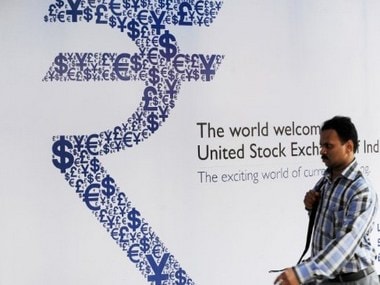 Representational image[/caption]"Right now there is a lot of buying in GSecs and tenure is going down," said Goenka. "The FCNRB (foreign currency non resident bank) deposits is currently dominating the scene and also the US dollar because of which rupee depreciation is very rampant. All the global major currencies except the British pound have gone significantly weak against the US dollar. Historically, we had strong co-relations between the Chinese yuan and the Japanese yen, but the yuan has now hit quite high at 6.84 and the yen at 108 though we have been out-performers," he said.Harihar Krishnamurthy, head of treasury at First Rand Bank, too said the rupee value is primarily determined by the actions of the US Fed. "The dollar has been rallying strong globally against every other major currency except the pound. So the rupee has taken a pounding on that account," he said.Presently, the dollar is at an 11-month high against major currencies. Since the demonetisation announcement, the rupee has depreciated by Rs 1.13 or 1.69 percent from Rs 66.63 to Rs 67.75 on 15 November. The Sensex is down by 1286 points or 4.66 percent during the same period.According to Krishnamurthy, rather than the demonetisation impact, any likely movement in the dollar value will have more bearing on the home currency in the short-term.Demonetisation shocksThe Modi government's decision, announced on 8 November, to withdraw Rs 500 and Rs 1,000 denomination currency post midnight took people by surprise. The demonetisation thus made these notes invalid in a major assault on black money, fake currency and corruption. In his 40-minute address on television, the PM said the notes of Rs 500 and Rs 1000 "will not be legal tender from midnight tonight" and these will be "just worthless piece of paper." Though everyone welcomed the move, the subsequent cash drought in ATMs and bank branches, caused a panic among its customers.Modi said people holding notes of Rs 500 and Rs 1,000 can deposit the same in their bank and in post office accounts from 10 November till 30 December. ATM withdrawals will be restricted to Rs 2,000 per day in the initial days and this limit will be raised to Rs 4,000 later, the PM said, which has now been raised to Rs 4,500. Withdrawals from bank accounts would be limited to Rs 10,000 a day and Rs 20,000 a week.Even after a week post-demonetisation, the ATMs and bank branches are struggling to meet the panic-driven cash demand from regular customers. Part of the reasons for the cash-drought is that people have been hoarding cash anticipating difficult days ahead. To understand the picture, one needs to look at only State Bank of India alone, the country's largest lender by assets, which saw withdrawals to the tune of Rs 7,705 crores in currency notes of Rs 100 and Rs 2,000 in just five days since the demonetisation announcement.The chaos that had reigned since the announcement continues till date, the 8th day.Bank deposits have surged too. In the first four days ( from 10 – 13 November, up to 5 pm ) about Rs 3 lakh crore of old Rs 500 and Rs 1,000 bank notes had been deposited in the banking system and about Rs 50,000 crore had been dispensed to customers by either withdrawal from their accounts or withdrawal from ATM’s or by exchange at the counter. Within these four days, the banking system has handled about 18 crore transactions.
However, with banks flush with deposits, interest rates are expected to go down. “Interest rates going down is an expectation or possibility from the RBI monetary policy because of liquidity in banking circle,” agrees Goenka. Historically, when there is an interest rate cut a knee jerk reaction in the dollar versus rupee would be always be slightly strong. As time passes after a day or two or three days, rupee would always depreciate, says Goenka.If you look at interest rate differentials between India and US, this is going to further reduce, he says. “If there is an interest rate cut here and the US tenure has been going up 2.25 percent, the arbitrage that people would enjoy in terms of putting money in the bond markets or taking positions on the currency markets will ultimately reduce. That is one reason why there is significant fall in rupee dollar frequence,” he said.
Manish Thanawala, director, Greenback Forex Services said the immediate impact of demonetisation will be liquidity squeeze in the short-term, which could act as a drag on the businesses. "It could slow down businesses," Thanawala said.Subsequently, the glut in deposits and the panic-ridden withdrawal by customers will likely affect the consumer demand, Thanawala said, adding that there will be liquidity crunch because businesses too will conserve cash and that will lead to demand slowdown and this, in turn, will have cascading impacts in the industry.(Data support from Kishor Kadam)
First Published:Nov 16, 2016, 10:07:18 IST
Advertisement
Advertisement

China has dominated Myanmar’s rare earth mines — now India eyes deal to harness country’s critical minerals
India is deepening rare earth cooperation with Myanmar as New Delhi seeks alternative sources of critical minerals dominated by China, including dysprosium and terbium used in EVs, defence systems and clean energy technologies
6 min read
JPMorgan to hire 1,000 technology professionals for India GCCs amid AI-led transformation
Wall Street banking giant to expand hiring across cloud, cybersecurity and AI data pipeline roles as it strengthens its India Global Capability Centres despite AI-driven workforce optimisation.
1 min read
BOJ seen raising interest rates by December as weak yen fuels inflation risks
Majority of economists expect Japan's central bank to deliver a 25-basis-point rate hike by year-end, with further policy tightening likely through 2027.
2 min read
'From make in India to launch from India': Skyroot COO on why Vikram-1 could change India’s space sector
Skyroot Aerospace’s successful Vikram-1 mission marks a major milestone for India’s private space sector, as the country seeks to shift from “Make in India” to “Launch from India” and compete in the global commercial satellite launch market
8 min read
Google burns cash for first time as AI spending pushes 2026 capex to $205 billion
Google parent Alphabet reported negative free cash flow of $5.9 billion in the second quarter for the first time since going public, as surging AI infrastructure spending pushed its 2026 capital expenditure forecast to as much as $205 billion
6 min read
Advertisement
Advertisement