


Should Twitter, Facebook stop selling spots for personal gripes?
Platforms like Twitter and Facebook cannot use a editorial vs. marketing argument at all since they are not media companies and they simply don't have an editorial point of view at all.

Beyond customer complaints (the British Airways example), here is perhaps the first documented case of one individual's opinion on another individual being promoted (more on this, in the original post below).
The individual in question already has 600,000+ followers, but still chose to promote his opinion using Twitter's paid option. That individual is Lalit Modi. And his target is BCCI head, Srinivasan.
I wonder what Srini will do now. I see this as no different from an interview in a mainstream media, given sufficient push by the promoted tweet
option, so one possible option is a libel case, in case Srini feels he's being targeted without the right facts.
Modi also seems to be using another Twitter tool to make this into a campaign of sorts - a hashtag called #ComeCleanSrini. If the hashtag trends, a large part of the credit may go to the fact that Modi used the paid promotion option.
 More from Brands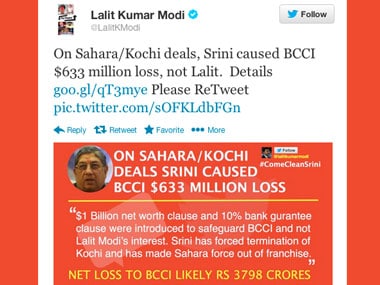
Thanks to @nikhilnarayanan and @raghuveer_v for pointing me out to this update from Modi.
Update (September 5, 2013): Here is Sanjay Mehta, adding a lot more context to this topic, from his perspective.
Original post:
I noticed an interesting topic of debate in Sanjay Mehta's Facebook timeline. The specific question he was asking centered around social networking platforms allowing people (disgruntled customers, in particular) to advertise their rants and give them wider reach. He also adds, 'Don't think you can go and buy anti-brand ads on Facebook or Google that easily? Can cause havoc otherwise...'
The topic of discussion is of course about the customer of British Airways who used paid promotion on Twitter to get more visibility to his anti-BA grievance.
I don't think there is anything wrong with a customer taking a paid spot to air his grievances.
Customers are already airing their grievance on Twitter, Facebook and any other channel where they can get some visibility without paying for it. Paying for reach just adds more visibility - I don't see anything dramatically changing here.
As for platforms like Twitter or Facebook not allowing customers to air negative views (not necessarily grievances alone, can even be a negative opinion), I don't see why they would bar these ads.
They are platforms, after all. The platform's paid tools are available to anyone who pays. If a toothpaste brand can use the platform to claim 130% better germ protection citing some obscure research done with 250 people and promote it aggressively by paying for it onFacebook, why can't a customer use paid tools to share his not-so-charitable opinion of a brand of airline?
If the airline is aggreived by that act, the onus would be on it to sue the person and ask him to back it up with proof. Or, show potential income that they missed due to that customer's paid effort in maligning (from the brand's point of view) the brand and sue on different grounds, like slander, perhaps.
It is not as if it doesn't happen already. There are blog posts offering not-so-charitable opinions on many brands, from both customers and mere onlookers. Not just blog posts, but also tweets and Facebook posts. If Twitter and Facebook don't stop these posts, why would they stop paid efforts?
Because the brands may stop advertising with the platforms if they notice them playing on both sides? The question then is, are they platforms, or are they media vehicles?
This question has plagued media companies for many years - can they write a negative editorial piece of a brand that advertises with them and risk losing that money? To some extent, the division between editorial and marketing was used to answer this question and it has always been a thin, grey line. And it has become worse with the advent of publications like The Times of India, no doubt.
But platforms like Twitter and Facebook cannot use a editorial vs. marketing argument at all since they are not media companies and they simply don't have an editorial point of view at all. Ok, forget editorial content - let's take user level content. Can I take out a print advertisement in a newspaper offering my bad experience with a brand? If I have the money to do so, I guess I can.From the newspaper's point of view, I'm just another advertiser.
Platforms like Twitter and Facebook have reduced the amount of money one needs to spend, unlikeprint media, but the commensurate visibility is also directly proportional, if you remove the viral element of how easy it can spread if shared by the right people.
The best the platforms can do is use the age-old argument of safe harbor, best used in copyright claims.
The Digital Millennium Copyright Act (DMCA) offers a safe harbor to service providers under Section 512(c). Under this act, service providers are not liable so long as:
1. They do not have actual knowledge that the material or an activity using the material on the system or network is infringing;
2. In the absence of such actual knowledge, is not aware of facts or circumstances from which infringing activity is apparent;
3. Upon obtaining such knowledge or awareness, acts expeditiously to remove, or disable access to, the material;
4. They do not receive a financial benefit directly attributable to the infringing activity, in a case in which the service provider has the right and ability to control such activity;
5. Upon notification of claimed infringement as described in paragraph (3), responds expeditiously to remove, or disable access to, the material that is claimed to be infringing or to be the subject of infringing activity; and
6. They have designated an agent to receive notifications of claimed infringement.
Can this framework be applied to social networks in case opinions are being promoted using paid tools? If brands can pay and promote select positive testimonials, why can't customers do the reverse? The second part of that question is, would the networks allow that, in the face of losing advertising income from brands?
If you notice the 4th point under DMCA safe harbor, it adds receiving financial benefit into the equation. In case of paid promotion of opinions, the network gets a financial benefit, but unlike copyright, it is under no obligation to verify the contents of an advertisement unless the platform has explicitly listed rules pertaining to it.
Let's check Google's advertisingpolicies.Google has its advertising policies covered under 69 topics. The first one happens to be 'Discrimination and violence" and that is the only policy that has a mild bearing on the topic I'm writing here.
It says: Google AdWords doesn't allow the promotion of "discrimination" or violent concepts, such as the following: Ad text advocating against an organisation, person or group of people.
Does it cover negative opinion against brands? I doubt it - going by the examples listed in that page.
What about Facebook? I see just this as a loophole that advertisers may use: Ads may not insult, attack, harass, bully, threaten, demean or impersonate others. Twitter? Nope, I don't see any rule that could be used by the platform to stop a customer or even a blogger from promoting negative views or experiences.
After this British Airways experience, will these networks make a change to their advertisingpolicy? We will have to wait and watch.
Karthik is National Lead, Social@Ogilvy,
Ogilvy & Mather
Karthik has a decade of experience in creating, building and managing perceptions of brands. At Edelman, Karthik heads the digital practice for India. He blogs on social media and PR at http://www.beastoftraal.com and on music at http://www.milliblog.com

IEA predicts major oil surplus in 2027 as Hormuz reopening sparks supply rebound
CNN-News18 Launches #CNNNews18OneLess, Inspiring India to Turn Small Actions into Big Environmental Impact
Sensex crashes over 1,000 points; Nifty tumbles 359 points in late sell-off
Hindware wins case against Google, Delhi HC fines tech giant Rs 30 lakh for trademark infringement
Best Ways to Get Exposure to Gold in India?