
Advertisement


Sections
Mumbai Mirror 'revises' Tanu Weds Manu Returns rating: Tabloid should be ashamed
It's a pity 'reader feedback' and 'research' hadn't taught Mumbai Mirror's writer how to use commas, but faulty syntax is the least of the tabloid's shames.

On Friday, if you read Mumbai Mirror, Tanu Weds Manu Returns was a two and a half star film, according to film critic Rahul Desai. Today, if you go to the Mumbai Mirror website, it's a three and a half star film. Some might think their memory is faulty, others may feel anxious about their eyesight, a few may worry about their counting skills. Everyone, relax. You didn't become blinder or stupider over the weekend. Mumbai Mirror decided that when it comes to a film review, journalistic ethics aren't really of critical importance.In today's paper, under a cutout of Charlize Theron from this year's red carpet at Cannes, there's a little notice to readers:"Our reviewer Rahul Desai had given this week's main fare Tanu Weds Manu Returns two and a half stars. Following reader feedback and research which differed significantly from him, this newspaper is upgrading the rating of the film to three and a half stars."It's a pity 'reader feedback' and 'research' hadn't taught Mumbai Mirror's writer how to use commas, but faulty syntax is the least of the tabloid's shames.The note in today's paper begs a couple of questions. First, why is Desai's review still online if Mumbai Mirror doesn't think it's worth defending against the monument of erudite film criticism that is "reader feedback"?[caption id="attachment_2261542" align="alignleft" width="380"]![A still from Tanu Weds Manu Returns.]() A still from Tanu Weds Manu Returns.[/caption]Second, what is this "research" that decided the changed rating? Third, how can the newspaper impose someone else's notion of a 'correct' rating upon Desai's review? Also, why bother with reviews and reviewers if all that matters is a rating based on reader feedback? Finally, isn't it a bit self-defeating for a news publication to report public opinion? Presumably, the public already knows its opinion and doesn't need to read it in the morning paper. There's also a tantalising phrase in there — "this week's main fare". Does that mean that if Tanu Weds Manu Returns not been a highly-anticipated and/or hit film, there would have been no revision?Mumbai Mirror belongs to India's largest media conglomerate, the Times Group, and is considered one of the more reliable sources of information about Mumbai. It has on numerous occasions been the first to unearth important civic and crime stories, as well as gossip. Its list of columnists are all respected writers. This is not the publication that you expect will hang its journalists out to dry.Yet in two awkward sentences, Mumbai Mirror did precisely that. Perhaps because film reviews are considered fluffy and unworthy of serious attention, the hope was that no one would notice. Had a news report on a political rally seen a revision based on "research" and "reader feedback", there would be an uproar.But this is just a film review. It's not really censorship. Right? Wrong.Mumbai Mirror declared its film critic Desai was wrong in his opinion of Tanu Weds Manu Returns, even though there's no "right" or "wrong" when it comes to reviews. You may agree or disagree with the reviewer, but that's about it. A film is not a maths exam: there isn't a correct answer. Yet the publication discredited its own reviewer, making it seem as though he had made a mistake, and distanced itself from Desai. That's disgraceful.Worse, Mumbai Mirror didn't revise its opinion of Desai's review because its editors thought it was unjustified or ill-conceived. His credibility is being shredded because the public opinion "differed significantly" from his. So the ultimate judge of Desai's critical faculty are not his peers at work, but a vast, anonymous community that may not be qualified to judge his writing.If we take a leaf out of Mumbai Mirror's book and treat reader feedback as truth, then 'research' on social media suggests the tabloid crumpled under pressure from Eros, which produced and distributed Tanu Weds Manu Returns.If Eros is indeed behind that little corrigendum, shame on them. Not just because the company has behaved like a bully, but because that quarter-column notice was definitely not paisa vasool. It can't be cheap to twist a major publication's arm and if you're going to go all the way with that splurge, then surely you want something flashier and bigger? Perhaps a huge heart — throbbing like the red one in Whatsapp — with snippets of random people's reviews? After all, Tanu Weds Manu Returns is one of the biggest hits of the year and Eros shares have seen a 4% jump because of the film.There has been so much anger on this issue that Mumbai Mirror is now one of the top trending topics on Twitter. Many have asked how the tabloid could stifle freedom of expression as it did and many more have wondered whether Desai consented to the change in rating and accepted being publicly humiliated in the corrigendum-esque message printed today.That "reader feedback" and some mysterious "research" can be used to discredit a critic is a malaise that isn't limited to Mumbai Mirror though. Once upon a time, critics were almost expected to be contrarian. Their job was to add to the existing body of knowledge, rather than parrot what people already thought.However, kowtowing to public opinion and blurring the lines between advertisement and editorial content threatens to be the way forward in contemporary journalism. As it is now, journalism is a broken business model and no one is quite sure how to fix it. Our only source of strength and encouragement: we've never had this many interested and eager-to-engage readers.But in India, this enormous audience may end up to be a double-edged sword. Our viewers and readers are vocal, frustrated and yearning to outrage because it makes them feel less helpless. Unnerved by the intensity that's been glimpsed in public surges like the anti-corruption begun by Anna Hazare and the pro-women's rights movement that was galvanised by the Delhi gangrape of 2012, public institutions often choose to follow prevalent moods because that feels like the safer option. If you don't, you risk drawing the ire of online trolls and offline muscle-flexers. The media has choices to make at this juncture. How will we serve our readers, our integrity as well as our paymasters?The scandal right now may be at Mumbai Mirror's doorstep, but it threatens all of Indian media. If publications won't stand by their journalists, how will reporters have the confidence to poke around structures of power and corruption? When we can't trust publications to hold their ground for something as uncomplicated as a film review, how do we believe what's printed about politics and current affairs? How can readers and viewers trust media to withstand the pressure they'll face when they do controversial reports on defence, the economy and politics? Will we only get news that doesn't ruffle any important feathers?
A still from Tanu Weds Manu Returns.[/caption]Second, what is this "research" that decided the changed rating? Third, how can the newspaper impose someone else's notion of a 'correct' rating upon Desai's review? Also, why bother with reviews and reviewers if all that matters is a rating based on reader feedback? Finally, isn't it a bit self-defeating for a news publication to report public opinion? Presumably, the public already knows its opinion and doesn't need to read it in the morning paper. There's also a tantalising phrase in there — "this week's main fare". Does that mean that if Tanu Weds Manu Returns not been a highly-anticipated and/or hit film, there would have been no revision?Mumbai Mirror belongs to India's largest media conglomerate, the Times Group, and is considered one of the more reliable sources of information about Mumbai. It has on numerous occasions been the first to unearth important civic and crime stories, as well as gossip. Its list of columnists are all respected writers. This is not the publication that you expect will hang its journalists out to dry.Yet in two awkward sentences, Mumbai Mirror did precisely that. Perhaps because film reviews are considered fluffy and unworthy of serious attention, the hope was that no one would notice. Had a news report on a political rally seen a revision based on "research" and "reader feedback", there would be an uproar.But this is just a film review. It's not really censorship. Right? Wrong.Mumbai Mirror declared its film critic Desai was wrong in his opinion of Tanu Weds Manu Returns, even though there's no "right" or "wrong" when it comes to reviews. You may agree or disagree with the reviewer, but that's about it. A film is not a maths exam: there isn't a correct answer. Yet the publication discredited its own reviewer, making it seem as though he had made a mistake, and distanced itself from Desai. That's disgraceful.Worse, Mumbai Mirror didn't revise its opinion of Desai's review because its editors thought it was unjustified or ill-conceived. His credibility is being shredded because the public opinion "differed significantly" from his. So the ultimate judge of Desai's critical faculty are not his peers at work, but a vast, anonymous community that may not be qualified to judge his writing.If we take a leaf out of Mumbai Mirror's book and treat reader feedback as truth, then 'research' on social media suggests the tabloid crumpled under pressure from Eros, which produced and distributed Tanu Weds Manu Returns.If Eros is indeed behind that little corrigendum, shame on them. Not just because the company has behaved like a bully, but because that quarter-column notice was definitely not paisa vasool. It can't be cheap to twist a major publication's arm and if you're going to go all the way with that splurge, then surely you want something flashier and bigger? Perhaps a huge heart — throbbing like the red one in Whatsapp — with snippets of random people's reviews? After all, Tanu Weds Manu Returns is one of the biggest hits of the year and Eros shares have seen a 4% jump because of the film.There has been so much anger on this issue that Mumbai Mirror is now one of the top trending topics on Twitter. Many have asked how the tabloid could stifle freedom of expression as it did and many more have wondered whether Desai consented to the change in rating and accepted being publicly humiliated in the corrigendum-esque message printed today.That "reader feedback" and some mysterious "research" can be used to discredit a critic is a malaise that isn't limited to Mumbai Mirror though. Once upon a time, critics were almost expected to be contrarian. Their job was to add to the existing body of knowledge, rather than parrot what people already thought.However, kowtowing to public opinion and blurring the lines between advertisement and editorial content threatens to be the way forward in contemporary journalism. As it is now, journalism is a broken business model and no one is quite sure how to fix it. Our only source of strength and encouragement: we've never had this many interested and eager-to-engage readers.But in India, this enormous audience may end up to be a double-edged sword. Our viewers and readers are vocal, frustrated and yearning to outrage because it makes them feel less helpless. Unnerved by the intensity that's been glimpsed in public surges like the anti-corruption begun by Anna Hazare and the pro-women's rights movement that was galvanised by the Delhi gangrape of 2012, public institutions often choose to follow prevalent moods because that feels like the safer option. If you don't, you risk drawing the ire of online trolls and offline muscle-flexers. The media has choices to make at this juncture. How will we serve our readers, our integrity as well as our paymasters?The scandal right now may be at Mumbai Mirror's doorstep, but it threatens all of Indian media. If publications won't stand by their journalists, how will reporters have the confidence to poke around structures of power and corruption? When we can't trust publications to hold their ground for something as uncomplicated as a film review, how do we believe what's printed about politics and current affairs? How can readers and viewers trust media to withstand the pressure they'll face when they do controversial reports on defence, the economy and politics? Will we only get news that doesn't ruffle any important feathers?
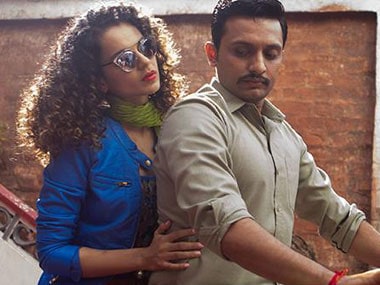 A still from Tanu Weds Manu Returns.[/caption]Second, what is this "research" that decided the changed rating? Third, how can the newspaper impose someone else's notion of a 'correct' rating upon Desai's review? Also, why bother with reviews and reviewers if all that matters is a rating based on reader feedback? Finally, isn't it a bit self-defeating for a news publication to report public opinion? Presumably, the public already knows its opinion and doesn't need to read it in the morning paper. There's also a tantalising phrase in there — "this week's main fare". Does that mean that if Tanu Weds Manu Returns not been a highly-anticipated and/or hit film, there would have been no revision?Mumbai Mirror belongs to India's largest media conglomerate, the Times Group, and is considered one of the more reliable sources of information about Mumbai. It has on numerous occasions been the first to unearth important civic and crime stories, as well as gossip. Its list of columnists are all respected writers. This is not the publication that you expect will hang its journalists out to dry.Yet in two awkward sentences, Mumbai Mirror did precisely that. Perhaps because film reviews are considered fluffy and unworthy of serious attention, the hope was that no one would notice. Had a news report on a political rally seen a revision based on "research" and "reader feedback", there would be an uproar.But this is just a film review. It's not really censorship. Right? Wrong.Mumbai Mirror declared its film critic Desai was wrong in his opinion of Tanu Weds Manu Returns, even though there's no "right" or "wrong" when it comes to reviews. You may agree or disagree with the reviewer, but that's about it. A film is not a maths exam: there isn't a correct answer. Yet the publication discredited its own reviewer, making it seem as though he had made a mistake, and distanced itself from Desai. That's disgraceful.Worse, Mumbai Mirror didn't revise its opinion of Desai's review because its editors thought it was unjustified or ill-conceived. His credibility is being shredded because the public opinion "differed significantly" from his. So the ultimate judge of Desai's critical faculty are not his peers at work, but a vast, anonymous community that may not be qualified to judge his writing.If we take a leaf out of Mumbai Mirror's book and treat reader feedback as truth, then 'research' on social media suggests the tabloid crumpled under pressure from Eros, which produced and distributed Tanu Weds Manu Returns.If Eros is indeed behind that little corrigendum, shame on them. Not just because the company has behaved like a bully, but because that quarter-column notice was definitely not paisa vasool. It can't be cheap to twist a major publication's arm and if you're going to go all the way with that splurge, then surely you want something flashier and bigger? Perhaps a huge heart — throbbing like the red one in Whatsapp — with snippets of random people's reviews? After all, Tanu Weds Manu Returns is one of the biggest hits of the year and Eros shares have seen a 4% jump because of the film.There has been so much anger on this issue that Mumbai Mirror is now one of the top trending topics on Twitter. Many have asked how the tabloid could stifle freedom of expression as it did and many more have wondered whether Desai consented to the change in rating and accepted being publicly humiliated in the corrigendum-esque message printed today.That "reader feedback" and some mysterious "research" can be used to discredit a critic is a malaise that isn't limited to Mumbai Mirror though. Once upon a time, critics were almost expected to be contrarian. Their job was to add to the existing body of knowledge, rather than parrot what people already thought.However, kowtowing to public opinion and blurring the lines between advertisement and editorial content threatens to be the way forward in contemporary journalism. As it is now, journalism is a broken business model and no one is quite sure how to fix it. Our only source of strength and encouragement: we've never had this many interested and eager-to-engage readers.But in India, this enormous audience may end up to be a double-edged sword. Our viewers and readers are vocal, frustrated and yearning to outrage because it makes them feel less helpless. Unnerved by the intensity that's been glimpsed in public surges like the anti-corruption begun by Anna Hazare and the pro-women's rights movement that was galvanised by the Delhi gangrape of 2012, public institutions often choose to follow prevalent moods because that feels like the safer option. If you don't, you risk drawing the ire of online trolls and offline muscle-flexers. The media has choices to make at this juncture. How will we serve our readers, our integrity as well as our paymasters?The scandal right now may be at Mumbai Mirror's doorstep, but it threatens all of Indian media. If publications won't stand by their journalists, how will reporters have the confidence to poke around structures of power and corruption? When we can't trust publications to hold their ground for something as uncomplicated as a film review, how do we believe what's printed about politics and current affairs? How can readers and viewers trust media to withstand the pressure they'll face when they do controversial reports on defence, the economy and politics? Will we only get news that doesn't ruffle any important feathers?
First Published:May 26, 2015, 12:34:38 IST
Advertisement
Advertisement

Nargis Fakhri rings in New Year's with rumoured boyfriend Tony Beig and ex-boyfriend Uday Chopra, photo goes viral
Before Tony, Nargis was in a relationship with Uday Chopra. In a conversation with ETimes, the Main Tera Hero actress revealed that she dated Uday for five years, adding he was the most beautiful human she met in India
Karan Johar drops selfie with Rani Mukerji and a message for trolls as 2024 begins
In the picture, Karan posed for a selfie with Rani Mukerji. The duo twinned in black. He accompanied the picture with a text that read "Ami Rani…2024"
WATCH: Ira Khan And Nupur Shikhare's wedding festivities begin at Aamir Khan’s Mumbai home
Nupur Shikhare made a romantic proposal to Ira Khan during a sports event. He went down on one knee to present the love of his life with a ring
'Three months of hell': Sonam Kapoor on husband Anand Ahuja's illness which 'no doctor could diagnose'
Sonam went on to reflect on how she balanced supporting her husband in his work while trying to spend time with her precious family and incredible friends and called it the most tough, amazing, fulfilling and enriching year
Prakash Raj summoned by Enforcement Directorate in a 100-crore ponzi & fraud case, actor reacts
The investigation pertains to a case against Pranav Jewellers, a partnership firm based in Tiruchirapalli, whom the ED raided on November 20 and claimed to have seized "unexplained" cash of Rs 23.70 lakh and some gold jewellery
Advertisement
Advertisement