


Attn Anna: Small changes are the first step to big changes
Anna Hazare and Co. would do well to remember that even small victories ought to be celebrated. His expectations are like my expecting to see Mumbai’s traffic problems disappear overnight or see Sania winning Wimbledon this year.

Consider this (courtesy Wikipedia) extract on the history of corruption in India: The economy of India was under socialist-inspired policies for an entire generation from the 1950s until the late 1980s. The economy was subject to extensive regulation, protectionism, and public ownership, leading to pervasive corruption and slow growth.[22][23][24][25] License Raj was often at the core of corruption. The Vohra Report, submitted by the former Indian Union Home Secretary, N.N. Vohra, in October 1993, studied the problem of the criminalisation of politics and of the nexus among criminals, politicians and bureaucrats in India. The report contained several observations made by official agencies on the criminal network which was virtually running a parallel government. It also discussed criminal gangs who enjoyed the patronage of politicians — of all political parties — and the protection of government functionaries. It revealed that political leaders had become the leaders of gangs. They were connected to the military. Over the years criminals had been elected to local bodies, State Assemblies, and even the Parliament. The unpublished annexures to the Vohra Report are believed to contain highly explosive material. According to Jitendra Singh, "in the bad old days, particularly pre-1991, when the License Raj held sway, and by design, all kinds of free market mechanisms were hobbled or stymied, and corruption emerged almost as an illegitimate price mechanism, a shadowy quasi-market, such that scarce resources could still be allocated within the economy, and decisions could get made. ... These were largely distortions created by the politico-economic regime. While a sea change has occurred in the years following 1991, some of the distorted cultural norms that took hold during the earlier period are slowly being repaired by the sheer forces of competition. The process will be long and slow, however. It will not change overnight."[26] One of the major problems and obstacles to development that many developing countries face is corruption by greedy, power-hungry politicians, which is endemic in certain parts of the world.And Anna Hazare expects all this to disappear or he’ll fast again?Reminds me of Pepe in Asterix in Spain![caption id="attachment_27058" align="alignleft" width="380" caption="Image: http://wsc.co.uk"]
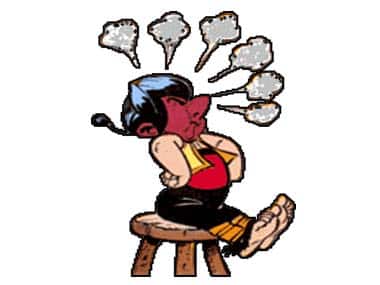 [/caption]Anna’s expectations are like my expecting to see Mumbai’s traffic problems disappear overnight or see Sania winning Wimbledon this year or see India winning 20 Gold Medals in London 2012. Indeed, it’s like expecting India to win the next FIFA World Cup.Anna and his team have missed an opportunity and a trick here. The draft Lokpal bill (even to the extent the UPA negotiators have found agreement with Anna Hazare and team), would have significantly improved the state of affairs with respect to corruption in India – and millions of Indians would have been grateful. An incremental improvement would have seen investments increasing, faster clearance of projects, increase in tax collections, to name a few obvious benefits.That’s not enough – as a starting point?It’s the ridiculous expectation of all-or-nothing that rankles. Now the process is in danger – and we might see nothing coming of it – and that would be a shame.What is disappointing is that I have not seen strong views in mainstream media asking Anna and team to negotiate hard without demanding that the government agree to all their suggestions.Like my getting excited about Sania’s progress, I (and I suspect many more) would have been energised and buoyed by incremental improvements – and from what I hear and read, what has been conceded thus far by the government would have delivered significant improvements.Don’t blow this, Anna. The opportunity to effect significant changes still exists; grab it and do is all a favour. Blow it and you’ll be reduced to a comic character. More importantly, you’ll take away hope after you gave us hope.
Anant Rangaswami was, until recently, the editor of Campaign India magazine, of which Anant was also the founding editor. Campaign India is now arguably India's most respected publication in the advertising and media space. Anant has over 20 years experience in media and advertising. He began in Madras, for STAR TV, moving on as Regional Manager, South for Sony’s SET and finally as Chief Manager at BCCL’s Times Television and Times FM. He then moved to advertising, rising to the post of Associate Vice President at TBWA India. Anant then made the leap into journalism, taking over as editor of what is now Campaign India's competitive publication, Impact. Anant teaches regularly and is a prolific blogger and author of Watching from the sidelines.

Key differences between third party, comprehensive & zero depreciation bike insurance coverage
These lucky members played the CRED bounty and won massive prizes, including Rs 1.5 lakh cash, a PS5, and more: Here’s how you can win as well!
Tech Goes Bold with the New Age Baleno: Everything A Hatchback Wants To Be
How saving water will save our future
‘Dune’ Is A Visual Extravaganza Tied With Spellbinding Performances That You Just Can’t Afford To Miss