


Pulitzer Prize 2021: Associated Press, New York Times win for pandemic reportage, protest coverage
In a year dominated by COVID-19 and furious debate over race and policing, the Star Tribune of Minneapolis won the breaking news reporting prize for its coverage of George Floyd’s murder and its aftermath, while Darnella Frazier — the teenager who recorded the killing on a cellphone — received a special citation.

The Associated Press won two Pulitzer Prizes in photography on 11 June for its coverage of the racial injustice protests and the coronavirus’s terrible toll on the elderly, while The New York Times received the public service award for its detailed, data-filled reporting on the pandemic.
In a year dominated by COVID-19 and furious debate over race and policing, the Star Tribune of Minneapolis won the breaking news reporting prize for its coverage of George Floyd’s murder and its aftermath, while Darnella Frazier — the teenager who recorded the killing on a cellphone — received a special citation.
Frazier’s award was intended to highlight “the crucial role of citizens in journalists’ quest for truth and justice,” the Pulitzer Board said.
The AP and The New York Times each won two Pulitzers, the most prestigious prize in journalism, first awarded in 1917.
The feature photography prize went to AP’s chief photographer in Spain, Emilio Morenatti, who captured haunting images of an older couple embracing through a plastic sheet, mortuary workers in hazmat gear removing bodies, and people enduring the crisis in isolation.
 More from Art And Culture
The breaking news photography prize was shared by 10 AP photographers for their coverage of the protests set off by Floyd’s killing. One widely published photograph by Julio Cortez on the night of 28 May in riot-torn Minneapolis showed a lone, silhouetted protester running with an upside-down American flag past a burning liquor store.
“Everybody, not just myself, has given up something to go cover this stuff,” Cortez said. “To be an illegal immigrant kid who now has a piece of the AP history is just insane. I’m just super proud of everyone’s work.”
Similarly, the prize for commentary went to Michael Paul Williams of the Richmond Times-Dispatch in Virginia for a series of columns on dismantling Confederate monuments in Richmond following Floyd’s death.
And Star Tribune journalists were honored for covering the rage in Minneapolis, where protesters burned buildings, including a police station, in the wake of Floyd’s death. The Black man died after a white Minneapolis police officer pinned him to the ground with his knee on Floyd’s neck for up to 9 1/2 minutes. The officer was later convicted of murder.
“Our staff poured its heart and soul into covering this story. It has been such a traumatic and tragic time for our community,” Star Tribune Editor Rene Sanchez said in a statement. “We felt that our journalism had to capture the full truth and depth of this pain and the many questions it renewed about Minnesota and the country.”
Prizes for explanatory reporting went to two recipients. Ed Yong of The Atlantic won for a series of deeply reported articles about the pandemic. Andrew Chung, Lawrence Hurley, Andrea Januta, Jaimi Dowdell and Jackie Botts of Reuters were honored for a look at the legal concept of qualified immunity and how it shields police from prosecution.
Two prizes for feature writing were also awarded. Nadja Drost won for her freelance piece on global migration in The California Sunday Magazine, which suspended publication late last year. And freelance contributor Mitchell S Jackson won for an account in Runner’s World on the killing of Ahmaud Arbery, a Black man who was chased down and shot while jogging in Georgia.
The national reporting prize went to the staffs of The Marshall Project, AL.com, IndyStar and the Invisible Institute for an investigation into attacks on people by police K-9 units around the country.
BuzzFeed News won its first Pulitzer, in international reporting, for a series by Megha Rajagopalan, Alison Killing and Christo Buschek on the infrastructure built by the Chinese government for the mass detention of Muslims.
Also, BuzzFeed News and the International Consortium of Journalists were finalists in that category for an expose on the global banking industry’s role in money laundering. A former US Treasury Department employee was sentenced to six months in prison this month for leaking the trove of confidential financial reports that served as the basis for the series.[caption id="attachment_9709221" align="alignnone" width="640"]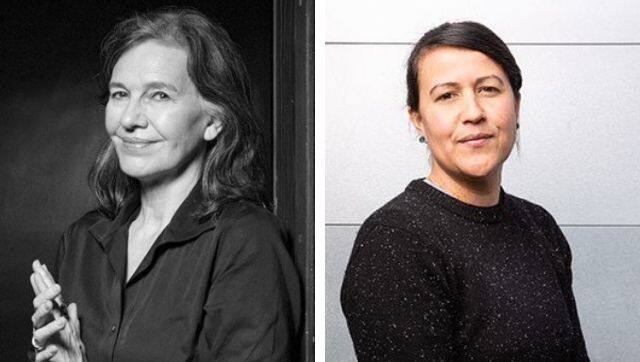 Louise Erdrich won the 2021 Pulitzer for fiction for The Night Watchman while Natalie Diaz bagged the poetry prize for the work, Postcolonial Love Poem.[/caption]Matt Rocheleau, Vernal Coleman, Laura Crimaldi, Evan Allen and Brendan McCarthy of The Boston Globe received the investigative reporting Pulitzer for a series demonstrating the systematic failure by state governments to share information about dangerous truck drivers.
McCarthy, the editor on the series, said the Globe “quickly found that this kind of tragedy had been happening year after year for decades. The problems were in plain sight but had never been addressed.”
The winner of the public service Pulitzer is honored with a gold medal. The awards in the other categories carry a prize of $15,000 each. The prizes are administered by Columbia University.
See the full list of winners below —JOURNALISMBreaking News ReportingStaff of Star TribuneInvestigative ReportingMatt Rocheleau, Vernal Coleman, Laura Crimaldi, Evan Allen and Brendan McCarthy of The Boston GlobeExplanatory ReportingEd Yong of The Atlantic; Andrew Chung, Lawrence Hurley, Andrea Januta, Jaimi Dowdell and Jackie Botts of ReutersLocal ReportingKathleen McGrory and Neil Bedi of Tampa Bay TimesNational ReportingStaffs of the Marshall Project, AL.com, IndyStar, and the Invisible InstituteInternational ReportingMegha Rajagopalan, Alison Killing and Christo Buschek of Buzzfeed NewFeature WritingNadja Drost, freelance contributor, The California Sunday Magazine; Mitchell S. Jackson, freelance contributor of Runner’s WorldCommentaryMichael Paul Williams of Richmond Times-DispatchCriticismWesley Morris of The New York TimesEditorial WritingRobert Greene of Los Angeles Times
Breaking News PhotographyPhotography Staff of The Associated PressFeature PhotographyEmilio Morenatti of The Associated PressAudio ReportingLisa Hagen, Chris Haxel, Graham Smith and Robert Little of National Public RadioPublic ServiceThe New York TimesLITERATURE AND MUSICDramaThe Hot Wing King by Katori HallFictionThe Night Watchman by Louise Erdrich (Harper)PoetryPostcolonial Love Poem by Natalie Diaz (Graywolf Press)General NonfictionWilmington’s Lie: The Murderous Coup of 1898 and the Rise of White Supremacy by David Zucchino (Atlantic Monthly Press)HistoryFranchise: The Golden Arches in Black America by Marcia ChatelainBiographyThe Dead Are Arising: The Life of Malcolm X by the late Les Payne and Tamara Payne (Liveright/ Norton)Music:'Stride' by Tania León (Peermusic Classical)Special Citation: Darnella Frazier(With inputs from The Associated Press)

The Louvre's Apollo Gallery reopens nine months after $102 million jewel heist, without any jewels
Midhaven on taking Indian Metal to Wacken this year: 'You’re sure to see a heavier, more nuanced performance'
The woman in Lucian Freud's $39 million portrait was alive to watch herself become history
Alexander McQueen is coming back to London Fashion Week, and its old shows explain why everyone's excited
Why the Kiran Nadar Museum of Art is earning international recognition