


From India to Madagascar: How revisiting Kalidasa can help us become sensitive towards biodiversity and climate change
Like Kalidasa’s Meghaduta, Monsoon not only depicts the rich flora and fauna of the places through which it travels but also highlights their vivid colours and sounds, tastes and aroma of the rich cuisine, and landscapes and monuments

While I was posted in Nepal (2012–16), I often heard people mentioning that the mythical city of Alkapuri in Kalidasa’s Meghaduta is believed to be the present day Kathmandu. However, I never had the opportunity to read the whole poem either in original Sanskrit or its English translation.In March 2020 I read a poem titled Lockdown by UK poet laureate Simon Armitage, published in the Guardian, UK in March 2020. He had penned the poem in response to the lockdown imposed worldwide in the midst of the Covid-19 pandemic. The poem made a reference to Kalidasa’s poem Meghaduta or The Cloud Messenger.Soon I started reading Meghaduta and was completely immersed in it for weeks. I first read its English translation by HH Wilson (1814) and then by Col HA Ouvry (1868), afterwards a translation of Meghaduta by Mallinatha (1895) with exhaustive notes and finally a translation by Chandra Rajan published by the Sahitya Akademi (1997). More translations I read, the more I felt the urge to translate it myself into contemporary English. I had studied Sanskrit earlier and it came handy while translating Meghaduta.Translating Meghaduta was a transformative experience. During the process of translation, I wrote an article titled What Kalidasa Teaches Us About the Lockdown, Loss of Biodiversity and Climate Change, which was published in April 2020. The article was widely read and commented upon. It brought me laurels from AND Haksar, translator of many Sanskrit texts, many published as Penguin classics. He remarked, “Abhay K’s translation of Meghaduta gives a fresh sense of the original.” It boosted my confidence and I was motivated to find a publisher for my translation of Meghaduta. Soon I found one, the book was published by Bloomsbury India in June 2021. It encouraged me to translate Kalidasa’s another classic poem, Ritusamhara, which is about the changing seasons and their impact on the rhythm of nature and people’s lives in ancient India.Translating Kalidasa’s poems Meghaduta and Ritusamhara inspired me to write a book-length love poem. The annual monsoon journey from Madagascar to the Indian subcontinent and back to Madagascar made me think about writing a poem that follows the path of the monsoon. Monsoon seemed to me as a perfect messenger to carry my message from Madagascar to my imaginary beloved in the Himalayas with its origin near Madagascar in April and its journey across the Indian Ocean and the Indian subcontinent to reach the high Himalayas in June every year before retreating to Madagascar after September. It took me over a year to write it and revise it over a dozen times.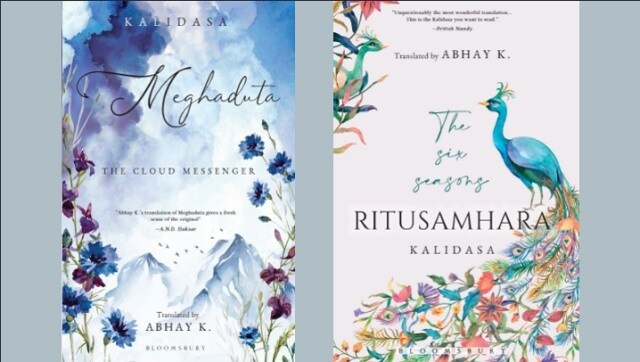 Monsoon (Sahitya Akademi, Rs 110) is a poem of love and longing that follows the path of monsoon that originated near Madagascar and traverses the Indian Ocean to reach the Himalayas and back to Madagascar. As monsoon travels the rich sights and sounds, languages and traditions, costumes and cuisine, flora and fauna, festivals and monuments, and the beauty and splendour of the Indian Ocean islands of Madagascar, Reunion, Mauritius, Seychelles, Mayotte, Comoros, Zanzibar, Socotra, Maldives, Sri Lanka, and Andaman & Nicobar and the Western Ghats, Aravalis, Gujarat, Rajasthan, Madhya Pradesh, Uttar Pradesh, Sundarbans, West Bengal, Bihar, Sikkim, Bhutan, Nepal, Tibet, Uttarakhand, Delhi, Punjab, Haryana, Himachal Pradesh and Kashmir Valley, are evoked. The poem weaves the beauty and splendour of the Indian Ocean islands and the Indian subcontinent into one poetic thread connected by monsoon offering an unparalleled sensuous experience.
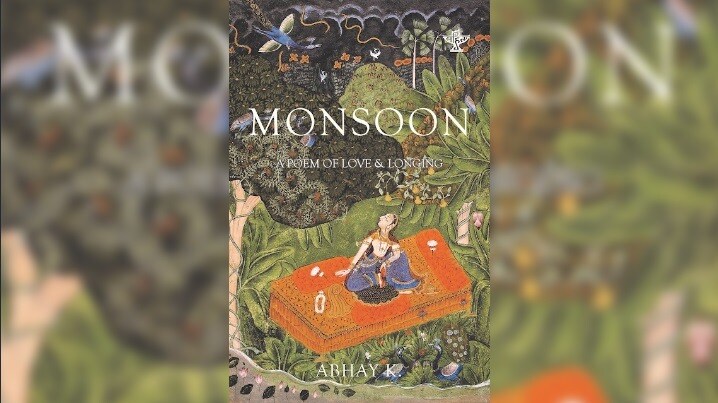 As Monsoon is inspired from Kalidasa’s Meghaduta, the comparisons between the two are natural. Monsoon has the same backdrop of two separated lovers longing for each other as in Meghaduta. While Meghaduta covers the journey of clouds from Ramagiri hills in central India to the mythical city of Alkapuri near Mount Kailash, Monsoon covers a much wider canvas stretching from Madagascar to the Himalayas. Meghaduta has 111 stanzas of four lines each written in Mandākrāntā meter, whereas Monsoon is a quatrain or ruba’i of 150 stanzas written in free verse. While Meghaduta gives descriptions of mythical creatures such as sylphs, eight-legged animals and plants such as Kalpataru along with the diverse flora and fauna of Kalidasa’s time, Monsoon not only depicts the rich flora and fauna of the places through which it travels but also highlights their vivid colours and sounds, tastes and aroma of the rich cuisine, history and legends, landscapes, monuments, among others.In this poem I have also tried to weave together monsoon-inspired architecture, such as the Monsoon Palace in Udaipur, Badal Mahal or Cloud Palace in Kumbhalgarh, Anup Talao at Fatehpur Sikri where Tansen used to sing his Megh Malhar, Deeg Palace near Bharatpur with its nine hundred fountains trying to recreate monsoon rains, and the monsoon festivals of Haryali Amavasya and Teej and the forgotten 17th century monsoon raga Gaund, which was once popular in the court of Mughal emperor Shah Alam. Monsoon is a homage to the rich natural world of the Indian Ocean islands and the Indian subcontinent, their vibrant cultures and traditions and to the great Kalidasa who gave us Meghaduta and Ritusamhara.Here are a few stanzas from Monsoon which has just been published by the Sahitya Akademi, India’s National Academy of Letters-I wake up with your thoughtsyour fragrance reaching meall the way from the Himalayasto the island of Madagascar 1 brought by monsoonfrom the blessed Himalayan valleyto the hills of Antananarivoon its return journey 2 I dream of you every night, the shimmering dawnsnatches my dreams but the morning breeze comeswhispering your name, permeating my beingwith your thoughts, only your thoughts, my love 3 I’m far away in this Indian Ocean islandyearning for your touch, gazing at the Moon,Venus and myriad star constellations,hoping you’re gazing at them too 4 I wait for the monsoon to be bornto send you sights, sounds and aromaof this island, redolent of vanilla, cloves,Ylang-ylang3 and herbs of various kinds 5 O’ Monsoon, wave-like mass of air,the primeval traveller from the seato the land in summer, go to my lovein the paradisiacal Himalayan valley 6 entering Nepal, bow in reverence to Sagarmathathen cross to Tibet to Mount Kailash—Shiva’seternal abode, recharge the waters of Mansarovarbefore drifting to Kathmandu—the city of Gods 66 listen to the holy chants at Changu Narayan andPashupatinath, circumambulate Swayambhunathand Boudhanath, offer your rains to Kumariand seek her blessings for my beloved’s happiness 67 cherish the sounds and smells of Thamelbefore arriving in Pokhara, there lake Phewawill enchant you, satiate her with your rainsand let your clouds caress Machhapuchchhre 68 plenish the sacred lotus pond in Lumbini—Buddha’s birthplace, with your plentiful rains,turn its gardens verdant with your healing touchand bring the ruins of Kapilvastu to life again 69 gharials, dolphins will rave sighting you at Bardia,tigers and elephants will be ecstatic smelling yourwet winds at Jim Corbett as you hasten towards Delhito meet your other half from the Arabian Sea 70 Abhay K is the author of ten poetry books including ‘Monsoon’ (Sahitya Akademi, 2022) ‘The Magic of Madagascar’ (L’Harmattan Paris, 2021), ‘The Alphabets of Latin America’ (Bloomsbury India, 2020), and the editor of The Book of Bihari Literature (Harper Collins, 2022). His poems have appeared in over 100 literary magazines including Poetry Salzburg Review, Asia Literary Review among others. Read all the Latest News, Trending News, Cricket News, Bollywood News,India News and Entertainment News here. Follow us on Facebook, Twitter and Instagram.

The Louvre's Apollo Gallery reopens nine months after $102 million jewel heist, without any jewels
Midhaven on taking Indian Metal to Wacken this year: 'You’re sure to see a heavier, more nuanced performance'
The woman in Lucian Freud's $39 million portrait was alive to watch herself become history
Alexander McQueen is coming back to London Fashion Week, and its old shows explain why everyone's excited
Why the Kiran Nadar Museum of Art is earning international recognition