


WTO rules against India's 'localisation' rules on US solar exports
In a setback to India, a World Trade Organisation (WTO) dispute settlement panel has ruled in favour of the US in its challenge to New Delhi's alleged discrimination against US solar exports, according to US Trade Representative (USTR)

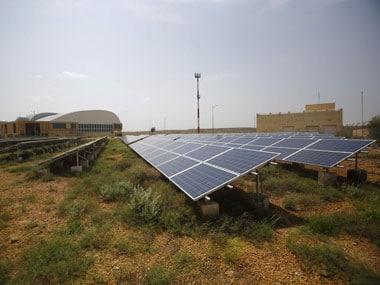
Representational image. Reuters[/caption]The panel also rejected India's defensive arguments and determined that India's local content requirements are inconsistent with the national treatment obligations in Article 2.1 of the Agreement on Trade-related Investment Measures (TRIMs Agreement) and Article III:4 of the General Agreement on Tariffs and Trade 1994.The USTR called it "an important outcome, not just as it applies to this case, but also as other countries consider localisation policies."USTR said it initiated this dispute in February 2013 because it considered that India's domestic content requirements are inconsistent with WTO rules that prohibit discrimination against imported products.The US, it said, has consistently made the case that India can achieve its clean energy goals faster and more cost-effectively by allowing solar technologies to be imported from the US and other solar producers."Today, the WTO panel agreed with the United States that India's 'localisation' measures discriminate against US manufacturers and are against WTO rules," Froman said.The US and India "are strong supporters of the multilateral, rules-based trading system and take our WTO obligations seriously," he said."This is an important outcome, not just as it applies to this case, but for the message it sends to other countries considering discriminatory 'localisation' policies.""The United States strongly supports the rapid deployment of solar energy around the world — including in India," Froman said."But discriminatory policies in the clean energy space in fact undermine our efforts to promote clean energy by requiring the use of more expensive and less efficient equipment, raising the cost of generating clean energy and making it more difficult for clean energy sources to be competitive," he said.The US had challenged the Government of India's imposition of domestic content requirements for solar cells and modules under India's National Solar Mission.IANS

US set to announce new tariff plan as temporary 10% duty nears expiry
India rejects Pakistan's 'baseless' claims at Asean, says Indus Waters Treaty to remain on hold
Indian trucker arrested in US over alleged theft of $3 million worth of tungsten powder
Austria turns Hitler’s birthplace into a police station 81 years after his death: 5 things to know
Nawaz Sharif wants to become prime minister of PoK — but laws framed by Pakistan disqualify him