


Why Egypt coup, Morsi's ouster is no surprise
The Egyptian coup did merit concern. Yet, there are many indicators that the turmoil could yet yield stability for Egypt, two years after the Tahrir Square revolution ousted Mubarak.

By Suhasini Haider Curfews... deserted streets... tanks rolling out…and an eerie silence. That’s the image of a coup-in-progress worldwide. Yet as Egypt’s army moved in to oust President Mohammad Morsi, the news was greeted by tens of thousands at Cairo’s Tahrir Square. Fireworks lit up the sky, as military helicopters hovered over, flying Egypt’s flag.The Egyptian coup did merit concern: the house arrest of Morsi and his top aides, the forced shutdown of television channels like Al-Jazeera’s Mubashir Misr, and the summary dismissal of the country’s new constitution, not to mention its first democratically elected government. Yet, there are many indicators that the turmoil could yet yield stability for Egypt, two years after the Tahrir Square revolution ousted Mubarak.[caption id="attachment_933825" align="alignleft" width="380"]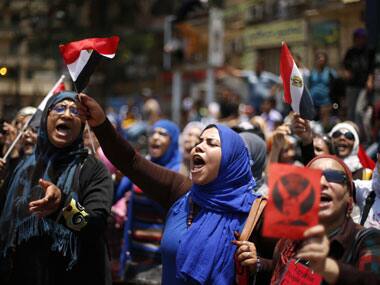 Protesters at Egypt's Tahrir Square. Reuters[/caption]To begin with, the coup was hardly unexpected. On a visit to Cairo in June, this writer saw ‘Tamarod’ (rebel) movement activists openly collecting signatures against Morsi on the streets, and the plan to rally on 30 June (the date Morsi became president in 2012), was clearly gathering support. "We will continue the revolution until we have real democracy," said 29-year old blogger-activist Waleed Rashed, "Morsi and the Muslim Brotherhood have hijacked it".The anger is understandable. For the past year in office, Morsi has been on collision course with practically every institution in the country. Early in his term, he carried out what ‘civilian coup’, sacking SCAF chief General Tantawi who had played a crucial role in backing the Tahrir protests. Like Pakistan, where Nawaz Sharif was ousted in 1999 by the General he promoted (Musharraf), here too, Morsi was ousted by General Abdel Fattah al-Sisi, the man he picked to replace Tantawi. The similiarity ends there, however, as Al-Sisi has chosen not to assume office himself, and made the Constitutional Chief Justice Adly Mansour head the interim government.The judiciary was the next institution Morsi chose to lock horns with — wanting to “purge it of judges from the Mubarak era”. In November, he proposed a draft law mandating an early retirement that could have forced 3,000 judges off the bench, a move opposed by his prosecutor general, who Morsi then sacked. Morsi also immunised presidential decisions from judicial review, and made the Islamist-dominated Shura council the final arbiter on most issues. The judiciary reacted by sacking the parliament, winning support from opposition parties as well.To be fair, those tussles were natural, and Morsi’s successors will struggle with Egypt’s power structure as well. Morsi’s biggest problem was civil society’s disappointment with him, as Egyptians grew increasingly uncomfortable with his Islamisation process. Morsi’s Freedom and Justice Party, the front for the Muslim Brotherhood, has a strong grassroots base, but he won Presidential elections in 2012 by a narrow majority. Yet he quickly turned that into a mandate for Islamists — passing a constitution that was seen as a step away from enforcing the Shariah, on a population that sees itself as more secular than its West Asian neighbours. Amongst its controversial clauses were new blasphemy laws that threatened minorities in the country. Egypt is proudly Muslim, but is also proud of its Pharaonic and Coptic past, and the fear that the Brotherhood would target temples and churches much as the Taliban government in Afghanistan targeted Bamiyan and its Buddhist past, grew.Morsi’s government also failed to stop attacks on minorities, and shared a platform with Salafist leaders like Safwat Hegazi who threatened to “spill the blood” of any of the nation’s 10% Christian community who didn’t show loyalty to the Muslim Brotherhood government. Weeks after his speech, Egypt’s main Coptic Christian cathedral was attacked, and more Christians killed in attacks on funeral processions. Shi’as too faced violence, and in June a mob surrounded a Shi’a home in Giza, and brutally killed five including the popular leader Sheikh Hassan Tahata. Despite the incendiary speeches, Morsi appointed Hegazi to Egypt’s Human Rights Council. Another controversial appointment was that of Luxor province governor Adel Al-Khayat in June, who belonged to the political arm of Gemaa Islamiya, the group that gunned down 58 tourists at a Luxor temple in 1997. Morsi’s appointment of Khayat threatened to drive more tourists away and it was his most blunderous calculation yet.Egypt’s poor, reeling from an economy at 2% growth, and a 60% drop in reserves may have forgone broad-mindedness, but not the assault on their daily bread. Tourism accounts for 3 million jobs and about 11% of Egypt’s economy, and it is an industry in collapse. From what I saw during my travels from Aswan to Cairo last month, even the most sought after tourist attractions like the Pyramids at Giza, and Luxor’s Valley of Kings are deserted, and the few tourists who come are accorded whopping discounts. The Arab spring unrest saw a 37% decline in tourist arrivals in Egypt, and Morsi’s actions did little to help bring tourists back. From Nile cruise operators, to souvenir sellers and tour guides, everyone held him responsible for their dwindling fortunes. The appointment of Adel Al-Khayat proved the last straw for many — and for a week angry Luxor locals and tour operators blocked his way to the Governorate, forcing him to resign on 23 June.Others say the final straw was Morsi’s rally of Sunni clerics at the Cairo indoor stadium in June where he snapped ties with Syria. At the rally, Morsi called for an “all-out war” against ‘infidels’ supporting President Bash’ar Al-Assad, and pushed for a no-fly zone over Syria. Morsi’s speech had a dually negative effect, with the Army worried he could unilaterally drag them into a conflict, while at the same time appearing to toe the US’s line, that upset many Egyptians who are mistrustful of America’s role in the region.The big message from Morsi’s ouster is that it isn’t just dictators that need to worry but that religious extremists seeking to hijack the Arab spring protests for political power may face the same fate. In that sense Egypt’s clinical coup is not so much “back to square one”, as it is Arab Spring 2.0.Suhasini Haidar is Foreign Affairs Editor, CNN-IBN, and presents the show “WorldView”Editor's note: This article was also published in Outlook.Suhasini Haidar is the Foreign Affairs Editor with CNN-IBN.

As Pakistan eyes American dollar for Iran mediation, economists sound the alarm: ‘It can buy time, not growth’
Are Chinese UN peacekeepers spies? Trump’s UN envoy sends out a warning
Why has Bangladesh’s choice of India spokespersons raised eyebrows?
Indian judo contender withdrawn from 2026 Commonwealth Games after failed dope test
US House passes $1 trillion defence bill despite concerns over Iran war and Israel ties