
Advertisement


Sections
Nobel Prize in Physics 2017: How gravitational waves termed 'undetectable' by Einstein were discovered at LIGO

"Once upon a time, in a galaxy far, far away, two massive black holes engaged in a deadly dance. They revolved around each other, spiraling faster and faster until they were whirling at half the velocity of light when they collided and merged, forming an even massive black hole," began Olga Botner on Tuesday.Botner was part of the panel announcing the Nobel Prize in Physics for 2017, which was awarded to Rainer Weiss, Barry Barish and Kip Thorne "for decisive contributions to the LIGO detector and the observation of gravitational waves".
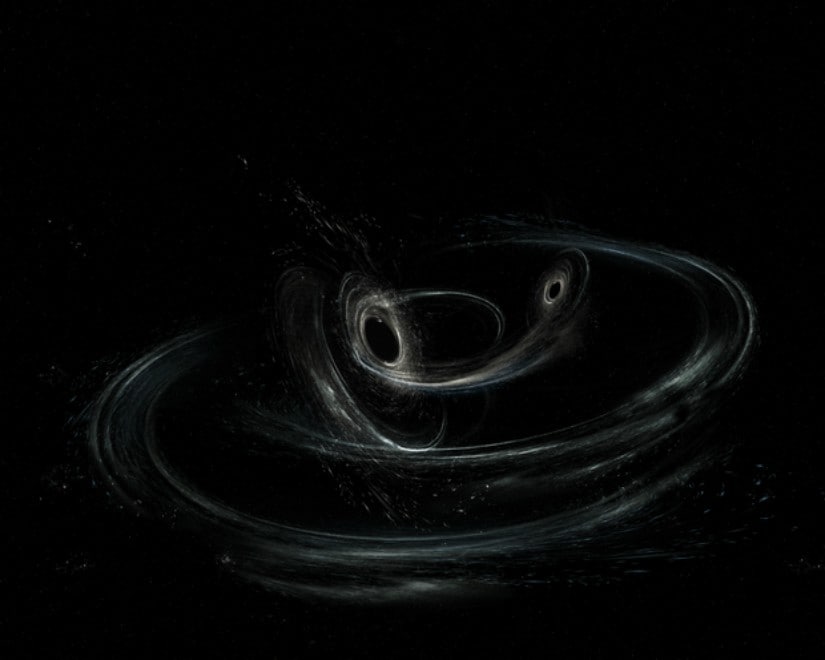 Artist's conception shows two merging black holes similar to those detected by LIGO. Image courtesy: LIGO[/caption]"Their discovery shook the world," said Goran Hansson, the head of the Swedish Royal Academy of Sciences, which selects the Nobel laureates.'Universe full of music'Black holes emit no light, and can be observed only through gravitational waves that occur when they collide and violently merge — offering scientists a means of studying them. Such violent events, LIGO's official website says, create ripples which travel outward as gravitational waves, carrying information about their cataclysmic origins as well as invaluable clues to the nature of gravity itself.[caption id="attachment_4108333" align="alignnone" width="825"]
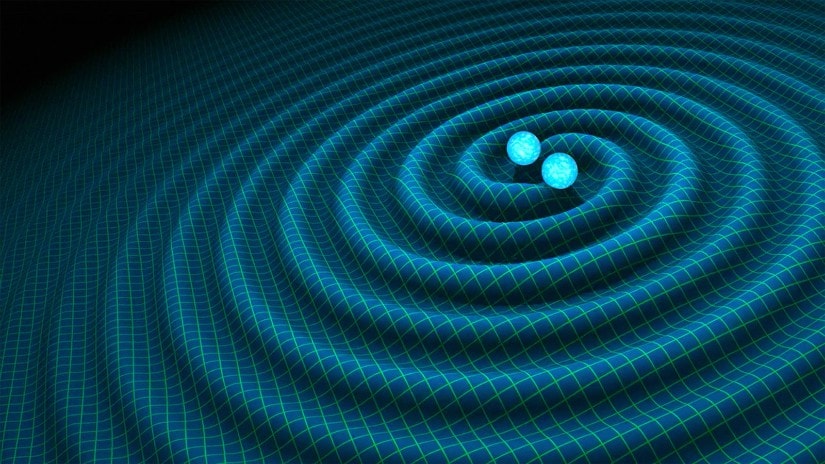 Artist's impression of gravitational waves generated by binary neutron stars. Image courtesy: NASA[/caption]The strongest gravitational waves are produced during catastrophic events such as colliding black holes, the collapse of star cores, coalescing neutron stars, the slightly wobbly rotation of neutron stars, and the remnants of gravitational radiation created by the birth of the universe itself."If we could hear all the waves and not only the strongest ones, the entire universe would be full of music, like birds chirping in a forest, with a louder tone here and a quieter one there," the Nobel academy said on Tuesday.
But Gravitational waves are minuscule and near-undetectable because they interact very weakly with matter and travel through the universe at the speed of light unimpeded.Although Einstein's mathematics allowed us to understand how gravitational waves operate and travel, proof of their existence wouldn't arrive for another 20 years until two astronomers discovered a binary pulsar — two extremely dense and heavy stars in orbit around each other.Since then, astronomers around the world and through the decades studied the timing of pulsar radio emissions and found similar effects, further confirming the existence of gravitational waves.Physical contactThese confirmations had always come indirectly or mathematically, and not through actual 'physical' contact with the waves.This changed on 14 September, 2015. LIGO, for the first time in history, physically sensed distortions in spacetime itself caused by passing gravitational waves generated by two colliding black holes over a billion light years away.[caption id="attachment_4108323" align="alignnone" width="825"]
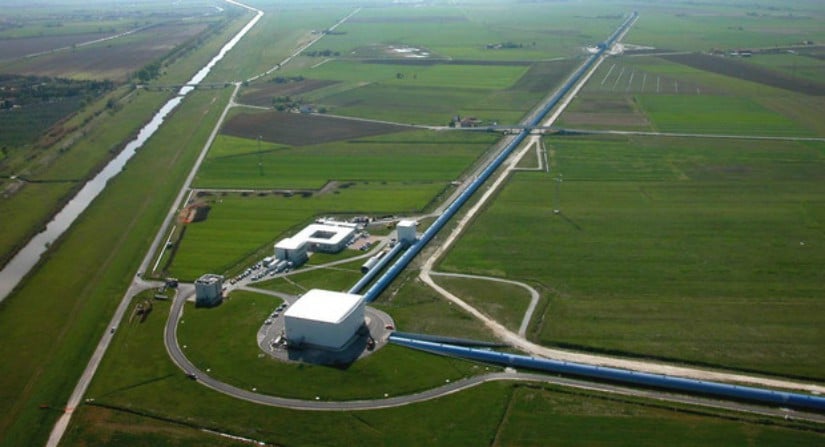 Aerial view of the LIGO Virgo detector. Image courtesy: LIGO[/caption]For this, LIGO used instruments called interferometers, whose design was based on work Weiss conducted in the 1960s.During regular laboratory experiments, a laser beam is split equally between the two extremely long arms of an interferometer. At the end of each arm is a mirror, which reflects the laser back to the starting point.LIGO realised it made the discovery when when the gravitational waves distorted spacetime just enough so that one of the arms becomes temporarily and very slightly longer than the other. The difference in the lengths of the two arms was smaller than the width of a proton.It is this sensitivity achieved by LIGO that won Weiss, Barish and Thorne the Nobel prize this year.Einstein was convinced such detection was impossibleIn 1984, Thorne, now 77, and Weiss, 85, co-created LIGO at the prestigious California Institute of Technology, which has taken home 18 Nobels since the prizes were first awarded in 1901. Barish, 81, joined the project in 1994 and helped bring it to completion. LIGO is now a collaboration between more than 1,000 researchers from 20 countries.[caption id="attachment_4108341" align="alignleft" width="380"]
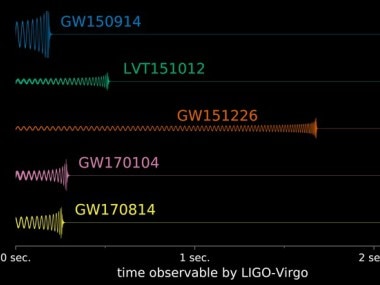 Gravitational waves detected by LIGO were extremely short and weak, which required the LIGO detectors to operate at very high sensitivity. Image courtesy: LIGO[/caption]"Although the signal was extremely weak when it reached Earth, it is already promising a revolution in astrophysics," the Nobel academy said. "Gravitational waves are an entirely new way of following the most violent events in space and testing the limits of our knowledge."In an interview on the Nobel prize website, Thorne said the discovery will enable scientists to see an "enormous number of things" in coming decades. "We will see neutron stars collide, tear each other apart, we will see black holes tearing neutron stars apart, we will see spinning neutron stars, pulsars ... We'll be exploring basically the birth of the universe."Since 2015, the enigmatic ripples of gravitational waves have been detected three more times: twice by LIGO and once by the Virgo detector at the European Gravitational Observatory (EGO) in Cascina, Italy.
"Einstein was convinced it would never be possible to measure them," the jury said."The LIGO project's achievement was using a pair of gigantic laser interferometers to measure a change thousands of times smaller than an atomic nucleus, as the gravitational wave passed the Earth" it said.'Thrilled and humbled'Weiss was awarded half the prize of nine million Swedish kronor (about $1.1 million), while Barish and Thorne shared the rest. "It's really wonderful. I view this more as a thing that recognises the work of about a thousand people," Weiss said shortly after the announcement."It took us a long time... two months... to convince ourselves that we had seen (something) that came from the outside and was truly a gravitational wave."Barish, who went to his laptop to see who won the Nobel when he didn't get a call, suddenly heard his cellphone ringing — wondering how Stockholm got that number. "My feelings at the time were... a complicated mixture between being thrilled and being humbled," he said."I had hoped it would go to the team, it didn't, it went to us," Thorne said after learning of the prize. "We had been expecting it, so I thought I would be blase but in fact I was overwhelmed."Caroline Crawford, an astronomer at Cambridge University, said the discovery "holds the potential for a completely new way of observing parts of the cosmos, the parts... completely obscured from our view."With inputs from AFP
First Published:Oct 04, 2017, 12:55:28 IST
Advertisement
Advertisement

Choke terror funding, keep international shipping lanes safe: Jaishankar at Asean Regional Forum
Jaishankar's remarks came against the backdrop of recent terror attacks targeting India and growing threats to commercial shipping amid conflicts in West Asia and Europe
2 min read
After Australia, New Zealand signs defence pact with Papua New Guinea as China expands in Indo-Pacific
After Australia, New Zealand has signed a defence cooperation agreement with Papua New Guinea. This is the latest agreement that countries in the region have signed to integrate themselves closer on security and defence as Chinas has sought to increase its footprint in the Indo-Pacific and the United States, the traditional guarantor of security, has abandoned the theatre.
2 min read
Pakistan's deep state weaponising LeT to counter Asim Munir critic Maulana Fazlur Rehman: Report
A deepening military-terror nexus is reportedly emerging in Pakistan in a bid to neutralise the JUI-F chief, Maulana Fazlur Rehman, after he openly criticised Pakistan's Army Chief Asim Munir.
2 min read
No premium queues, 30-minute target: What changes for Indian passport applicants in UAE
Indian passport applicants in the UAE can now access passport, visa and attestation services through Alhind’s 16 centres, with no premium queues, a Dh19 service fee and a target of completing applications within 30 minutes
4 min read
'We don't need straits': Trump says Iran war isn't about Hormuz as US strikes for 12th night
US President Donald Trump on Wednesday declared that the country does not need the Strait of Hormuz as Washington bombards Iran for the 12th consecutive night.
2 min read
Advertisement
Advertisement