
Advertisement


Sections
The small club of countries that US will join if it scraps Roe v Wade ruling
A leaked document from the United States Supreme Court shows that it may overturn the landmark Roe v Wade ruling on abortion rights. This comes at a time when other countries are battling to loosen their restrictive measures

In 2021, women activists celebrated the world moving towards easier access to abortion. However, now millions of American women are on the verge of losing access to abortion, if a document leaked from the United States Supreme Court is to be believed.On Tuesday, American media house Politico published a leaked draft opinion by conservative Justice Samuel Alito on overturning the historic Roe v Wade ruling. If the court went ahead and struck down this legislation, it would mean that each American state would be free to make its own abortion laws, and the likelihood is that many would choose to ban the procedure.If the court actually goes ahead with the draft opinion, the United States would join a very small club of countries that have moved to restrict access in recent years.Also read: What would the end of Roe v Wade mean? Five burning questions answeredHere’s a look at where the US stands on abortion laws vis-à-vis other countries.EuropeMost Western countries and allies of the United States allow abortion.In fact, most developed countries in the world allow abortions on request or on broad health and socio-economic grounds, according to the Center for Reproductive Rights (CRR), which campaigns for improved access to abortion and monitors laws worldwide.However, abortion remains completely illegal in three microstates: Andorra, Malta and Vatican City.It is important to note that Poland’s Constitutional Tribunal rolled back women’s right to terminate pregnancies in 2021, ruling that women can undergo an abortion only in cases of rape, incest, or if their life is in danger.Other predominantly Catholic countries have also permitted abortions such as Ireland. In 2018, a popular referendum led to abortion being legalised up to 12 weeks, and limited circumstances beyond then. Before the change, thousands of Irish women would typically travel to nearby England for the procedure every year, according to the Belfast-based journalism project Detail Data.Germany, the giant of Europe, outlaws abortion, but women do not face penalties for going through with the procedure — if they get mandatory counselilng within 12 weeks after conception, if the pregnancy creates health risks, or if the pregnancy is the result of rape.[caption id="attachment_10632011" align="alignnone" width="640"]![File image of demonstrators protesting with placards against Poland's near-total ban on abortion during a demonstration in Berlin in 2020. AFP]() File image of demonstrators protesting with placards against Poland's near-total ban on abortion during a demonstration in Berlin in 2020. AFP[/caption]Latin AmericaCourts in most Latin American countries have been moving towards the ‘pro-choice’ direction.In February, Colombia legalised the procedure until the 24th week of pregnancy, part of a broader trend seen in parts of heavily Catholic Latin America.Recently, Chile’s constitutional convention – which is drafting a new constitution for the country — passed an article enshrining sexual and reproductive rights as fundamental and guaranteed by the state. These rights include abortion on request.Abortion was banned in Chile in all instances and only permitted in 2017 in cases of rape, foetal inviability and risk to the woman's life. The public will vote on the new constitution in September; if approved, it will become the first country in the world to give constitutional status to the right to abortion.In 2021, Mexico’s supreme court ruled the criminalisation of abortion unconstitutional, and invalidated a federal law that allowed health personnel to refuse to perform terminations on the grounds of “conscientious objection”. This ruling means no woman can be imprisoned for ending her pregnancy.A report reveal that that 37 per cent of Latin America and the Caribbean’s population of 652 million live in countries where women have won rights to legal abortion or are no longer imprisoned for terminating a pregnancy (including Cuba, Guyana and Puerto Rico). Five years ago, it was less than three per cent.AmericasWhile America grapples with its abortion status, many have turned their focus to US’ northern neighbour, Canada, where abortion is permitted at any point during pregnancy.There are no federal laws governing abortion in Canada – it was decriminalised in 1988. However, adequate access to routine abortions continues to be an issue.In fact, as US dealt with the Supreme Court leak on abortions, Prime Minister Justin Trudeau and Deputy Prime Minister Chrystia Freeland affirmed their support of women’s right to choose.Reuters reported Trudeau as saying, “We’ll never back down from protecting and promoting women’s rights in Canada and around the world.”[caption id="attachment_10632021" align="alignnone" width="640"]
File image of demonstrators protesting with placards against Poland's near-total ban on abortion during a demonstration in Berlin in 2020. AFP[/caption]Latin AmericaCourts in most Latin American countries have been moving towards the ‘pro-choice’ direction.In February, Colombia legalised the procedure until the 24th week of pregnancy, part of a broader trend seen in parts of heavily Catholic Latin America.Recently, Chile’s constitutional convention – which is drafting a new constitution for the country — passed an article enshrining sexual and reproductive rights as fundamental and guaranteed by the state. These rights include abortion on request.Abortion was banned in Chile in all instances and only permitted in 2017 in cases of rape, foetal inviability and risk to the woman's life. The public will vote on the new constitution in September; if approved, it will become the first country in the world to give constitutional status to the right to abortion.In 2021, Mexico’s supreme court ruled the criminalisation of abortion unconstitutional, and invalidated a federal law that allowed health personnel to refuse to perform terminations on the grounds of “conscientious objection”. This ruling means no woman can be imprisoned for ending her pregnancy.A report reveal that that 37 per cent of Latin America and the Caribbean’s population of 652 million live in countries where women have won rights to legal abortion or are no longer imprisoned for terminating a pregnancy (including Cuba, Guyana and Puerto Rico). Five years ago, it was less than three per cent.AmericasWhile America grapples with its abortion status, many have turned their focus to US’ northern neighbour, Canada, where abortion is permitted at any point during pregnancy.There are no federal laws governing abortion in Canada – it was decriminalised in 1988. However, adequate access to routine abortions continues to be an issue.In fact, as US dealt with the Supreme Court leak on abortions, Prime Minister Justin Trudeau and Deputy Prime Minister Chrystia Freeland affirmed their support of women’s right to choose.Reuters reported Trudeau as saying, “We’ll never back down from protecting and promoting women’s rights in Canada and around the world.”[caption id="attachment_10632021" align="alignnone" width="640"]![File image of abortion-rights activists celebrating after the Constitutional Court approved the decriminalisation of abortion, lifting all limitations on the procedure until the 24th week of pregnancy, in Bogota, Colombia. AP]() File image of abortion-rights activists celebrating after the Constitutional Court approved the decriminalisation of abortion, lifting all limitations on the procedure until the 24th week of pregnancy, in Bogota, Colombia. AP[/caption]AsiaThe Asian countries don’t have a good track record when it comes to dealing with women’s abortion rights. The World Health Organization (WHO) has stated that more than half of all unsafe abortions occur in Asia, most of them in south and central Asia.Japan, alongside India, makes provisions for abortion in cases of rape or risk to the woman's health, but also on wider socioeconomic grounds.Abortion remains completely illegal in Laos and the Philippines.The Philippines’ ban is based off a colonial-era law introduced by the Spanish back in 1870. A woman who has an abortion in the Philippines risks up to six years in prison.Other southeast Asian countries like Thailand allow abortions with conditions. In 2021, the country allowed abortions up to the 12th week of pregnancy. Previously, with some exceptions, the procedure was considered a criminal offense and could carry prison time.Other Muslim-dominated countries also restrict abortions. In the United Arab Emirates, abortion is illegal except if the pregnancy endangers the woman’s life or there is evidence the baby will not survive. Women could face up to one year in prison and a hefty fine. Women who seek hospital treatment for a miscarriage may be accused of attempted abortion.AfricaMany African nations also maintain complete bans, but in October 2021, Benin legalised abortion in most circumstances up to 12 weeks. Previously it was permitted in cases of rape or incest; risk to the woman's life; or severe fetal malformation.In several countries, including Egypt, Democratic Republic of Congo and Senegal, abortion is completely illegal.The Guttmacher Institute has reported that Africa has the highest death rate related to unsafe abortions and that deaths of up to 15,000 women a year could be prevented by improving access to safe abortions across the continent.With inputs from agenciesRead all the Latest News, Trending News, Cricket News, Bollywood News,India News and Entertainment News here. Follow us on Facebook, Twitter and Instagram.
File image of abortion-rights activists celebrating after the Constitutional Court approved the decriminalisation of abortion, lifting all limitations on the procedure until the 24th week of pregnancy, in Bogota, Colombia. AP[/caption]AsiaThe Asian countries don’t have a good track record when it comes to dealing with women’s abortion rights. The World Health Organization (WHO) has stated that more than half of all unsafe abortions occur in Asia, most of them in south and central Asia.Japan, alongside India, makes provisions for abortion in cases of rape or risk to the woman's health, but also on wider socioeconomic grounds.Abortion remains completely illegal in Laos and the Philippines.The Philippines’ ban is based off a colonial-era law introduced by the Spanish back in 1870. A woman who has an abortion in the Philippines risks up to six years in prison.Other southeast Asian countries like Thailand allow abortions with conditions. In 2021, the country allowed abortions up to the 12th week of pregnancy. Previously, with some exceptions, the procedure was considered a criminal offense and could carry prison time.Other Muslim-dominated countries also restrict abortions. In the United Arab Emirates, abortion is illegal except if the pregnancy endangers the woman’s life or there is evidence the baby will not survive. Women could face up to one year in prison and a hefty fine. Women who seek hospital treatment for a miscarriage may be accused of attempted abortion.AfricaMany African nations also maintain complete bans, but in October 2021, Benin legalised abortion in most circumstances up to 12 weeks. Previously it was permitted in cases of rape or incest; risk to the woman's life; or severe fetal malformation.In several countries, including Egypt, Democratic Republic of Congo and Senegal, abortion is completely illegal.The Guttmacher Institute has reported that Africa has the highest death rate related to unsafe abortions and that deaths of up to 15,000 women a year could be prevented by improving access to safe abortions across the continent.With inputs from agenciesRead all the Latest News, Trending News, Cricket News, Bollywood News,India News and Entertainment News here. Follow us on Facebook, Twitter and Instagram.
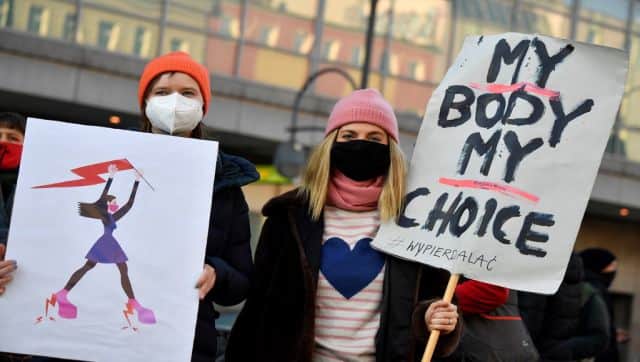 File image of demonstrators protesting with placards against Poland's near-total ban on abortion during a demonstration in Berlin in 2020. AFP[/caption]Latin AmericaCourts in most Latin American countries have been moving towards the ‘pro-choice’ direction.In February, Colombia legalised the procedure until the 24th week of pregnancy, part of a broader trend seen in parts of heavily Catholic Latin America.Recently, Chile’s constitutional convention – which is drafting a new constitution for the country — passed an article enshrining sexual and reproductive rights as fundamental and guaranteed by the state. These rights include abortion on request.Abortion was banned in Chile in all instances and only permitted in 2017 in cases of rape, foetal inviability and risk to the woman's life. The public will vote on the new constitution in September; if approved, it will become the first country in the world to give constitutional status to the right to abortion.In 2021, Mexico’s supreme court ruled the criminalisation of abortion unconstitutional, and invalidated a federal law that allowed health personnel to refuse to perform terminations on the grounds of “conscientious objection”. This ruling means no woman can be imprisoned for ending her pregnancy.A report reveal that that 37 per cent of Latin America and the Caribbean’s population of 652 million live in countries where women have won rights to legal abortion or are no longer imprisoned for terminating a pregnancy (including Cuba, Guyana and Puerto Rico). Five years ago, it was less than three per cent.AmericasWhile America grapples with its abortion status, many have turned their focus to US’ northern neighbour, Canada, where abortion is permitted at any point during pregnancy.There are no federal laws governing abortion in Canada – it was decriminalised in 1988. However, adequate access to routine abortions continues to be an issue.In fact, as US dealt with the Supreme Court leak on abortions, Prime Minister Justin Trudeau and Deputy Prime Minister Chrystia Freeland affirmed their support of women’s right to choose.Reuters reported Trudeau as saying, “We’ll never back down from protecting and promoting women’s rights in Canada and around the world.”[caption id="attachment_10632021" align="alignnone" width="640"]
 File image of abortion-rights activists celebrating after the Constitutional Court approved the decriminalisation of abortion, lifting all limitations on the procedure until the 24th week of pregnancy, in Bogota, Colombia. AP[/caption]AsiaThe Asian countries don’t have a good track record when it comes to dealing with women’s abortion rights. The World Health Organization (WHO) has stated that more than half of all unsafe abortions occur in Asia, most of them in south and central Asia.Japan, alongside India, makes provisions for abortion in cases of rape or risk to the woman's health, but also on wider socioeconomic grounds.Abortion remains completely illegal in Laos and the Philippines.The Philippines’ ban is based off a colonial-era law introduced by the Spanish back in 1870. A woman who has an abortion in the Philippines risks up to six years in prison.Other southeast Asian countries like Thailand allow abortions with conditions. In 2021, the country allowed abortions up to the 12th week of pregnancy. Previously, with some exceptions, the procedure was considered a criminal offense and could carry prison time.Other Muslim-dominated countries also restrict abortions. In the United Arab Emirates, abortion is illegal except if the pregnancy endangers the woman’s life or there is evidence the baby will not survive. Women could face up to one year in prison and a hefty fine. Women who seek hospital treatment for a miscarriage may be accused of attempted abortion.AfricaMany African nations also maintain complete bans, but in October 2021, Benin legalised abortion in most circumstances up to 12 weeks. Previously it was permitted in cases of rape or incest; risk to the woman's life; or severe fetal malformation.In several countries, including Egypt, Democratic Republic of Congo and Senegal, abortion is completely illegal.The Guttmacher Institute has reported that Africa has the highest death rate related to unsafe abortions and that deaths of up to 15,000 women a year could be prevented by improving access to safe abortions across the continent.With inputs from agenciesRead all the Latest News, Trending News, Cricket News, Bollywood News,India News and Entertainment News here. Follow us on Facebook, Twitter and Instagram.
First Published:May 04, 2022, 14:51:36 IST
Advertisement
Advertisement

Pakistan resorts to its military-terror nexus in a bid to neutralise Munir critic, JUI-F chief Rehman: Report
A deepening military-terror nexus is reportedly emerging in Pakistan in a bid to neutralise the JUI-F chief, Maulana Fazlur Rehman, after he openly criticised Pakistan's Army Chief Asim Munir.
2 min read
No premium queues, 30-minute target: What changes for Indian passport applicants in UAE
Indian passport applicants in the UAE can now access passport, visa and attestation services through Alhind’s 16 centres, with no premium queues, a Dh19 service fee and a target of completing applications within 30 minutes
4 min read
'We don't need straits': Trump says Iran war isn't about Hormuz as US strikes for 12th night
US President Donald Trump on Wednesday declared that the country does not need the Strait of Hormuz as Washington bombards Iran for the 12th consecutive night.
2 min read
Iran claims to stop three oil tankers transiting Strait of Hormuz
In recent weeks, Iran has targeted tankers using a route along the Omani coast to cross the strait, in what it says is an effort to force vessels to use Iranian waters and pay for safe passage
1 min read
Globe at a glance: From Houthis striking Saudi tankers in Red Sea to wildfires in Europe
Your window to world news: As Yemen's Houthi rebels claimed to have struck two Saudi oil tankers in the Red Sea on Wednesday, the United States has announced a landmark deal with Saudi Arabia that would establish a civilian nuclear program in the Gulf country
2 min read
Advertisement
Advertisement