
Advertisement


Sections
Superhenge? Stonehenge archeologists find huge neolithic site with up to 90 standing stones
Archaeologists on Monday said they had found the buried remains of a mysterious prehistoric monument close to Britain's famous Stonehenge heritage site.

London: Archaeologists on Monday said they had found the buried remains of a mysterious prehistoric monument close to Britain's famous Stonehenge heritage site.Up to 90 standing stones, some originally measuring 4.5 metres (15 feet) and dating back some 4,500 years, may have been buried for millennia under a bank of earth, they said.[caption id="attachment_2425346" align="alignleft" width="380"]![Stonehenge. Reuters]() Stonehenge. Reuters[/caption]The discovery was made at Durrington Walls - a so-called "superhenge" located less than three kilometres (1.8 miles) from Stonehenge - thanks to hi-tech sensors, they said.The site may have been used in neolithic times for rituals or as some kind of arena."Durrington Walls is an immense monument and up until this point we thought it was merely a large bank and ditched enclosure, but underneath that massive monument is another monument," Vincent Gaffney, of the University of Bradford, told the BBC.The discovery was made by the Stonehenge Hidden Landscapes Project, a collaboration between the University of Birmingham and the Vienna-based Ludwig Boltzmann Institute for Archaeological Prospection and Virtual Archaeology (LBI ArchPro).The newly discovered stones, which have yet to be excavated, are thought to have been toppled over, with the bank of the later Durrington Walls henge built over them.The monument, which lies in the Stonehenge World Heritage Site, is one of the largest known henges - a circle of stone or wooden uprights - ever found.It measures 500 metres (yards) across and more than 1.5 km in circumference.Surrounded by a 17.6m-wide ditch and a bank around 1m high, the site has long mystified archaeologists as one side is straight and the other curved.Now ground penetrating radar has revealed that the straight edge in fact sits on top of a "C-shaped" monument, which may have been used as a site for rituals or an arena for gatherings, researchers said.'Very important' findProject initiator Wolfgang Neubauer, director of the LBI ArchPro, described the discovery as a "very important and fantastic finding" and said the monument could originally have comprised up to 200 stones."The missing stones might be the stone material which was used later on to build Stonehenge," he explained, adding that those left in place were probably broken during attempts to move them.Although none of the stones have yet been excavated, archaeologists believe they may be locally sourced stones similar to a single standing stone, known as "The Cuckoo Stone", in an adjacent field.The earthwork enclosure at Durrington Walls was built about a century after Stonehenge, a ring of standing stones believed to have been erected between 3,000 and 2,000 BC.Archeologists say the new stone row could date back to the same period, or even earlier."This discovery of a major new stone monument, which has been preserved to a remarkable extent, has significant implications for our understanding of Stonehenge and its landscape setting," said Gaffney."Not only does this new evidence demonstrate a completely unexpected phase of monumental architecture at one of the greatest ceremonial sites in prehistoric Europe, the new stone row could well be contemporary with the famous Stonehenge sarsen circle or even earlier."Nick Snashall, a National Trust archaeologist for the Stonehenge site, said the findings provided "tantalising evidence" of what lies beneath Durrington Walls."The presence of what appear to be stones, surrounding the site of one of the largest Neolithic settlements in Europe adds a whole new chapter to the Stonehenge story," he said.AFP
Stonehenge. Reuters[/caption]The discovery was made at Durrington Walls - a so-called "superhenge" located less than three kilometres (1.8 miles) from Stonehenge - thanks to hi-tech sensors, they said.The site may have been used in neolithic times for rituals or as some kind of arena."Durrington Walls is an immense monument and up until this point we thought it was merely a large bank and ditched enclosure, but underneath that massive monument is another monument," Vincent Gaffney, of the University of Bradford, told the BBC.The discovery was made by the Stonehenge Hidden Landscapes Project, a collaboration between the University of Birmingham and the Vienna-based Ludwig Boltzmann Institute for Archaeological Prospection and Virtual Archaeology (LBI ArchPro).The newly discovered stones, which have yet to be excavated, are thought to have been toppled over, with the bank of the later Durrington Walls henge built over them.The monument, which lies in the Stonehenge World Heritage Site, is one of the largest known henges - a circle of stone or wooden uprights - ever found.It measures 500 metres (yards) across and more than 1.5 km in circumference.Surrounded by a 17.6m-wide ditch and a bank around 1m high, the site has long mystified archaeologists as one side is straight and the other curved.Now ground penetrating radar has revealed that the straight edge in fact sits on top of a "C-shaped" monument, which may have been used as a site for rituals or an arena for gatherings, researchers said.'Very important' findProject initiator Wolfgang Neubauer, director of the LBI ArchPro, described the discovery as a "very important and fantastic finding" and said the monument could originally have comprised up to 200 stones."The missing stones might be the stone material which was used later on to build Stonehenge," he explained, adding that those left in place were probably broken during attempts to move them.Although none of the stones have yet been excavated, archaeologists believe they may be locally sourced stones similar to a single standing stone, known as "The Cuckoo Stone", in an adjacent field.The earthwork enclosure at Durrington Walls was built about a century after Stonehenge, a ring of standing stones believed to have been erected between 3,000 and 2,000 BC.Archeologists say the new stone row could date back to the same period, or even earlier."This discovery of a major new stone monument, which has been preserved to a remarkable extent, has significant implications for our understanding of Stonehenge and its landscape setting," said Gaffney."Not only does this new evidence demonstrate a completely unexpected phase of monumental architecture at one of the greatest ceremonial sites in prehistoric Europe, the new stone row could well be contemporary with the famous Stonehenge sarsen circle or even earlier."Nick Snashall, a National Trust archaeologist for the Stonehenge site, said the findings provided "tantalising evidence" of what lies beneath Durrington Walls."The presence of what appear to be stones, surrounding the site of one of the largest Neolithic settlements in Europe adds a whole new chapter to the Stonehenge story," he said.AFP
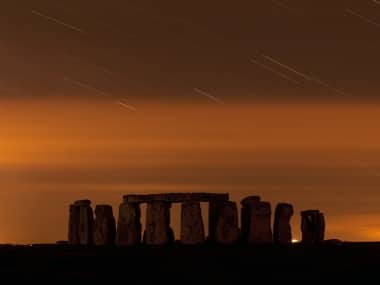 Stonehenge. Reuters[/caption]The discovery was made at Durrington Walls - a so-called "superhenge" located less than three kilometres (1.8 miles) from Stonehenge - thanks to hi-tech sensors, they said.The site may have been used in neolithic times for rituals or as some kind of arena."Durrington Walls is an immense monument and up until this point we thought it was merely a large bank and ditched enclosure, but underneath that massive monument is another monument," Vincent Gaffney, of the University of Bradford, told the BBC.The discovery was made by the Stonehenge Hidden Landscapes Project, a collaboration between the University of Birmingham and the Vienna-based Ludwig Boltzmann Institute for Archaeological Prospection and Virtual Archaeology (LBI ArchPro).
First Published:Sep 08, 2015, 11:52:12 IST
Advertisement
Advertisement

Nawaz Sharif wants to become prime minister of PoK — but laws framed by Pakistan disqualify him
Former Pakistani Prime Minister Nawaz Sharif has said that he would ask his brother, Prime Minister Shehbaz Sharif, to appoint him as the Prime Minister of Pakistan-occupied Jammu and Kashmir (POJK). But the Constitution bars him from making such a move.
2 min read
Fake jobs, tourist visas: Inside Russia’s vast network luring foreigners to fight Ukraine war
Russia is accused of using fake job offers, tourist visas and lucrative military contracts to recruit thousands of foreign nationals for the Ukraine war. Investigations reveal how poverty, deception and coercion have drawn people from Asia, Africa and Latin America into one of the world's deadliest conflicts
8 min read
As Pakistan eyes American dollar for Iran mediation, economists sound the alarm: ‘It can buy time, not growth’
Pakistan is reportedly seeking billions in US support after claiming a role in easing US-Iran tensions, but economists warn fresh funding would offer only temporary relief without deep structural economic reforms.
2 min read
Are Chinese UN peacekeepers spies? Trump’s UN envoy sends out a warning
US UN Envoy Mike Waltz has warned that China has been using United Nations' platforms, such as peacekeeping missions, for espionage. He accused Chinese peacekeepers of serving as the eyes and ears of the Communist Party of China.
2 min read
Why has Bangladesh’s choice of India spokespersons raised eyebrows?
Bangladesh’s appointment of journalists Md Saidur Rahman and Umme Marufa to media roles in New Delhi and Kolkata has triggered controversy over their past anti-India social media posts, many of which were later deleted, prompting diplomatic scrutiny as India and Bangladesh seek to improve bilateral ties
6 min read
Advertisement
Advertisement