


Soft robotic sleeve makes heart beat like cardiac muscle
In a ray of hope for those suffering from heart conditions, a team of scientists has developed the world's first soft robotic sleeve that is fitted around the heart, where it twists and compresses the heart's chambers just like healthy cardiac muscle would

New York: In a ray of hope for those suffering from heart conditions, a team of scientists has developed the world's first soft robotic sleeve that is fitted around the heart, where it twists and compresses the heart's chambers just like healthy cardiac muscle would.[caption id="attachment_3211194" align="alignleft" width="380"]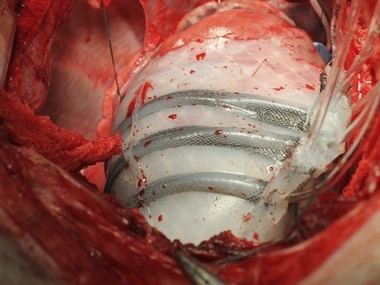 A soft robotic sleeve that fits around the heart could open the door to a new class of cardiac devices to treat heart failure. AP[/caption]To create a device that does not come into contact with blood, the team from Harvard University and Boston Children's Hospital developed a thin silicone sleeve that uses soft pneumatic actuators placed around the heart to mimic the outer muscle layers of a human heart."This research demonstrates that the growing field of soft robotics can be applied to clinical needs and potentially reduce the burden of heart disease and improve the quality of life for patients," said lead author Ellen T Roche, a former PhD student at Harvard and is currently a postdoctoral fellow at the National University of Ireland.The actuators twist and compress the sleeve in a similar motion to the beating heart. The device is tethered to an external pump, which uses air to power the soft actuators. Unlike other therapeutic systems known as ventricular assist devices (VADs), the soft robotic sleeve does not directly contact blood, avoiding that risk.With heart failure affecting 41 million people worldwide, researchers expect the device may be able to bridge a patient to transplant or to aid in cardiac rehabilitation and recovery. "The sleeve can be customised for each patient. If a patient has more weakness on the left side of the heart, for example, the actuators can be tuned to give more assistance on that side," Roche noted in a paper published in the journal Science Translational Medicine.The pressure of the actuators can also increase or decrease over time, as the patient's condition evolves. The device is tethered to an external pump, which uses air to power the soft actuators. According to the researchers, soft robotic devices are ideally suited to interact with soft tissue and give assistance that can help with augmentation of function, and potentially even healing and recovery.

After Australia, New Zealand signs defence pact with Papua New Guinea as China expands in Indo-Pacific
Pakistan's deep state weaponising LeT to counter Asim Munir critic Maulana Fazlur Rehman: Report
No premium queues, 30-minute target: What changes for Indian passport applicants in UAE
'We don't need straits': Trump says Iran war isn't about Hormuz as US strikes for 12th night
Iran claims to stop three oil tankers transiting Strait of Hormuz