


Protests in Iran continue for third day: Govt warns demonstrators will 'pay the price', forces media blackout
Iran on Sunday warned that protesters will "pay the price" after a third night of unrest saw mass demonstrations across the country in which dozens were arrested and official buildings attacked.

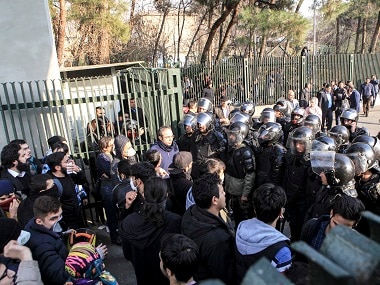
Anti-riot Iranian police prevents students from joining other protesters. AP[/caption]"Those who damage public property, disrupt order and break the law must be responsible for their behaviour and pay the price," Interior Minister Abdolrahman Rahmani Fazli said on state television early on Sunday.US president Donald Trump weighed in on the protests, saying "oppressive regimes cannot endure forever".There was no confirmation of widespread reports that at least two people had been shot dead in the small western town of Dorud.In one of the few official reports, an official in Arak, around 300 kilometres southwest of Tehran, said 80 people had been arrested overnight."Some intended to enter and damage some government places but the attackers did not manage to achieve their goals... and the town is under control," the unidentified official told the ILNA news agency.Iranian authorities said the majority of social media reports were emanating from regional rival Saudi Arabia and exile groups based in Europe.Internet was temporarily cut on mobile phones last night but was restored not long after.President Hassan Rouhani, who came to power in 2013 promising to mend the economy and ease social tensions, has so far not made any statement since the unrest started in second city Mashhad on Thursday.The protests began in Mashhad against high living costs and the struggling economy before spreading quickly to other areas and turning against the Islamic regime as a whole.Slogans such as "Death to the dictator" have been heard throughout the protests.There have been reminders of the regime's continued support among conservative sections of society, with pro-regime students outnumbering protesters at the University of Tehran on Saturday.Pre-planned rallies to mark the defeat of a 2009 protest movement also saw thousands of regime supporters out on the streets across the country on Saturday morning.But the anti-government protests appear to have been driven in large part by poorer sections of society, angry over high unemployment, soaring prices and financial scandals."These protests are driven by the lower levels of society who have been hit by major economic problems, particularly losing their money when credit institutions collapsed," said Payam Parhiz, editor in chief of reformist media network Nazar, which first broke news of the Mashhad protests."These economic protests are not something that has started overnight, it's been at least a year since these people lost their money in credit institutions and have been protesting at various places," he told AFP.Unemployment is particularly high among young people, who have grown up in a less restrictive environment and are generally considered less deferential to authority.Since the 2009 protests against a disputed presidential election that gave hardliner Mahmoud Ahmadinejad a second term were ruthlessly put down, many middle-class Iranians have abandoned hope of securing change from the streets.But low-level strikes and demonstrations have continued, with bus drivers, teachers and factory workers protesting against unpaid wages and poor conditions.

Epstein's model scout Daniel Siad found dead at his home near Paris amid rape case trial
South China Sea tensions rise as China claims it expelled Philippine ships
Choke terror funding, keep international shipping lanes safe: Jaishankar at Asean Regional Forum
After Australia, New Zealand signs defence pact with Papua New Guinea as China expands in Indo-Pacific
Pakistan's deep state weaponising LeT to counter Asim Munir critic Maulana Fazlur Rehman: Report