


Preliminary report on MH370 puts focus on air traffic flaws
Flight MH370's disappearance has led to calls for real-time tracking, it has also re-focused attention on the gap between what controllers sometimes think and see.

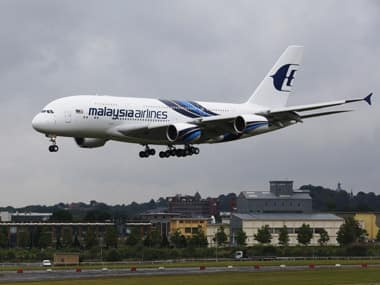
A Malaysia Airlines flight is seen in this file photo. Reuters[/caption]Half an hour later, the airline reassured controllers that the Boeing 777 was in a "normal condition" based on a signal placing it even further east, on the other side of Vietnam.In fact, by then it had flown back west across Malaysia and was already on a new southerly course thought to have taken it across the tip of Indonesia and towards the Indian Ocean, where investigators believe it crashed with 239 people on board.The false trail appears to have cost controllers time, according to maps and a chronology released on Thursday.Unnoticed by civil controllers because its transponder was switched off, and deemed no threat by a military radar controller, the aircraft flew back across Malaysia and the Malacca Straits for an hour while the airline believed it was in Cambodian and then Vietnamese airspace.The airline later told controllers the information had been based on a "projection" and was not reliable, according to the report.Malaysia Airlines could not be reached for comment.The confusion echoes a fumble when Air France 447 vanished over the Atlantic five years ago. Controllers at first mistook a virtual flight path for the plane's actual course, according to an official report, which may have delayed a search operation.In both cases, people on the ground were looking only at projections when they thought they were looking at real data.HIGH TRAFFICBoth events illustrate the problems in handling a growing amount of air traffic crossing through remote areas, where controllers and dispatchers sometimes have to fill in the blanks by anticipating where an aircraft should be."It is a natural consequence of the old traditional industry ways, which are limited by communications capability," said air traffic control expert Hans Weber, president of U.S.-based consultancy TECOP International.Experts say such methods are not necessarily unsafe because controllers simply compensate for uncertainty by leaving a bigger "bubble" of vacant space around a jet to avoid collision. But that can also lead to delays and greater congestion."Controllers anticipate where a plane's next call should come from: that is what they do because that is all they have to work with," said Weber.Many private satellite firms are offering flight tracking services, but analysts say they face problems of capacity due to sharp rises in global air traffic expected over coming years.Such issues could be overtaken by broader plans for a radical overhaul of air traffic control in the next decade in the United States and Europe, using satellites. But the schemes are costly and have not yet been widely adopted elsewhere.Reuters

Epstein's model scout Daniel Siad found dead at his home near Paris amid rape case trial
South China Sea tensions rise as China claims it expelled Philippine ships
Choke terror funding, keep international shipping lanes safe: Jaishankar at Asean Regional Forum
After Australia, New Zealand signs defence pact with Papua New Guinea as China expands in Indo-Pacific
Pakistan's deep state weaponising LeT to counter Asim Munir critic Maulana Fazlur Rehman: Report