


Polar Vortex Explained: Artic-like deep freeze grips US with coldest temperature in 20 years, but is this climate change?
Occasionally we get meandering of the polar vortex and that is what is happening right now. And if you get a real big one you can have a big blob of cold air penetrate very far south.

Tampa (United States): An Arctic-like deep freeze gripping much of the United States with double-digit subzero temperatures is the coldest of its kind in two decades, but is it linked to climate change?Experts say it could be, but whether global warming plays a role in this particular extreme weather phenomenon is still up for debate. Here's why:What is a polar vortex?"It is a mass of very cold air that typically sits right on the North Pole and tends to be restricted to the North Pole by the jet stream," explained Ben Kirtman, professor of atmospheric sciences at the University of Miami Rosenstiel School of Marine and Atmospheric Science.Normally, the jet stream — which is a strong a current in the atmosphere — would keep this cold air in the Arctic, but when the jet stream wavers, or weakens, the chill can spill. "Occasionally we get meandering of the polar vortex and that is what is happening right now. And if you get a real big one you can have a big blob of cold air penetrate very far south," Kirtman told AFP.[caption id="attachment_5997071" align="alignnone" width="825"]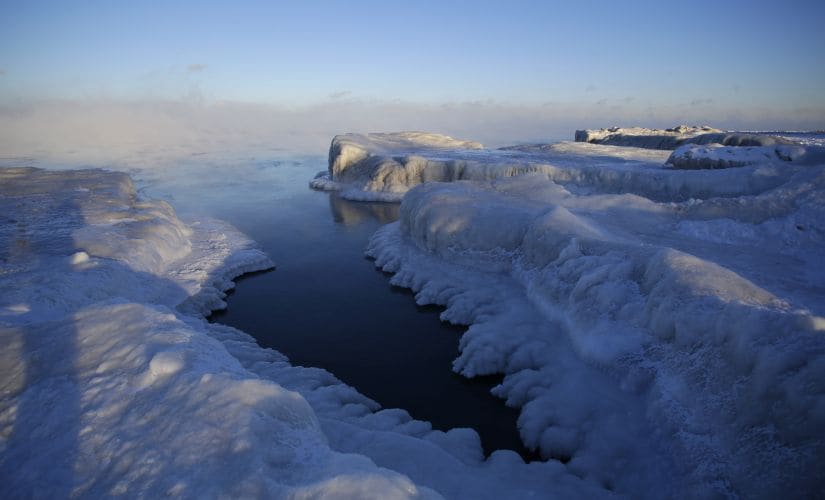
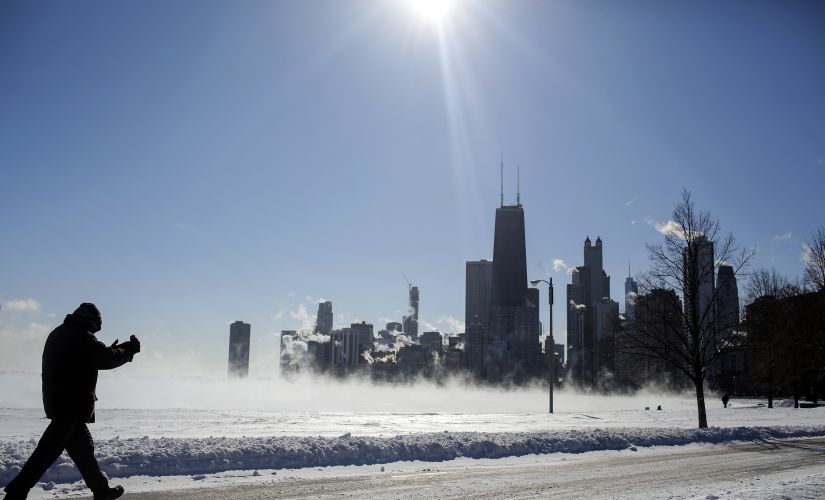
The National Weather Service warned that a wind chill of -20 F can cause frostbite in as little as 30 minutes. AFP[/caption]However, sometimes a jet stream that is too strong can also become unstable, "and these instabilities cause a certain amount of waviness in the jet so you can get these meanders," said Kirtman.Some evidence also suggests that when the poles heat up, there is less contrast between the tropics and the poles, and that, too, can make the jet stream become wavier, allowing cold air to spill down from the north.The Arctic is well known to be heating at twice the rate of the rest of the planet.Can this type of extreme weather be blamed on climate change?"What people are starting to ask is, if you weaken the jet stream, does that mean we are going to have more, stronger excursions of the polar vortex? If that turns out to be true, we can link more extreme cold spells to climate change," Kirtman added.Researchers are examining data in the quest to find out."There are some hints that it is linked to climate change, but I would emphasise that the jury is still out," he said.Scientists are getting better at deciphering the role of climate change in certain weather extremes. So far, the signals are clearest in events like rainfall, drought, heatwaves and wildfires. But when it comes to cold snaps, the answers are not as clear."I would say the science is still incomplete. We don't have proof at this point," said Kirtman.

'We don't need straits': Trump says Iran war isn't about Hormuz as US strikes for 12th night
Iran claims to stop three oil tankers transiting Strait of Hormuz
Globe at a glance: From Houthis striking Saudi tankers in Red Sea to wildfires in Europe
Houthis claim responsibility for attack on two Saudi oil tankers in Red Sea as a new chokepoint emerges
Air India to cut Delhi-Toronto flight time by 3 hours, resume non-stop services from August 1