


Penrose's Nobel for Physics comes two decades too late, a delayed recognition of important theoretical work
It took the Nobel Committee five decades to recognize the work of Indian-origin astrophysicist Subramanyan Chandrasekhar.

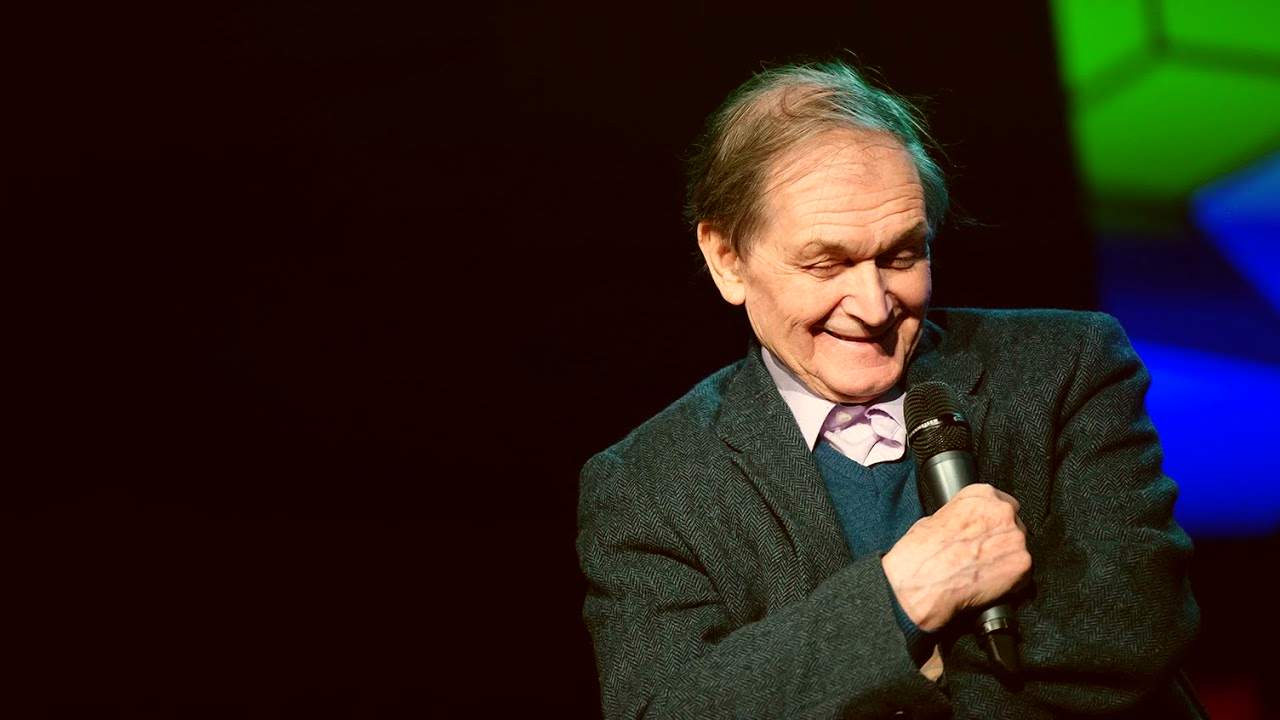
Sir Roger Penrose during an interview with Pioneer Works. Image Credit: PioneerWorks/YouTube[/caption]
Significance of Penrose's discovery
We know, from observing the stars in our galaxy and others, that stars form and die. Stars with a low mass, like our Sun, live for a long time and die as 'white dwarfs'. Bigger stars that are over eight times our Sun's mass, die in a spectacular explosion that we call a supernova. For stars that are much more massive – say, over 20 times the mass of the Sun – the central collapsing core is thought to be much, much larger. The core becomes immensely dense and compact, forming a black hole. This extraordinary event, when a black hole forms, and matter gets crushed to limits beyond the nuclear scale, is a complex one to describe theoretically. It asks for a combination of gravity and quantum physics and mathematics. The closest we can get without this theoretical work is a vague estimate of a black hole’s density, from studying other compact objects in the universe. Only recently was the first direct image of a black hole from a nearby galaxy (M87) captured by astronomers in the globe, in a remarkable feat. However, there's still a huge gap in the modern understanding of black holes. We’re yet to understand the singularity that was present in the beginning, before the big bang which supposedly gave rise to everything in the universe. We also don’t know what happens to an observer that falls into a black-hole singularity. Before the Penrose-Hawking singularity theorems came along in the 70s, singularities were thought to only form in certain situations. For instance, in a supernova explosion where a black hole is formed from the collapse of a star's core, it might be possible for a spinning star to partly counteract its own gravity. It was thought that a singularity wouldn't form under these circumstances – till the Penrose-Hawking singularity theorems disproved this belief. It showed that a singularity is formed in every instance there is an event horizon – the notional boundary around a black hole beyond which no light can escape.
Much-needed recognition for theoretical work
Penrose's Nobel decades overdue?
On a brief visit to the Indian Institute of Astrophysics in 2-9 January 1994, Sir Penrose delivered lectures at an international conference on (non-accelerator) particle physics. We were expecting him to receive a Nobel Prize in the next few years. I was a PhD student in the Institute at the time, and we were elated to hear him speak, and to interact with him. During the conference, Prof Penrose also wrote an article 'On the role of gravity in quantum state reduction' for the Proceedings of the International Conference on Non-Accelerator Particle Physics, edited by IIA's then-director, Prof R Cowsik. Prof Penrose was knighted the same year, for his "services to science". It would take another 26 years for him to win the Nobel Prize for his contributions to the theoretical understanding of black holes. It is heartening to see, despite the delay, that Sir Penrose was recognized by the Nobel Committee.Subramanyan Chandrasekhar, an Indian-origin astrophysicist, received the Nobel Prize for Physics in 1983, for the work he did in the early 1930s. It took about 50 years for the Nobel Committee to recognize his work. Lest we forget that Albert Einstein never won the Nobel Prize for his timeless work on the General Theory of Relativity. Many great theoretical works and discovered are awarded late or missed altogether from consideration for the Nobel Prize.Perhaps this is because Alfred Nobel intended for the prize to be given to those inventions that most benefit mankind?The author is the director of the Indian Institute of Astrophysics, Bangalore, and works in the study of star clusters, stellar evolution and population in galaxies and Magellanic clouds. She tweets at @fiddlingstars
 More from World
After Australia, New Zealand signs defence pact with Papua New Guinea as China expands in Indo-Pacific
Pakistan's deep state weaponising LeT to counter Asim Munir critic Maulana Fazlur Rehman: Report
No premium queues, 30-minute target: What changes for Indian passport applicants in UAE
'We don't need straits': Trump says Iran war isn't about Hormuz as US strikes for 12th night
Iran claims to stop three oil tankers transiting Strait of Hormuz