
Advertisement


Sections
Orlando massacre and the issue of guns: What's the next POTUS' take?
In the wake of the massacre at Pulse nightclub in Orlando, Florida — that claimed 50 lives, US presidential hopefuls Hillary Clinton and Donald Trump made statements that were expectedly as different as chalk and cheese

In the wake of the massacre at Pulse nightclub in Orlando, Florida — that claimed 50 lives, US presidential hopefuls Hillary Clinton and Donald Trump made statements that were expectedly as different as chalk and cheese. And while Clinton chose to focus on themes of sticking by each other, staying true to American values and condemning the free availability of guns, Trump decided to use the occasion to take shots at President Barack Obama, Clinton, West Asia and so on.Without spending too long on their statements, here's the essence of what the likely Democrat presidential nominee had to say:![donkey]() Meanwhile, this is the essence of what the likely Republican presidential nominee Trump had to say:
Meanwhile, this is the essence of what the likely Republican presidential nominee Trump had to say:![elephant]() The most obvious observation here is that while Clinton took the time to address the LGBT community that was unarguably the target of Sunday's attack, Trump referenced the entire community under the umbrella of 'gays' as part of a sentence slamming radical Islam: "Radical Islam advocates hate for women, gays, Jews, Christians and all Americans".But, scratch the surface and you'll find that beyond the peace-making (Clinton) and blame-throwing (Trump) rhetoric is the ever-widening gulf between the views of the Republican and Democratic parties on guns. And according to commentators, the gun issue isn't going to be just an issue in the upcoming US presidential election. It's likely to be the issue. So let's see where Trump and Clinton stand on the matter.At the heart of the matter is the Second Amendment to the US Constitution that states:
The most obvious observation here is that while Clinton took the time to address the LGBT community that was unarguably the target of Sunday's attack, Trump referenced the entire community under the umbrella of 'gays' as part of a sentence slamming radical Islam: "Radical Islam advocates hate for women, gays, Jews, Christians and all Americans".But, scratch the surface and you'll find that beyond the peace-making (Clinton) and blame-throwing (Trump) rhetoric is the ever-widening gulf between the views of the Republican and Democratic parties on guns. And according to commentators, the gun issue isn't going to be just an issue in the upcoming US presidential election. It's likely to be the issue. So let's see where Trump and Clinton stand on the matter.At the heart of the matter is the Second Amendment to the US Constitution that states:
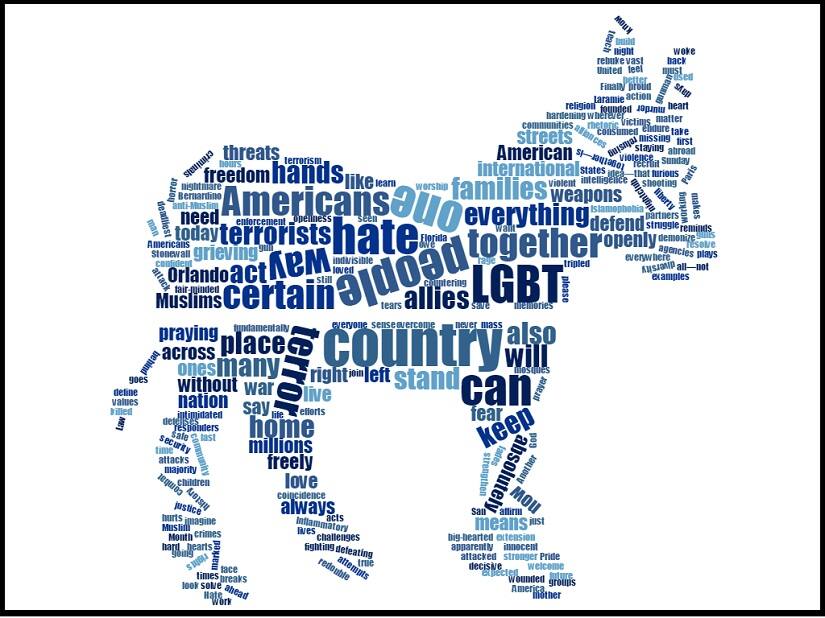 Meanwhile, this is the essence of what the likely Republican presidential nominee Trump had to say:
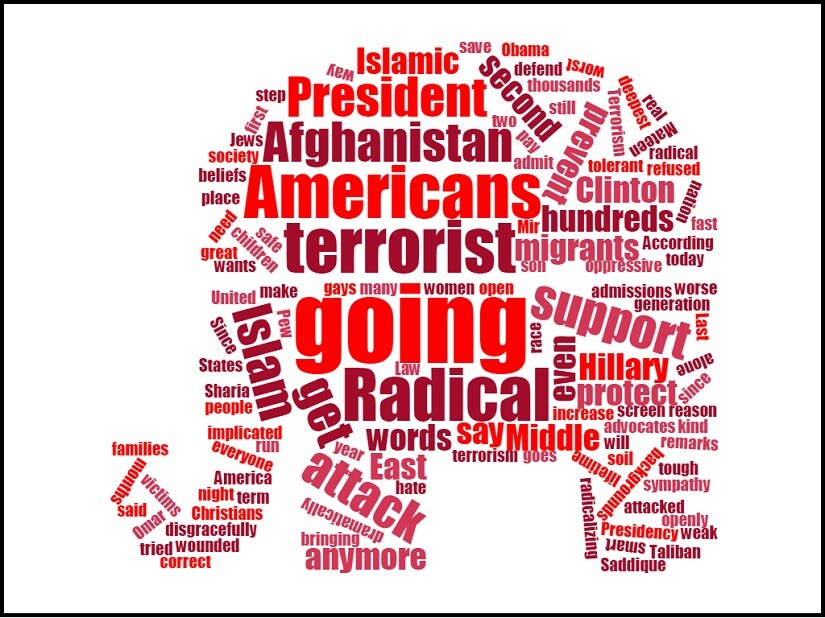 The most obvious observation here is that while Clinton took the time to address the LGBT community that was unarguably the target of Sunday's attack, Trump referenced the entire community under the umbrella of 'gays' as part of a sentence slamming radical Islam: "Radical Islam advocates hate for women, gays, Jews, Christians and all Americans".But, scratch the surface and you'll find that beyond the peace-making (Clinton) and blame-throwing (Trump) rhetoric is the ever-widening gulf between the views of the Republican and Democratic parties on guns. And according to commentators, the gun issue isn't going to be just an issue in the upcoming US presidential election. It's likely to be the issue. So let's see where Trump and Clinton stand on the matter.At the heart of the matter is the Second Amendment to the US Constitution that states:
A well regulated militia being necessary to the security of a free state, the right of the people to keep and bear arms shall not be infringedTo prevent this article from turning into a series of books, we'll sidestep the 'well regulated militia' part and jump straight into the right to bear arms.Both Clinton and Trump have made the topic of arms a key issue in their respective campaigns, with Clinton declaring that 'It is past time we act on gun violence' and Trump announcing that 'Protecting our Second Amendment rights will make America great again'. It's worth noting at this point that Democrats have traditionally taken the position that it is the actual gun that is the problem, Republicans have maintained that it's not the gun but the bearer that is the problem.What's interesting, however, is that they don't have completely opposite positions. Certainly, there are differences between the Clinton and Trump viewpoints on guns, but there is also a key similarity.Both agree that the mentally unwell or 'deranged madmen' must not be allowed to own arms.However this moment of convergence is ephemeral. Clinton advocates that "(the) Bureau of Alcohol, Tobacco, Firearms and Explosives should finalise its rulemaking to close loopholes in our laws and clarify that people involuntarily committed to outpatient treatment... are prohibited from buying guns" (emphasis added). Meanwhile, according to Trump, the need of the hour is to "expand treatment programmes, because most people with mental health problems aren’t violent, they just need help". He cautiously goes on to add, "But for those who are violent, a danger to themselves or others, we need to get them off the street before they can terrorise our communities".Now, the areas of divergence:Clinton seeks to make the process of getting a gun tougher by increasing the number of gun sales that are subject to background checks, while Trump feels the whole system of background checks is flawed and seeks to do away with it altogether.Clinton believes that 'military-style assault weapons' do not belong on American streets, while Trump maintains that it is the opponents of gun rights who invent "scary sounding phrases like 'assault weapons', 'military-style weapons'... to confuse people". He adds that 'law-abiding people should be allowed to own the firearm of their choice'.And then there are those things that only one of the two presidential hopefuls are 'gunning' for:Clinton wants the practice of proxy buying or straw purchasing (when an individual with a clean record buys a gun with the intention of giving it to a violent felon) a federal crime.Trump wants concealed carry permits to be, like driving licences, valid across all 50 states of the USA.Clinton wants 'the gun industry (to be) held accountable for violence perpetrated with their guns' and for gun stores that sell illegal arms or sell arms to felons, to lose their licences.Trump wants to 'empower law-abiding gun owners to defend themselves'.The gun rights versus gun control issue has been brought into sharp focus thanks to the Omar Mateen's heinous actions. But will it influence the election? Only time will tell.
First Published:Jun 14, 2016, 14:26:18 IST
Advertisement
Advertisement

Nawaz Sharif wants to become prime minister of PoK — but laws framed by Pakistan disqualify him
Former Pakistani Prime Minister Nawaz Sharif has said that he would ask his brother, Prime Minister Shehbaz Sharif, to appoint him as the Prime Minister of Pakistan-occupied Jammu and Kashmir (POJK). But the Constitution bars him from making such a move.
2 min read
Fake jobs, tourist visas: Inside Russia’s vast network luring foreigners to fight Ukraine war
Russia is accused of using fake job offers, tourist visas and lucrative military contracts to recruit thousands of foreign nationals for the Ukraine war. Investigations reveal how poverty, deception and coercion have drawn people from Asia, Africa and Latin America into one of the world's deadliest conflicts
8 min read
As Pakistan eyes American dollar for Iran mediation, economists sound the alarm: ‘It can buy time, not growth’
Pakistan is reportedly seeking billions in US support after claiming a role in easing US-Iran tensions, but economists warn fresh funding would offer only temporary relief without deep structural economic reforms.
2 min read
Are Chinese UN peacekeepers spies? Trump’s UN envoy sends out a warning
US UN Envoy Mike Waltz has warned that China has been using United Nations' platforms, such as peacekeeping missions, for espionage. He accused Chinese peacekeepers of serving as the eyes and ears of the Communist Party of China.
2 min read
Why has Bangladesh’s choice of India spokespersons raised eyebrows?
Bangladesh’s appointment of journalists Md Saidur Rahman and Umme Marufa to media roles in New Delhi and Kolkata has triggered controversy over their past anti-India social media posts, many of which were later deleted, prompting diplomatic scrutiny as India and Bangladesh seek to improve bilateral ties
6 min read
Advertisement
Advertisement