


Orangutan in Swedish zoo can predict taste of new drink, just like humans
An orangutan in a Swedish zoo can tell whether a specific new juice mix will taste nice, without having sampled the drink before, by recombining relevant memories from the past, scientists have found. Only humans were previously thought to have this ability

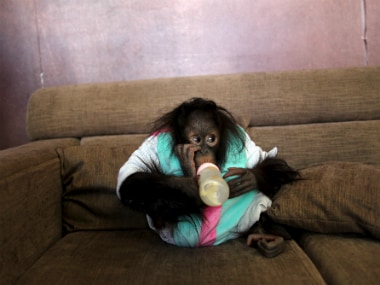
Representational image. Reuters[/caption]All other animals are thought to be stuck in their previous experiences. At best, they should be able to predict that the juice they tasted before will taste the same again.However, they would be unable to realise that a novel mixture of known juices will have new gustatory qualities, which depend on those of the ingredients.Faced with such new situations, animals are expected to be clueless and act by trial-and-error.To examine whether affective forecasting is indeed limited to humans, researchers developed a test to assess how an animal responds to new tastes.The 21-year old male Sumatran orangutan (Pongo abelii) called Naong living at Furuvik Zoo in Sweden was part of the study, as were ten people aged between 20 and 35 years old. The tests among others required all participants toThe tests among others required all participants to mentally construct new juice blends from ingredients they already knew and to predict whether the end products would be enjoyable or not.In the process, they combined four familiar ingredients (cherry, lemon, rhubarb and vinegar) into six drink mixes they had never before tasted.It was found that both the human subjects and the orangutan consistently made choices that reflected their particular taste preferences for the various ingredients.They could mentally integrate relevant memories to generate new liquid blends, and predict whether the end product would be tasty or not. The orangutan's performance in this regard was within the range of that shown by the humans.The animal made consistent choices when confronted with never-before-experienced situations, and did not respond randomly by way of trial-and-error.Most importantly, at the end of the study, the researchers found that these consistent choices matched the orangutan's settled preferences for the mixes.This indicates that his choices in the first encounters with the novel situations were indeed guided by predictions concerning the taste of the never-before-experienced mixes."The orangutan, just like humans, seems to have been able to make hedonic predictions concerning never-before-experienced events," said Sauciuc.The research was published in the journal Animal Cognition.

No premium queues, 30-minute target: What changes for Indian passport applicants in UAE
'We don't need straits': Trump says Iran war isn't about Hormuz as US strikes for 12th night
Iran claims to stop three oil tankers transiting Strait of Hormuz
Globe at a glance: From Houthis striking Saudi tankers in Red Sea to wildfires in Europe
Houthis claim responsibility for attack on two Saudi oil tankers in Red Sea as a new chokepoint emerges