


New Zealand attacks a lesson in right-wing extremism; world must acknowledge link between violence and socioeconomic situation
The lesson from the New Zealand terror attacks is that violence begets violence — Left, Right or otherwise — in an almost linear progression.

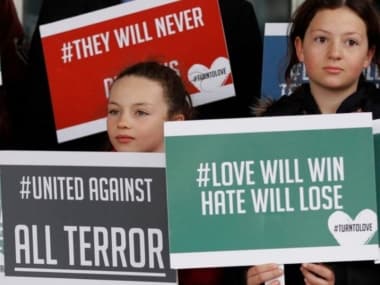
Young demonstrators hold banners from multi-faith group 'Turn to Love' during a vigil at New Zealand House in London. AP[/caption]Cases across the world indicate that a person bent on violence may switch from one religion or cause to another. This is often apparent among cadre of the Islamic State who are in it for the killing rampage. In the UK, for instance, many Islam converts have a criminal and violent past. In the US, there have been instances where white supremacists switched to radical Islamic beliefs before committing murder. Besides, terrorists of any kind — Left, Right or religious — have long been seen to have strikingly similar motivations.First, however, it has to be acknowledged that white supremacist and right-wing attacks have been rising in parts of Europe and the US. In the latter case, the perception of immigrants as the 'other' is often blamed on President Trump's policies, which is centred around building a wall along the Mexico border at present. In many cases, the threat from illegal migration in terms of a rise in crime and violence is real, particularly in border states. But the danger arises from the fact that right-wing supremacist ride on these arguments. This makes it hardly surprising that attacks by this group are rising and could become a serious threat to the US itself.A perceptive article in The Atlantic quoting the respected Anti-Defamation League observes that between 2009 and 2018, right-wing extremists accounted for 73 percent of extremist attacks in the US, dwarfing Islamist terror at 23 percent. Similar figures are reported in the UK, where the police recorded 94,000 hate crimes in 2017, up by 17 percent from previous years. This could well be linked to the horrific terror attacks in that year.Second, there is another rather overlooked factor that must be noted. The statistics referring to this rise of far-right attacks in the UK were also linked to the Brexit debate and immigration. In simple words, in both the UK and the US, as well as other parts of Europe, hate crimes and far-right terror surges during an economic slowdown. Let's not forget that the last surge of right-wing politics was in the mid 1990s, fuelled by an immigrant wave and an economic downturn. With an economic slowdown in Europe, such incidents could increase.To return to the present, a commentary on the violence in New Zealand notes the extreme hopelessness in Christchurch after its destruction in an earthquake in 2011 and the rise of right-wing sentiment, often quite unacknowledged. So yes, a deteriorating social or economic situation adds to the danger.The last issue, however, is equally unacknowledged. The fact is that much of the 'wars' or violent conflicts, where populations have been bombed, strafed or otherwise killed, have been in West and South Asia. The US has been a primary actor in most of these. But there is also the disturbing fact that States like Saudi Arabia, Iran and Pakistan have been equally, if not more, violent on their own and neighbouring Muslim populations. It is hardly an accident that Pakistan remains the 'ground zero' of terrorism, since it has a hand to play in most, if not all, of these conflicts.The lesson is that violence begets violence — racist or otherwise — in an almost linear progression. For instance, nationals from Afghanistan, Syria and Yemen, among others, are viewed with suspicion and often denied entry into most 'white' countries. That process, in turn, increases the perception of these nationals as the 'other', where anyone with a turban is seen as a potential terrorist.Remember that Brenton Tarrant's rant against the world, which was in his 'manifesto', included a hate against all immigrants, including Indians. Indians have never been involved in terrorist attacks anywhere. But hate crimes and their ideology don't deal with facts. It's all sentiment.Indians affected by the attack will grieve the deaths of their relatives, while others will wonder at its logic. However, before Indian commentators throw up their hands at the New Zealand terror attacks, it would do well to acknowledge that the perception of the 'other' is growing in this country, as well.If a white man does the unthinkable, so can a brown one. The hatred runs deep, and like the other such instances, can hardly be blamed on religion. Hinduism, unlike some book-based religions, has nowhere justified attacks on anyone, let alone a small religious minority. The trouble runs deeper and may well again originate in the wallet.

Nawaz Sharif wants to become prime minister of PoK — but laws framed by Pakistan disqualify him
Fake jobs, tourist visas: Inside Russia’s vast network luring foreigners to fight Ukraine war
As Pakistan eyes American dollar for Iran mediation, economists sound the alarm: ‘It can buy time, not growth’
Are Chinese UN peacekeepers spies? Trump’s UN envoy sends out a warning
Why has Bangladesh’s choice of India spokespersons raised eyebrows?