


NASA scientists recreate space dust found in dying stars in lab
NASA scientists have recreated, right here on Earth, dust grains similar to those that form in the outer layers of dying stars.

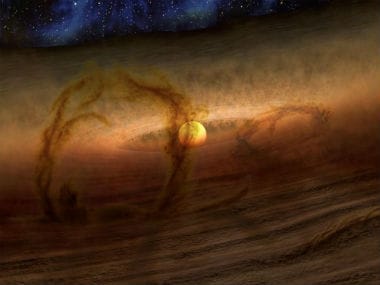
This NASA image obtained March 7, 2014 shows magnetic loops as they carry gas and dust above disks of planet-forming material circling stars as seen in an artist's conception. AFP[/caption]Scientists plan to use the dust to gather clues to better understand the composition and the evolution of the universe.Dust grains that form around dying stars and are ejected into the interstellar medium lead, after a life cycle spanning millions of years, to the formation of planets and are a key component of the universe's evolution.Scientists have found the materials that make up the building blocks of the universe are much more complicated than originally anticipated."The harsh conditions of space are extremely difficult to reproduce in the laboratory, and have long hindered efforts to interpret and analyse observations from space," said Farid Salama, project leader and a space science researcher at Ames."Using the COSmIC simulator we can now discover clues to questions about the composition and the evolution of the universe, both major objectives of NASA's space research programme," Salama said.The team started with small hydrocarbon molecules that it expanded in the cold jet spray in COSmIC and exposed to high energy in an electric discharge.They detected and characterised the large molecules that are formed in the gas phase from these precursor molecules with highly sensitive detectors, then collected the individual solid grains formed from these complex molecules and imaged them using Ames' Scanning Electron Microscope (SEM)."During COSmIC experiments, we are able to form and detect nanoparticles on the order of 10 nm size, grains ranging from 100-500 nanometers and aggregates of grains up to 1.5 micrometres in diameter, about a tenth the width of a human hair, and observe their structure with SEM, thus sampling a large size distribution of the grains produced," said Ella Sciamma-O'Brien, of the BAER Institute and a research fellow at Ames.These results have important implications and ramifications not only for interstellar astrophysics, but also for planetary science, researchers said.For example, they can provide new clues on the type of grains present in the dust around stars. That in turn, will help us understand the formation of planets, including Earth-like planets.PTI

Indian trucker arrested in US over alleged theft of $3 million worth of tungsten powder
Austria turns Hitler’s birthplace into a police station 81 years after his death: 5 things to know
Nawaz Sharif wants to become prime minister of PoK — but laws framed by Pakistan disqualify him
Fake jobs, tourist visas: Inside Russia’s vast network luring foreigners to fight Ukraine war
As Pakistan eyes American dollar for Iran mediation, economists sound the alarm: ‘It can buy time, not growth’