
Advertisement


Sections
Muhammad Ali's flaws make him an even truer hero, why do we need to whitewash him?
The picture that emerges of Ali is of a human being in all his complexity. Dazzlingly brilliant, supremely confident, heroic in fight for his belief and against a disease that affected his body but failed to cripple his will and yet a man who is imperfect, inflammatory and outrageous. Why should that prevent us from celebrating his life?

One of the many reasons why I find Christopher Nolan's Batman Trilogy fascinating is that it does not believe in absolutes. There is no uniform, higher moral standard to adhere to. The British director took his ensembles from the Batman universe and made them humane. Nolan's characters do not have an obligation to be what we want them to be.[caption id="attachment_2816592" align="alignleft" width="380"]![File photo of Muhammad Ali. Reuters]() File photo of Muhammad Ali. Reuters[/caption]You cannot keep his Batman or Joker confined in a comic book. You will meet them in public places, over a game of football or a beer. Nolan's heroes and villains sometimes switch places. The plot evolves and his characters develop. His Batman, for instance, is deeply flawed, replete with hubris and doubts. And to me, that's why he is a truer hero.The mention of Nolan's Batman is necessary in an article about Muhammad Ali because ever since the greatest boxer of all time punched out in style, zettabytes of hagiographies have reduced him to a one-dimensional cardboard character who lived within the confines of a DC Comic strip.In our desperate quest for a pin-up Muslim hero, we have ironically trapped Muhammad Ali into his religious identity. We have turned one of sport's greatest ever champions and truly a remarkable human being into a template of whatever we want him to be. The Ali that I have been reading about ever since he departed resembles less the man he was and more a reflection of our frantic will that seeks to make him mirror our values.Whatever it is, it is not a tribute and the great man deserves better than to be imposed with our insecurities.Muhammad Ali's boxing prowess is only part of the story. He inspired lives, stood like a rock for what he believed in at a great cost to his career and through his life, changed America for good. But he also held politically incorrect and quite regressive views on many issues including women, Jews and whites.While we celebrate the man and his greatness, it is important to understand that denying shades of gray in a human in favour of lily whiteness turns him into a caricature. So let's not pretend that the celebrated boxer didn't say certain things because those do not fit in our hero-worshipping narrative. Why must a person be perfect on all scores to be worthy of admiration?British journalist and TV personality Piers Morgan, in his column for Daily Mail, wrote "Muhammad Ali taught us to dream, dare and fight for what we believe in. That's why he's The Greatest."But Morgan ran into rough weather when he suggested in a series of tweets that Ali was an imperfect genius and had said some very inflammatory, misogynist and blatantly racist things in his lifetime.For his tweets, Morgan has received a volley of abuse from social justice crusaders. His parents, too, were not spared. Closer home, economist and columnist Rupa Subramanya has been at the receiving end of similar bile for pointing out Ali's views on Jews or homosexuality.The abuse and hatred raise the question that why is it so difficult for us to process the information that while Ali was as important to black civil rights movement in the US as perhaps Martin Luther King was, he also had radical views on racism, advocated for hijab and wanted a ban on miscegenation.Or here where Ali advocates that "a real man should throw a woman out if she doesn't listen to him."He was also against interracial sex. “A black man should be killed if he’s messing with a white woman,” he had said. Inside and outside the ring he called black opponents “Uncle Toms” and worse.His association with the Nation of Islam (NoI), an extremist, anti-white religious group has been much documented and many have pointed out — like British newspaper Guardian does here — how his derisive views on the white population of America was actually the NoI and its leader Elijah Muhammad's ideology and he became its most vocal mouthpiece.Be that as it may, some of his comments are still on record such as this interview in August 1969 where he was strongly challenged by David Frost on views that "all Jews and gentiles are the devil" and that "all white people are the devil".In 1974, during an interview with Machael Parkinson, Ali exploded while claiming that he has "no white friends." When the interviewer suggested that the boxer’s trainer for 14 years — Angelo Dundee — might be a friend, Ali insisted, gruffly: “He is an associate. You say I got white friends, I say they are associates.”It must be equally pointed out that by 1975, Ali had converted to the far more conventional Sunni Islam and over the years he mellowed substantially, became more well-rounded and evolved as a an empathetic human being.When Wall Street Journal reporter Daniel Pearl was kidnapped by Islamic extremists in January 2002, Ali had famously pleaded for his release and life. “I appeal to you to show Daniel Pearl compassion and kindness,” Ali had implored Pearl’s abductors, who eventually beheaded the journalist in Pakistan.The picture that emerges of Ali is of a human being in all his complexity. Dazzlingly brilliant, supremely confident, heroic in fight for his belief and against a disease that affected his body but failed to cripple his will and yet a man who is imperfect, inflammatory and outrageous. Why should that prevent us from celebrating his life? His flaws only serve to make him more of a hero. Why should we whitewash him?
File photo of Muhammad Ali. Reuters[/caption]You cannot keep his Batman or Joker confined in a comic book. You will meet them in public places, over a game of football or a beer. Nolan's heroes and villains sometimes switch places. The plot evolves and his characters develop. His Batman, for instance, is deeply flawed, replete with hubris and doubts. And to me, that's why he is a truer hero.The mention of Nolan's Batman is necessary in an article about Muhammad Ali because ever since the greatest boxer of all time punched out in style, zettabytes of hagiographies have reduced him to a one-dimensional cardboard character who lived within the confines of a DC Comic strip.In our desperate quest for a pin-up Muslim hero, we have ironically trapped Muhammad Ali into his religious identity. We have turned one of sport's greatest ever champions and truly a remarkable human being into a template of whatever we want him to be. The Ali that I have been reading about ever since he departed resembles less the man he was and more a reflection of our frantic will that seeks to make him mirror our values.Whatever it is, it is not a tribute and the great man deserves better than to be imposed with our insecurities.Muhammad Ali's boxing prowess is only part of the story. He inspired lives, stood like a rock for what he believed in at a great cost to his career and through his life, changed America for good. But he also held politically incorrect and quite regressive views on many issues including women, Jews and whites.While we celebrate the man and his greatness, it is important to understand that denying shades of gray in a human in favour of lily whiteness turns him into a caricature. So let's not pretend that the celebrated boxer didn't say certain things because those do not fit in our hero-worshipping narrative. Why must a person be perfect on all scores to be worthy of admiration?British journalist and TV personality Piers Morgan, in his column for Daily Mail, wrote "Muhammad Ali taught us to dream, dare and fight for what we believe in. That's why he's The Greatest."But Morgan ran into rough weather when he suggested in a series of tweets that Ali was an imperfect genius and had said some very inflammatory, misogynist and blatantly racist things in his lifetime.For his tweets, Morgan has received a volley of abuse from social justice crusaders. His parents, too, were not spared. Closer home, economist and columnist Rupa Subramanya has been at the receiving end of similar bile for pointing out Ali's views on Jews or homosexuality.The abuse and hatred raise the question that why is it so difficult for us to process the information that while Ali was as important to black civil rights movement in the US as perhaps Martin Luther King was, he also had radical views on racism, advocated for hijab and wanted a ban on miscegenation.Or here where Ali advocates that "a real man should throw a woman out if she doesn't listen to him."He was also against interracial sex. “A black man should be killed if he’s messing with a white woman,” he had said. Inside and outside the ring he called black opponents “Uncle Toms” and worse.His association with the Nation of Islam (NoI), an extremist, anti-white religious group has been much documented and many have pointed out — like British newspaper Guardian does here — how his derisive views on the white population of America was actually the NoI and its leader Elijah Muhammad's ideology and he became its most vocal mouthpiece.Be that as it may, some of his comments are still on record such as this interview in August 1969 where he was strongly challenged by David Frost on views that "all Jews and gentiles are the devil" and that "all white people are the devil".In 1974, during an interview with Machael Parkinson, Ali exploded while claiming that he has "no white friends." When the interviewer suggested that the boxer’s trainer for 14 years — Angelo Dundee — might be a friend, Ali insisted, gruffly: “He is an associate. You say I got white friends, I say they are associates.”It must be equally pointed out that by 1975, Ali had converted to the far more conventional Sunni Islam and over the years he mellowed substantially, became more well-rounded and evolved as a an empathetic human being.When Wall Street Journal reporter Daniel Pearl was kidnapped by Islamic extremists in January 2002, Ali had famously pleaded for his release and life. “I appeal to you to show Daniel Pearl compassion and kindness,” Ali had implored Pearl’s abductors, who eventually beheaded the journalist in Pakistan.The picture that emerges of Ali is of a human being in all his complexity. Dazzlingly brilliant, supremely confident, heroic in fight for his belief and against a disease that affected his body but failed to cripple his will and yet a man who is imperfect, inflammatory and outrageous. Why should that prevent us from celebrating his life? His flaws only serve to make him more of a hero. Why should we whitewash him?
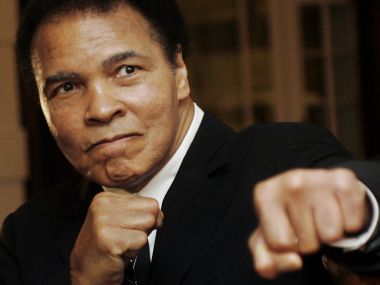 File photo of Muhammad Ali. Reuters[/caption]You cannot keep his Batman or Joker confined in a comic book. You will meet them in public places, over a game of football or a beer. Nolan's heroes and villains sometimes switch places. The plot evolves and his characters develop. His Batman, for instance, is deeply flawed, replete with hubris and doubts. And to me, that's why he is a truer hero.The mention of Nolan's Batman is necessary in an article about Muhammad Ali because ever since the greatest boxer of all time punched out in style, zettabytes of hagiographies have reduced him to a one-dimensional cardboard character who lived within the confines of a DC Comic strip.In our desperate quest for a pin-up Muslim hero, we have ironically trapped Muhammad Ali into his religious identity. We have turned one of sport's greatest ever champions and truly a remarkable human being into a template of whatever we want him to be. The Ali that I have been reading about ever since he departed resembles less the man he was and more a reflection of our frantic will that seeks to make him mirror our values.Whatever it is, it is not a tribute and the great man deserves better than to be imposed with our insecurities.Muhammad Ali's boxing prowess is only part of the story. He inspired lives, stood like a rock for what he believed in at a great cost to his career and through his life, changed America for good. But he also held politically incorrect and quite regressive views on many issues including women, Jews and whites.While we celebrate the man and his greatness, it is important to understand that denying shades of gray in a human in favour of lily whiteness turns him into a caricature. So let's not pretend that the celebrated boxer didn't say certain things because those do not fit in our hero-worshipping narrative. Why must a person be perfect on all scores to be worthy of admiration?British journalist and TV personality Piers Morgan, in his column for Daily Mail, wrote "Muhammad Ali taught us to dream, dare and fight for what we believe in. That's why he's The Greatest."But Morgan ran into rough weather when he suggested in a series of tweets that Ali was an imperfect genius and had said some very inflammatory, misogynist and blatantly racist things in his lifetime.For his tweets, Morgan has received a volley of abuse from social justice crusaders. His parents, too, were not spared. Closer home, economist and columnist Rupa Subramanya has been at the receiving end of similar bile for pointing out Ali's views on Jews or homosexuality.The abuse and hatred raise the question that why is it so difficult for us to process the information that while Ali was as important to black civil rights movement in the US as perhaps Martin Luther King was, he also had radical views on racism, advocated for hijab and wanted a ban on miscegenation.
First Published:Jun 06, 2016, 14:37:55 IST
Advertisement
Advertisement

Epstein's model scout Daniel Siad found dead at his home near Paris amid rape case trial
A modelling scout who recruited women for the late sex offender Jeffrey Epstein has been found dead at his home in Paris.
2 min read
South China Sea tensions rise as China claims it expelled Philippine ships
China said on Thursday it tracked and drove away two Philippine vessels it accused of having "intruded into" waters near the disputed Scarborough Shoal despite warnings
1 min read
Choke terror funding, keep international shipping lanes safe: Jaishankar at Asean Regional Forum
Jaishankar's remarks came against the backdrop of recent terror attacks targeting India and growing threats to commercial shipping amid conflicts in West Asia and Europe
2 min read
After Australia, New Zealand signs defence pact with Papua New Guinea as China expands in Indo-Pacific
After Australia, New Zealand has signed a defence cooperation agreement with Papua New Guinea. This is the latest agreement that countries in the region have signed to integrate themselves closer on security and defence as Chinas has sought to increase its footprint in the Indo-Pacific and the United States, the traditional guarantor of security, has abandoned the theatre.
2 min read
Pakistan's deep state weaponising LeT to counter Asim Munir critic Maulana Fazlur Rehman: Report
A deepening military-terror nexus is reportedly emerging in Pakistan in a bid to neutralise the JUI-F chief, Maulana Fazlur Rehman, after he openly criticised Pakistan's Army Chief Asim Munir.
2 min read
Advertisement
Advertisement