


Latin America grappling with a 'decline of democracy' under coronavirus pandemic
The gradual undermining of democratic rules during an economic crisis and a public health catastrophe could leave Latin America primed for slower growth and an increase in corruption and human rights abuses

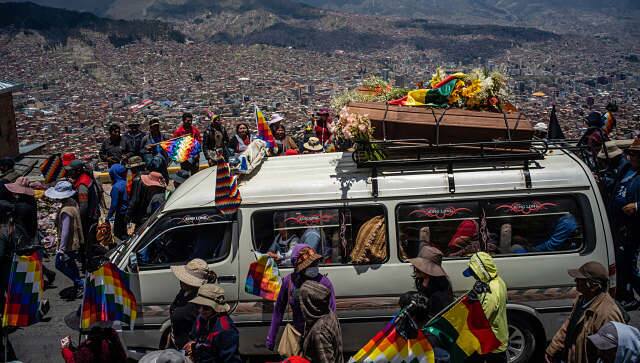
File image of coffins of demonstrators killed in clashes between protesters and government forces being carried during a funeral procession and protest march in La Paz, Bolivia. By Federico Rios © 2020 The New York Times[/caption]Discontent with the political establishment led to a wave of populist victories in recent years, including those of President Jair Bolsonaro of Brazil, who is on the far-right, and President Andrés Manuel López Obrador of Mexico, who is on the left. It also led to mass street protests in several Latin American countries last year.The pandemic, hitting during this time of political upheaval, has plunged the region into the deepest recession in its history, exacerbating weaknesses in health and welfare systems and highlighting the ways in which many leaders are unable to meet public demands.“All the things that Latin Americans have already been clamouring for — greater equality, better services — have been dramatically worsened by the pandemic,” said Cynthia Arnson, Latin America program director at the Wilson Centre, a think-tank in Washington. “The economic pain is dramatic, and it’s putting additional strain on the already weak institutions.”It has also put a strain on the region’s struggling health care systems. Latin America has become a global hot spot for the virus, with Brazil, Mexico and Peru among the 10 nations with the highest numbers of deaths. And according to the United Nations, about 16 million people in Latin America are expected to fall into extreme poverty this year, reversing nearly all of the gains made by the region this century.Adding to those challenges, democracy in Latin America has also lost a champion in the United States, which had played an important role in promoting democracy after the end of the Cold War by financing good governance programs and calling out authoritarian abuses.Under President Donald Trump, the United States has mostly focussed regional policy on opposing left-wing autocrats in Venezuela and Cuba and curbing immigration, making aid to Central American nations, among the region’s poorest, contingent on cooperating with the administration on immigration.The Trump administration also refrained from commenting when Nayib Bukele, president of El Salvador, ignored Supreme Court rulings and used the military to crack down on quarantine violators during the pandemic.US support for democracy initiatives in Latin America fell by almost half last year to $326 million, according to preliminary figures compiled by the US Agency for International Development.“In the last few years we have not only abandoned our role as a democratising force in Latin America and the world, but we have promoted negative forces,” said Orlando Pérez, a political scientist at the University of North Texas. “Our policy is now: ‘You’re on your own — America first.’ ”In the few democratic strongholds in Latin America, such as Uruguay and Costa Rica, leaders responded to the pandemic with efficiency and transparency, bolstering public trust in the government. In the Dominican Republic and Suriname, incumbent presidents recently bowed out of power after losing elections that were held despite the pandemic.In many instances, judges and civil servants have resisted the attacks on democratic institutions during the pandemic, said Javier Corrales, a professor of Latin American studies at Amherst College in Massachusetts. “The defenders of liberal democracy in Latin America are not defeated,” Corrales said. “It’s not an open terrain for would-be authoritarians.”Yet in most Latin American nations, the coronavirus accelerated an existing democratic decline by exposing the weakness and corruption of governments in the face of the catastrophe.“When confronted with an existential threat, countries that did not already have deep democratic systems are choosing tactics that help leaders consolidate their power,” said John Polga-Hecimovich, a political scientist at the US Naval Academy in Maryland.The political tensions gripping the region during the pandemic could be just the beginning of a longer wave of unrest and authoritarianism, said Thomas Carothers, a fellow at the Carnegie Endowment for International Peace. “It will drag the region down into poorer economic performance,” he said. “It also means poorer treatment of human beings, their dignity and rights.”Anatoly Kurmanaev c.2020 The New York Times Company

US set to announce new tariff plan as temporary 10% duty nears expiry
India rejects Pakistan's 'baseless' claims at Asean, says Indus Waters Treaty to remain on hold
Indian trucker arrested in US over alleged theft of $3 million worth of tungsten powder
Austria turns Hitler’s birthplace into a police station 81 years after his death: 5 things to know
Nawaz Sharif wants to become prime minister of PoK — but laws framed by Pakistan disqualify him