
Advertisement


Sections
Key events in Turkey under President Erdogan: A timeline
Elements of the Turkish military backed by tanks staged an attempted coup Friday night against the government of President Recep Tayyip Erdogan.

Elements of the Turkish military backed by tanks staged an attempted coup Friday night against the government of President Recep Tayyip Erdogan.Here are the key dates and events since the ruling Justice and Development Party (AKP), which Erdogan founded, came to power:2002 The AKP scores its first electoral victory in November after years of political instability and an unprecedented financial crisis. The victory sets off alarm bells in the secular establishment. Its leader Recep Tayyip Erdogan becomes prime minister the following year.2004The AKP launches a vast range of democratic reforms, such as allowing Kurdish language broadcasts on public television.2005Turkey begins accession talks with the EU in October.2007In the spring, a political crisis erupts after the AKP names Abdullah Gul as its candidate for president. The army cites concerns over secularism, triggering early elections.The AKP wins the July vote. Erdogan remains prime minister and a month later, parliament elects Gul as president. The government progressively brings the army to heel.2008The AKP initiates a constitutional amendment to lift the ban on the Islamic headscarf at universities but it is annulled by the constitutional court.The AKP narrowly escapes a dissolution by court order for anti-secular activities and the headscarf ban is progressively eased from 2010.[caption id="attachment_2896504" align="alignleft" width="380"]
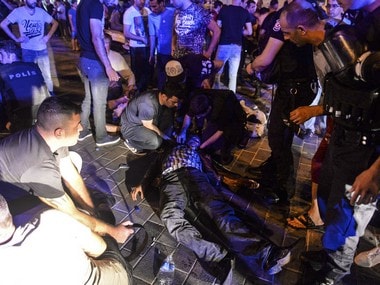 Representational image.AP[/caption]2011In June, the AKP wins its third consecutive election. Erdogan begins a third term as premier, the last mandate according to AKP rules.2012In June, Syria shoots down a Turkish fighter jet. Other incidents follow. Ankara broke off relations with Damascus after the start of the conflict in March 2011, supporting the rebels and admitting Syrian refugees — who number some 2.7 million in 2016.2013In March, the leader of the outlawed Kurdistan Workers' Party (PKK), Abdullah Ocalan, announces a ceasefire after secret negotiations with Ankara.In May, demonstrators stage a rally against government plans to redevelop a park near Istanbul's Taksim square. The protest quickly grows into wider nationwide demonstrations against Erdogan throughout June, leaving eight dead and thousands injured after a brutal police crackdown.In November, a feud emerges between Erdogan and exiled influential US-based Muslim cleric Fethullah Gulen.In December, the government becomes engulfed in a corruption scandal with the arrests of key Erdogan allies.2014Turkish authorities arrest thousands of police and prosecutors believed to be linked to Gulen and place curbs on the judiciary and the Internet.The AKP wins local elections in March.In May, a mine disaster claims 301 lives, sparking new anti-government protests that are violently repressed.In August, Erdogan wins the presidential election — the first popular vote for the post — with 52 percent.2015The AKP wins most votes in a 7 June election, but loses its parliamentary majority, ending almost 13 years of single party rule.In July, several dozen people are killed in an attack in a mainly Kurdish town on the Syrian border. Turkey launches air strikes on IS targets in Syria and PKK militants in northern Iraq. A wave of violence is unleashed between Kurdish rebels and Turkish security forces. Turkey joins the US-led coalition fighting IS the following month.In August, Erdogan schedules fresh elections for 1 November to break weeks of political stalemate.Twin suicide bomb blasts in Ankara on October 10 kill 102 people at pro-Kurdish opposition peace rally.The AKP recaptures its parliamentary majority in November elections.2016In May, Prime Minister Binali Yildirim forms a government loyal to Erdogan, after Ahmet Davutoglu stepped down following a power struggle with the president.Turkey manoeuvres an end to foreign policy disputes with Israel and Russia.On 28 June, 47 people are killed in a triple suicide bombing at Istanbul airport, which authorities blame on IS jihadists. Attacks over the last year in Istanbul and Ankara have left almost 200 dead and thousands wounded.
First Published:Jul 16, 2016, 11:54:19 IST
Advertisement
Advertisement

India rejects Pakistan's 'baseless' claims at Asean, says Indus Waters Treaty to remain on hold
India accused Pakistan of misusing the Asean Regional Forum to spread false narratives, reiterating that the Indus Waters Treaty will remain suspended until Islamabad credibly and irrevocably ends cross-border terrorism.
1 min read
Indian trucker arrested in US over alleged theft of $3 million worth of tungsten powder
A 39-year-old Indian national living illegally in the US has been arrested in California after authorities alleged he stole a truck carrying nearly $3 million worth of hazardous tungsten powder.
1 min read
Austria turns Hitler’s birthplace into a police station 81 years after his death: 5 things to know
Austrian authorities inaugurated a police station at the birthplace of Adolf Hitler after years of debate around the site’s troubled legacy.
3 min read
Nawaz Sharif wants to become prime minister of PoK — but laws framed by Pakistan disqualify him
Former Pakistani Prime Minister Nawaz Sharif has said that he would ask his brother, Prime Minister Shehbaz Sharif, to appoint him as the Prime Minister of Pakistan-occupied Jammu and Kashmir (POJK). But the Constitution bars him from making such a move.
2 min read
Fake jobs, tourist visas: Inside Russia’s vast network luring foreigners to fight Ukraine war
Russia is accused of using fake job offers, tourist visas and lucrative military contracts to recruit thousands of foreign nationals for the Ukraine war. Investigations reveal how poverty, deception and coercion have drawn people from Asia, Africa and Latin America into one of the world's deadliest conflicts
8 min read
Advertisement
Advertisement