


J&K water dispute: India registers diplomatic victory over Pak
It is a diplomatic news that will inevitably be lost in the din and chatter over the Devyani Khobragade case despite India’s victory vis a vis Pakistan.

It is a diplomatic news that will inevitably be lost in the din and chatter over the Devyani Khobragade case despite India’s victory vis a vis Pakistan.[caption id="attachment_1301077" align="alignleft" width="380"]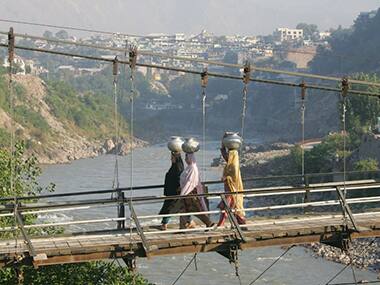 Pakistan accused India of trying to divert the river to harm Pakistan's Neelum-Jhelum hydro-electric project. AFP[/caption]On 20 December night India received the “Final Award” and the “Courts decision on India’s request for Clarification” wherein the Hague-based International Court of Arbitration has rejected Pakistan's objections by upholding India’s right to divert water from the Kishenganga river (called Neelum in Pakistan) for power generation in Jammu and Kashmir.The Hague-based international court had given its “Partial Award” in February this year, wherein it had upheld India’s main contention that it has the right to divert waters of the western rivers, in a non-consumptive manner, for the optimal generation of power. The final award is binding upon the two sides (India and Pakistan) without recourse to appeal.Pakistan’s reaction to the final award is rather interesting, if not queer. Pakistan’s Water Minister Khwaja Asif claimed a “big victory” through the court’s ruling and remarked on 21 December thus: “Pakistan has achieved a big victory (as) International Court of Arbitration has accepted Pakistan’s right as a riparian state to waters of Kishanganga. Similarly Pakistan’s right over waters of Jhelum and Chenab rivers is also established... The decision will safeguard our water rights in future also.”Pakistan welcomed the ICA verdict and hailed it as a victory considering that the court also ruled that India cannot take the water on a very low level in the dam.Pakistan’s reaction is understandable as it has no recourse to appeal. This perfectly suits India. After all, India’s reaction should be something like this: Let them feel happy and victorious if they feel that way as long as we have got what wanted to get from the ICA.On 17 May, 2010, Pakistan had moved for arbitration against India under the provisions of the Indus Waters Treaty 1960, claiming that India’s 330 MW Kishenganga project would rob it of 15 percent of its share of river waters.Pakistan accused India of trying to divert the river to harm Pakistan's Neelum-Jhelum hydro-electric project (NJHEP) and had objected to the construction of the Kishanganga hydroelectric project arguing that the Indian project would affect its 969 MW Neelum-Jhelum hydroelectric project.The neutral nature of the seven-member ICA that pronounced the final award can be gauged by the fact that it was chaired by judge Stephen M Schwebel of the US, who is former president of the International Court of Justice, while the other members of the court were Franklin Berman and Howard S Wheater (UK), Lucius Caflisch (Switzerland), Jan Paulsson (Sweden) and judges Bruno Simma (Germany) and Peter Tomka (Slovakia).Significantly, the ICA has also ruled that both India and Pakistan may seek "reconsideration" of its decision through the Permanent Indus Commission and the mechanisms of the Indus Waters Treaty "after a period of seven years from the first diversion of water from the Kishenganga river."It is here that the Indians can rightly claim a resounding diplomatic victory over Pakistan. The ICA’s final award specifies that an amount of 9 cumecs of natural flow of water must be maintained in the Kishenganga river at all times, to maintain the environment downstream. This is much lower than the 100 cumecs of natural flow that Pakistan wanted to maintain.The Indians should derive succor from the court’s observation that India had "coupled intent with action" in the planning and construction of the KHEP (Kishenganga project) before Pakistan achieved the same with respect to NJHEP (the Pakistani hydel project over Neelum), and that the KHEP had acquired "priority in right" as a result.The Kishenganga victory is an icing on the cake for India’s diplomatic wins over Pakistan on the international stage with regard to disputes over India’s strategy of exploiting its water resources for power generation in the state of Jammu and Kashmir.Pakistan had raised similar objection to the Baglihar dam, a run-of-the-river project in Doda district of Jammu and Kashmir and had gone to the World Bank (a broker and signatory of Indus Water Treaty) for arbitration after several rounds of talks between the two sides from 1999 to 2004 proved to be a dialogue of the deaf.Baglihar dam was a much more ambitious hydel power project with huge strategic connotations for India. It is a 900 MW hydel project with a price tag of over a billion dollars.India pocketed a major victory over the Baglihar dam on 12 February 2007 when the World Bank adjudicator Raymond Lafitte, a Swiss civil engineer, gave his final verdict, rejecting Pakistan’s objections on height and gated control of the dam’s spillways. On the Baglihar issue too Pakistan had to eat a humble pie and was left with no option but to honour the verdict and not raise the issue any further.One good thing in Pakistan proclaiming its victory over the ICA final award on the Kishenganga project is that the neighbour has learnt to accept the court verdict happily. As for Pakistan’s claims of victory in the Kishenganga case, India should have no problem in allowing the Pakistanis to score some brownie points.The writer is a Firstpost columnist and a strategic analyst who tweets @Kishkindha.
Consulting Editor, Firstpost. Strategic analyst. Political commentator. Twitter handle @Kishkindha.

Epstein's model scout Daniel Siad found dead at his home near Paris amid rape case trial
South China Sea tensions rise as China claims it expelled Philippine ships
Choke terror funding, keep international shipping lanes safe: Jaishankar at Asean Regional Forum
After Australia, New Zealand signs defence pact with Papua New Guinea as China expands in Indo-Pacific
Pakistan's deep state weaponising LeT to counter Asim Munir critic Maulana Fazlur Rehman: Report