


Japan's Takaaki Kajita, Canada's Arthur McDonald win Nobel Prize in Physics
Takaaki Kajita of Japan and Arthur McDonald of Canada have won the Nobel Prize in Physics for the discovery of neutrino oscillations.

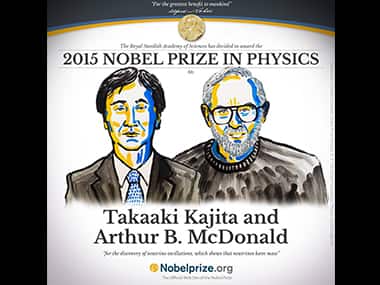
Image courtesy: Nobel Prize Facebook page[/caption]The Royal Swedish Academy of Sciences said the two researchers had made key contributions to experiments showing that neutrinos change identities.Neutrinos are particles that whiz through the universe at nearly the speed of light. They are created in nuclear reactions, such as in the sun and the stars, or in nuclear power plants."The discovery has changed our understanding of the innermost workings of matter and can prove crucial to our view of the universe," the academy said.Kajita, 56, is director of the Institute for Cosmic Ray Research and professor at the University of Tokyo. McDonald, 72, is a professor emeritus at Queen's University in Kingston, Canada.The winners will split the 8 million Swedish kronor (about $960,000) prize money. Each winner also gets a diploma and a gold medal at the prize ceremony on 10 December.On Monday, the Nobel Prize in medicine went to scientists from Japan, the US and China who discovered drugs that are now used to fight malaria and other tropical diseases.The prize announcements continue with chemistry on Wednesday, literature on Thursday, the Nobel Peace Prize on Friday and the economics award next Monday.Associated Press

Fake jobs, tourist visas: Inside Russia’s vast network luring foreigners to fight Ukraine war
As Pakistan eyes American dollar for Iran mediation, economists sound the alarm: ‘It can buy time, not growth’
Are Chinese UN peacekeepers spies? Trump’s UN envoy sends out a warning
Why has Bangladesh’s choice of India spokespersons raised eyebrows?
Indian judo contender withdrawn from 2026 Commonwealth Games after failed dope test