


Ireland's hospital staff failed to adequately assess Savita: Report
Staff at an Irish hospital failed to adequately assess and monitor Indian dentist Savita Halappanavar who died after suffering a miscarriage, a key report on her death said today and warned that such incidents could happen again in the absence of clarity on abortion law.

London: Staff at an Irish hospital failed to adequately assess and monitor Indian dentist Savita Halappanavar who died after suffering a miscarriage, a key report on her death said today and warned that such incidents could happen again in the absence of clarity on abortion law.A clinical inquiry into the death of Savita, which was published today, found that the most likely cause of her death was infection- with the risk of infection and sepsis increasing after her waters broke.Savita had died of septicaemia in her 17th week of pregnancy at University Hospital Galway and an inquest into her death held in April heard that she had been denied a potentially life-saving termination on the grounds that Ireland is a "Catholic country".[caption id="attachment_869887" align="alignleft" width="380"]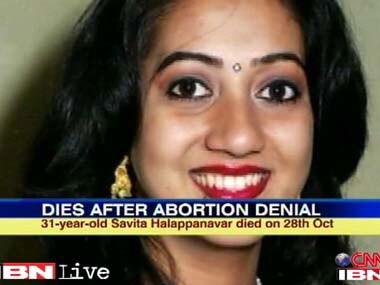 Courtesy: ibn live[/caption]Savita was admitted to the hospital on October 21. Her husband Praveen Halappanavar said his wife had repeatedly asked for a termination but was refused because a foetal heartbeat was present.It was several hours before the decision to terminate her pregnancy was taken, but by this stage it was too late. The review said there had been an over-emphasis on the need to not intervene until the foetal heartbeat stopped and not enough emphasis on the need to focus on monitoring and managing the risk of infection.Professor of obstetrics and gynaecology Sir Sabaratnam Arulkumaran, who headed the review commissioned by the Health Service Executive (HSE), said the plan in her case had been to "await events", which he said was appropriate so long as it is not a risk to the mother or unborn baby.HSE says clinical staff at Galway University Hospital failed to properly assess or monitor dying woman s condition Delaying adequate treatment including expediting delivery in a clinical situation where there is prolonged rupture of the membranes and increasing risk to the mother can, on occasion, be fatal.It was found that the diagnosis of sepsis secondary to chorioamnionitis or septic shock should have merited expediting delivery to reduce risk of infection."The gravity of the situation was increasing but appears not to have been recognised and acted upon," it said. "This was a complex clinical situation and a request for advice/support from a consultant and other specialities would have been beneficial.He also said the situation team was complicated "by the difficult association with the application of the law in Ireland relating to the termination of a pregnancy".PTI

India rejects Pakistan's 'baseless' claims at Asean, says Indus Waters Treaty to remain on hold
Indian trucker arrested in US over alleged theft of $3 million worth of tungsten powder
Austria turns Hitler’s birthplace into a police station 81 years after his death: 5 things to know
Nawaz Sharif wants to become prime minister of PoK — but laws framed by Pakistan disqualify him
Fake jobs, tourist visas: Inside Russia’s vast network luring foreigners to fight Ukraine war