


In Thailand, discontent of pro-democracy protesters bubbles over as government battens down hatches
Thai political history is littered with army coups that have nullified the results of national elections. The last coup, in 2014, was followed by the passage of an army-drafted Constitution that has eroded democratic institutions further. The Senate, for instance, is now entirely appointed.

“As humans, no one is bigger than anyone,” he added. “No one has power more than others.”Dozens of protest leaders, many students, have been arrested in recent weeks and charged with crimes like sedition that carry imprisonment for up to seven years. Early Thursday, at least three protest leaders, Arnon Nampa, Parit Chirawat and Panupong Jadnok, were arrested, according to the Thai Lawyers for Human Rights group. Each had been arrested before.The rally Wednesday also brought out large numbers of royalist counterprotesters in yellow shirts symbolising their loyalty to the king. Some had the matching buzz cuts often worn by members of the security forces, suggesting that their defence of the Thai crown was an official duty rather than a personal mission.As the crowds for both sides swelled Wednesday, some people in a country conditioned to regular bouts of political violence feared that clashes might break out. But aside from a few scuffles, the anti-government rally, which pushed past barricades to march toward Government House, was peaceful.Before the police swept away the protesters Thursday, they had planned to stay on the streets for at least three days.King Maha Vajiralongkorn is now back in Bangkok for weeks, a rarity for a monarch who normally spends no more than a couple of days in the country he reigns over.Last week, Heiko Maas, the German foreign minister, called into question the Thai king’s engagement in politics while living in Germany.“We have made it clear that politics concerning Thailand should not be conducted from German soil,” Maas said in a parliamentary session.Street protests have regularly gripped Thailand over the past two decades. The security crackdowns on some of those mass rallies have been bloody, with dozens of people killed. Over the past few years, outspoken dissidents who fled overseas after criticising the monarchy and the military have disappeared. Some of their bodies have washed up with obvious signs of foul play.“Thailand’s international friends should call on the government to stop arresting peaceful protesters, listen to their views, and allow them to freely and safely express their visions for the future,” Brad Adams, Asia director for Human Rights Watch, said in a statement.The security presence Wednesday was formidable. About 15,000 police were dispatched to the protest area near Democracy Monument, built to commemorate the end of absolute monarchy in 1932. Public buses were parked to block the path toward Government House.[caption id="attachment_8916201" align="alignnone" width="640"]
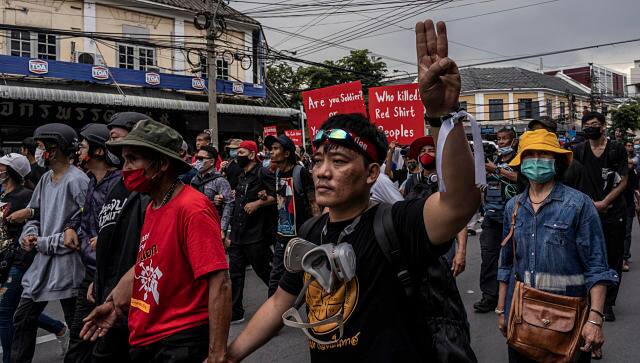
Anti-government protesters during a march from Democracy Monument to Government House in Bangkok on Wednesday. By Adam Dean © 2020 The New York Times[/caption]Thai political history is littered with army coups that have nullified the results of national elections. The junta leaders that conceived of the past two putsches justified their actions as necessary to protect the monarchy from naysayers. The last coup, in 2014, was followed by the passage of an army-drafted Constitution that has eroded democratic institutions further. The Senate, for instance, is now entirely appointed.The protesters have called for a new charter and for fresh elections, after a national vote last year that was dismissed by some international observers as neither free nor fair.“We have been imprisoned in a special prison called Thailand for a long time,” said Attapon Buapat, another protest speaker.The protest movement has woven together disparate strands of dissatisfaction, ranging from frustration with school uniform rules to anger at the lavish lifestyle of the king at a time when a coronavirus ban on international tourism has hit Thailand’s economy hard.The date of the protest on Wednesday evoked a student-led uprising on 14 October, 1973, that led to the toppling of a military dictatorship. During the turmoil, under the reign of the current king’s father, the gates to one of the royal palaces were opened to shelter students fleeing the gunfire.Three years later, however, security forces and paramilitary mobs killed scores of student protesters. Right-wing rule was restored to Thailand.On Wednesday evening, after dark fell, a group of protesters tried to extend part of the rally toward a royal palace. But rows of yellow-shirted royalists stood guard. The protesters fell back. By Thursday morning, they were all gone.Panusaya Sithijirawattanakul, a protest leader who has been one of the fiercest critics of the monarchy’s role in Thai society, even as she has cautioned that she does not want the royal institution overthrown, said Thursday morning that the right to free assembly should be guaranteed in a democracy.“It is the fundamental right of all human beings from birth,” said Panusaya, who was arrested later Thursday morning. “The emergency decree could be interpreted as the monarchy setting itself up as an opponent of democracy.”Hannah Beech and Muktita Suhartono c.2020 The New York Times Company

Indian trucker arrested in US over alleged theft of $3 million worth of tungsten powder
Austria turns Hitler’s birthplace into a police station 81 years after his death: 5 things to know
Nawaz Sharif wants to become prime minister of PoK — but laws framed by Pakistan disqualify him
Fake jobs, tourist visas: Inside Russia’s vast network luring foreigners to fight Ukraine war
As Pakistan eyes American dollar for Iran mediation, economists sound the alarm: ‘It can buy time, not growth’