


Hurricane Nate hits US Gulf Coast: Downpour brings floods, power outages; storm weakens after landfall
Hurricane Nate brought a burst of flooding and power outages to the US Gulf Coast before weakening rapidly, sparing the region the kind of catastrophic damage left by a series of hurricanes that hit the southern US and Caribbean in recent weeks.

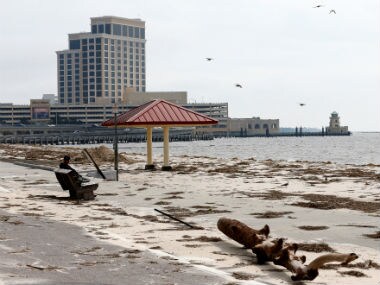
Hurricane Nate hit Mississippi coast on Saturday. Reuters[/caption]As of last evening, Alabama Power said it had electricity back to more than 64,000 customers and some 36,000 remained without power, while utilities and cooperatives in Mississippi said it had restored power to more than 21,000 customers.In Louisiana, there were scattered outages during the storm, while Florida Gov. Rick Scott said 6,800 customers had lost power in his state.Mississippi's Gulf Coast casinos got approval to reopen in midmorning after closing Saturday as the storm approached. Sean Stewart, checking on his father's sailboat at a Biloxi marina after daybreak, found another boat had sunk, its sail still fluttering in Nate's diminishing winds. Stewart was relieved to find his father's craft intact."I got lucky on this one," he said.Before Nate sped past Mexico's Yucatan Peninsula late Friday and entered the Gulf of Mexico, it drenched Central America with rains that left at least 22 people dead. But Nate didn't approach the intensity of Harvey, Irma and Maria — powerful storms that left behind massive destruction during 2017's exceptionally busy hurricane season."We are thankful because this looked like it was going to be a freight train barrelling through the city," said Vincent Creel, a spokesman for the city of Biloxi.The head of the Federal Emergency Management Agency said the four hurricanes that have struck the U.S. and its territories this year have "strained" resources, with roughly 85 per cent of the agency's forces deployed."We're still working massive issues in Harvey, Irma, as well as the issues in Puerto Rico and the Virgin Islands, and now this one," FEMA Administrator Brock Long told ABC's "This Week."The federal government declared emergencies in Louisiana, Mississippi, Alabama and Florida.Nate initially made landfall Saturday evening in Louisiana, but fears that it would overwhelm the fragile pumping system in New Orleans proved to be unfounded. The storm passed to the east of New Orleans, and Mayor Mitch Landrieu lifted a curfew on the city known for its all-night partying."Hurricane Nate had the potential to wreak havoc on Louisiana, but thankfully, we were largely spared major damage," Governor John Bel Edwards said in a statement.In Alabama, Dauphin Island Mayor Jeff Collier said he woke up around 3 am yesterday to discover knee-deep water in his yard. Although some homes and cars on the island had flooded, Collier said he hadn't heard of anyone needing rescue."We didn't think it would be quite that bad," he said. "It kind of snuck up on us in the wee hours of the morning." At landfall in Mississippi, the fast-moving storm had maximum sustained winds near 85 mph (140 kph), the US National Hurricane Center in Miami said. Nate steadily weakened after its first landfall in a sparsely populated area of Plaquemines Parish, Louisiana.At 5 pm EDT, the center of Nate was about 75 miles (120 kilometers) south of Nashville, Tennessee. Nate was expected to bring three to six inches of rain to the Deep South, eastern Tennessee Valley and southern Appalachians through Monday. The Ohio Valley, central Appalachians and Northeast could also get heavy rain before the storm exits Maine on Tuesday.

US set to announce new tariff plan as temporary 10% duty nears expiry
India rejects Pakistan's 'baseless' claims at Asean, says Indus Waters Treaty to remain on hold
Indian trucker arrested in US over alleged theft of $3 million worth of tungsten powder
Austria turns Hitler’s birthplace into a police station 81 years after his death: 5 things to know
Nawaz Sharif wants to become prime minister of PoK — but laws framed by Pakistan disqualify him