
Advertisement


Sections
Hurricane Irma could make a $300 billion dent in US economy, say analysts
As the Texas residents were still reeling from the aftermath of Hurricane Harvey, two weeks later on Sunday, Irma made landfall on America’s southeastern state of Florida causing widespread damage to property, businesses, and crops taking the lives of atleast four people.

While Texas residents were still reeling from the aftermath of Hurricane Harvey, two weeks later on Sunday, Hurricane Irma made landfall on America’s southeastern state of Florida causing widespread damage to property, businesses, and crops, and taking the lives of at least four people.[caption id="attachment_508123" align="alignleft" width="380"]![Representational image. AP]() Representational image. AP[/caption]Bank of America acknowledged the impact of the natural calamities in the country's economic growth on Friday and lowered its third-quarter growth estimate by 0.4 percentage points to 2.5 percent, and warned that Hurricane Irma was probably going to represent “an additional drag”, reported financialtimes.com.As the overall impact of Hurricane Irma on the country is yet to be assessed, analysts predict that the effect of the hurricane on the US economy would be significant ranging from $150 billion to $300 billion.Credit Suisse said that Hurricane Irma could bring $125 billion in damages or even double that if it hits Miami as a Category 5 hurricane. That's significantly higher than damage estimates for Hurricane Harvey with an estimated $180 billion in damages.According to a Bloomberg article, total losses from Katrina had reached $160 billion in 2017 dollars after it slammed into New Orleans in 2005.
Representational image. AP[/caption]Bank of America acknowledged the impact of the natural calamities in the country's economic growth on Friday and lowered its third-quarter growth estimate by 0.4 percentage points to 2.5 percent, and warned that Hurricane Irma was probably going to represent “an additional drag”, reported financialtimes.com.As the overall impact of Hurricane Irma on the country is yet to be assessed, analysts predict that the effect of the hurricane on the US economy would be significant ranging from $150 billion to $300 billion.Credit Suisse said that Hurricane Irma could bring $125 billion in damages or even double that if it hits Miami as a Category 5 hurricane. That's significantly higher than damage estimates for Hurricane Harvey with an estimated $180 billion in damages.According to a Bloomberg article, total losses from Katrina had reached $160 billion in 2017 dollars after it slammed into New Orleans in 2005.![Trajectory of Hurricane Irma. AFP]() Trajectory of Hurricane Irma. AFP[/caption]The impact in the financial markets has already started to be felt with TheGuardian.com writing that insurance stocks are falling and orange juice futures surging last week. The price of contracts for November deliveries of frozen orange juice concentrate spiked as investors feared the worst.Tourism, the state’s largest industry, also faces major disruptions. Florida had 112.4 million out-of-state and international visitors last year and tourism generated $90 billion in economic activity, reported usatoday.com.Some major cruise lines canceled voyages out of the nation's big three cruise ports — Port of Miami, Port Canaveral and Fort Lauderdale's Port Everglades, the website added.According to Bloomberg, about nine million of Florida’s 20.6 million people may lose power and Hurricane Irma may also curb natural gas demand in one of the largest US markets, the article added.
Trajectory of Hurricane Irma. AFP[/caption]The impact in the financial markets has already started to be felt with TheGuardian.com writing that insurance stocks are falling and orange juice futures surging last week. The price of contracts for November deliveries of frozen orange juice concentrate spiked as investors feared the worst.Tourism, the state’s largest industry, also faces major disruptions. Florida had 112.4 million out-of-state and international visitors last year and tourism generated $90 billion in economic activity, reported usatoday.com.Some major cruise lines canceled voyages out of the nation's big three cruise ports — Port of Miami, Port Canaveral and Fort Lauderdale's Port Everglades, the website added.According to Bloomberg, about nine million of Florida’s 20.6 million people may lose power and Hurricane Irma may also curb natural gas demand in one of the largest US markets, the article added.
 Representational image. AP[/caption]Bank of America acknowledged the impact of the natural calamities in the country's economic growth on Friday and lowered its third-quarter growth estimate by 0.4 percentage points to 2.5 percent, and warned that Hurricane Irma was probably going to represent “an additional drag”, reported financialtimes.com.As the overall impact of Hurricane Irma on the country is yet to be assessed, analysts predict that the effect of the hurricane on the US economy would be significant ranging from $150 billion to $300 billion.Credit Suisse said that Hurricane Irma could bring $125 billion in damages or even double that if it hits Miami as a Category 5 hurricane. That's significantly higher than damage estimates for Hurricane Harvey with an estimated $180 billion in damages.According to a Bloomberg article, total losses from Katrina had reached $160 billion in 2017 dollars after it slammed into New Orleans in 2005.
The Guardian.com wrote that about $2 trillion of property lay in the storm’s path, and Florida being the second-largest produce grower in the US and the world’s second largest producer of orange juice, the impact on US food prices could be immense.Chuck Watson, an analyst with the disaster research group Enki Research, spoke to money.cnn.com and said that the situation "looks pretty grim" adding that out of the estimated $172 billion Irma losses, $65 billion will be insured losses and that $40 billion will need to be covered by the National Flood Insurance Programme.Analysts said that the wind damage to the properties will be particularly severe for the insurance industry. “You are talking about companies failing,” said Watson to Bloomberg in another article.[caption id="attachment_4032411" align="alignnone" width="825"]Rain & Wind entering #Miami #hurricane #irma #get #ready #jacksonville #Florida #Cat #5 pic.twitter.com/Nr7EhBVyKq
— ChrisACantillo (@ChrisACantillo) September 9, 2017
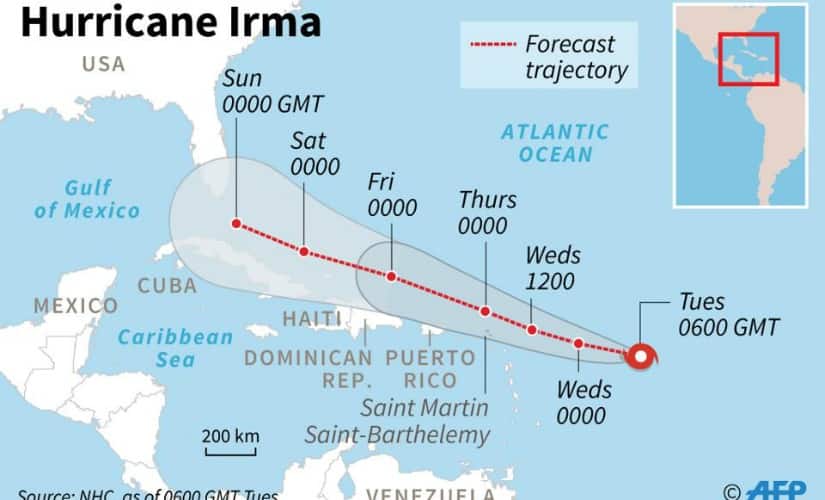 Trajectory of Hurricane Irma. AFP[/caption]The impact in the financial markets has already started to be felt with TheGuardian.com writing that insurance stocks are falling and orange juice futures surging last week. The price of contracts for November deliveries of frozen orange juice concentrate spiked as investors feared the worst.Tourism, the state’s largest industry, also faces major disruptions. Florida had 112.4 million out-of-state and international visitors last year and tourism generated $90 billion in economic activity, reported usatoday.com.Some major cruise lines canceled voyages out of the nation's big three cruise ports — Port of Miami, Port Canaveral and Fort Lauderdale's Port Everglades, the website added.According to Bloomberg, about nine million of Florida’s 20.6 million people may lose power and Hurricane Irma may also curb natural gas demand in one of the largest US markets, the article added.
4 dead as #Hurricane #Irma rocks #Florida, leaving 3.5mn without power https://t.co/3HWlw4iLwV pic.twitter.com/yEeO3HVx9o — RT (@RT_com) September 11, 2017But the problem is not restricted to financial markets, crops, and property only. According to money.cnn.com, Harvey has already hurt the job market, and Hurricane Irma could exacerbate the problem which could have a negative impact on short-term economic growth.According to the website, the federal government on Thursday reported that 62,000 more people sought jobless insurance in the last week of August raising the total number of claims for the week to 2,98,000 — the highest level in more than two years.A Reuters article citing Goldman Sachs wrote, oil demand is likely to fall by about 900,000 barrels per day (bpd) in September due to the combined impact of hurricanes Harvey and Irma.However, economists at Goldman Sachs said that the US economy will quickly bounce back from the hurricane's impact, reported Bloomberg.Goldman, after cutting its estimate for third-quarter growth by 0.8 percentage point, said that the next three quarters will get a boost from a recovery in consumption, inventories, housing and energy, the article reported.“Costly and broad-based natural disasters are associated with particularly large declines in economic activity, but also sharper subsequent rebounds,” the economists, led by Jan Hatzius, said in the 9 September note to clients, Bloomberg reported.
First Published:Sep 12, 2017, 06:47:03 IST
Advertisement
Advertisement

Epstein's model scout Daniel Siad found dead at his home near Paris amid rape case trial
A modelling scout who recruited women for the late sex offender Jeffrey Epstein has been found dead at his home in Paris.
2 min read
South China Sea tensions rise as China claims it expelled Philippine ships
China said on Thursday it tracked and drove away two Philippine vessels it accused of having "intruded into" waters near the disputed Scarborough Shoal despite warnings
1 min read
Choke terror funding, keep international shipping lanes safe: Jaishankar at Asean Regional Forum
Jaishankar's remarks came against the backdrop of recent terror attacks targeting India and growing threats to commercial shipping amid conflicts in West Asia and Europe
2 min read
After Australia, New Zealand signs defence pact with Papua New Guinea as China expands in Indo-Pacific
After Australia, New Zealand has signed a defence cooperation agreement with Papua New Guinea. This is the latest agreement that countries in the region have signed to integrate themselves closer on security and defence as Chinas has sought to increase its footprint in the Indo-Pacific and the United States, the traditional guarantor of security, has abandoned the theatre.
2 min read
Pakistan's deep state weaponising LeT to counter Asim Munir critic Maulana Fazlur Rehman: Report
A deepening military-terror nexus is reportedly emerging in Pakistan in a bid to neutralise the JUI-F chief, Maulana Fazlur Rehman, after he openly criticised Pakistan's Army Chief Asim Munir.
2 min read
Advertisement
Advertisement