


Hunger is a weapon of war but the World Food Programme can't build peace on its own
Hunger has been used as a weapon of war for many years, but the issue has recently risen to prominence because of the increased risk of mass starvation in today’s conflicts.

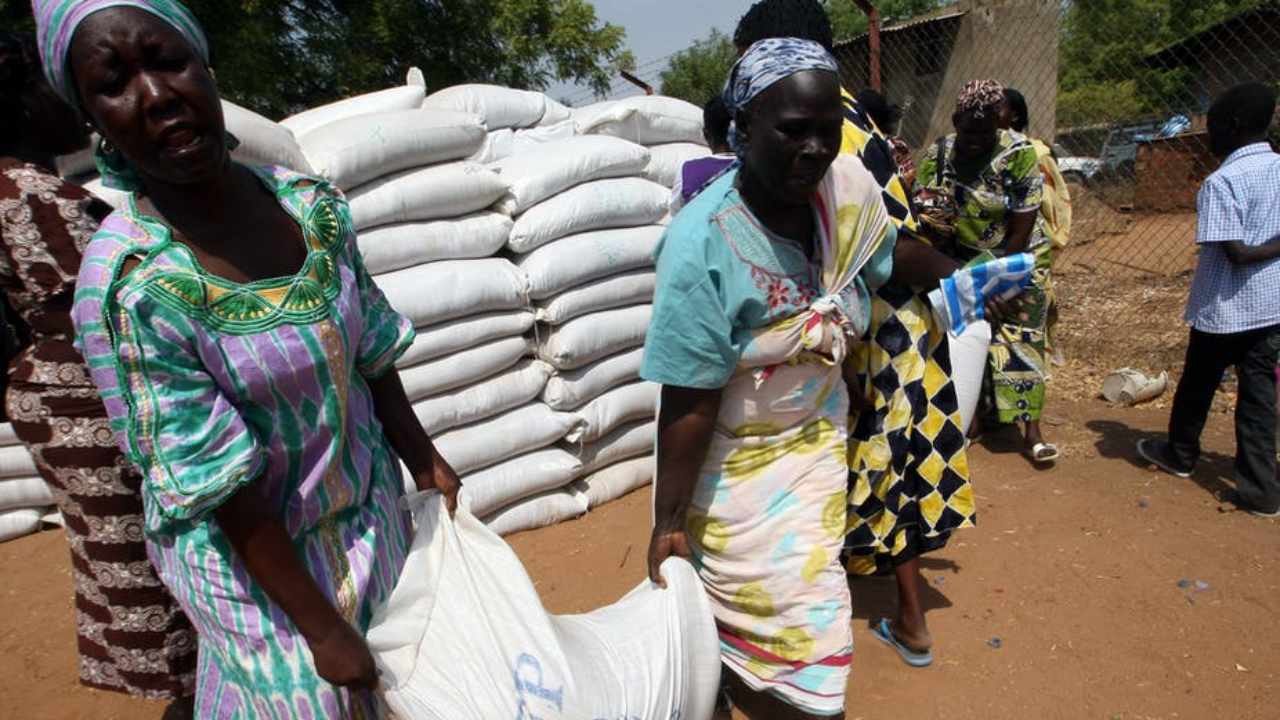
Food aid from the World Food Programme arriving in Juba, South Sudan in 2011. Khaled Elfiqi/EPA[/caption]
Hunger as a weapon
Hunger has been used as a weapon of war for many years, but the issue has recently risen to prominence because of the increased risk of mass starvation in today’s conflicts.The political acts which cause hunger and starvation can be divided into acts of commission, omission and provision. Acts of commission are attacks on food production, markets and the restriction of people’s movement. Omission is the failure to act, such as when food relief is blocked, while provision is the selective provision of aid to one side of a conflict.Similar tactics are used in protracted crises but with more subtle manipulation of markets, trade and aid than direct attacks. The war on terror, a rise in authoritarian governments, and geopolitical manoeuvring have magnified these issues and increased the risk of starvation.The link between war and hunger was recognised explicitly with the passing of a UN security council resolution in 2018 which prohibited the use of hunger as a weapon of war. Since then, WFP has been working more actively to understand the link between food security and conflict and how it can contribute to building peace.
The power of food aid
Since its establishment in 1961, WFP has set up an expansive food logistics system and a wealth of tools to assess needs and vulnerability. In the past decade, it has also become involved in cash transfers.It is now one of the world’s largest humanitarian organisations, but also a business which dominates all aspects of general food distribution and humanitarian assistance. It involves a whole range of people, institutions and practices which can have political and economic consequences well beyond meeting the needs of hungry people.One of most intractable issues is the manipulation of food aid during conflict and its incorporation into the political economy of famine and war. Food aid has been stolen or taxed by warring parties or local authorities, providing not only a source of finance but boosting their political status.In Somalia, food aid has been big business and its contractors key political actors. Elsewhere, governments increasingly deny access for food distribution in opposition-held areas, with Syria, and Sudan under its previous regime, being a case in point.The denial of food aid can also benefit traders as it increases food prices and it benefits business because as people become displaced they are potential sources of cheap labour. The vulnerable are frequently excluded or marginalised, because they are the politically weaker members of society.[caption id="attachment_8916001" align="alignnone" width="1000"]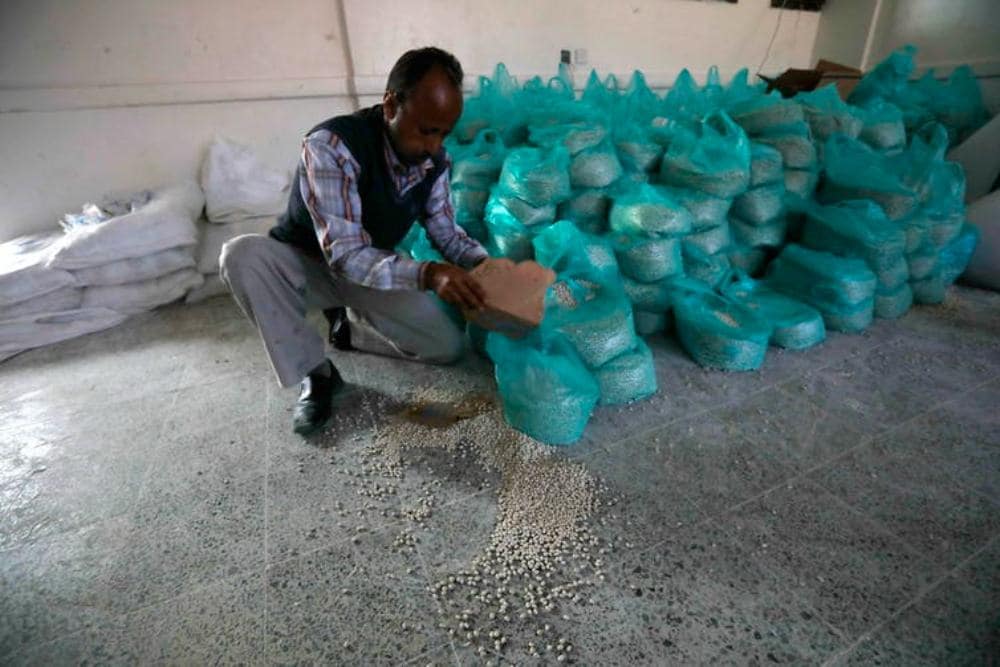
In Yemen, the politics surrounding access to food aid has left thousands at risk of starvation. Yahya Arhab/EPA[/caption]
Spotlight on political inaction
As part of its role in improving conditions for peace, WFP can analyse these wider political and economic effects, and include them in the way it makes decisions. However, WFP cannot address the political causes of hunger, food insecurity and malnutrition with food aid – or in fact with any technical intervention.Conflicts need political solutions and crimes of mass starvation need to be prosecuted. Even one of WFP’s most successful operations, the massive food distribution in Darfur in 2005 which effectively reduced malnutrition and mortality, required diplomatic efforts to negotiate the necessary access.There is a danger that WFP becomes a substitute for political action to address the causes of conflict or for prosecuting crimes of mass starvation. This would actually perpetuate the problem, as structural causes of hunger and malnutrition remain unaddressed.In turn, this keeps vulnerable people in a state of protracted crisis or precarity and persistent malnutrition. An over-reliance on WFP can also absolve politicians of the blame for creating famine or, alternatively, the international community’s responsibility to protect.With the spotlight of the Nobel peace prize, WFP can do much by making the political causes of hunger in conflict visible, helping to identify famine crimes, promoting effective assistance that is specific to particular contexts, and using its power to bring about political action. Susanne Jaspars, Research Associate, LSE's Conflict and Civil Society Research Unit, and Food Studies Centre, SOAS, University of LondonThis article is republished from The Conversation under a Creative Commons license. Read the original article.

US set to announce new tariff plan as temporary 10% duty nears expiry
India rejects Pakistan's 'baseless' claims at Asean, says Indus Waters Treaty to remain on hold
Indian trucker arrested in US over alleged theft of $3 million worth of tungsten powder
Austria turns Hitler’s birthplace into a police station 81 years after his death: 5 things to know
Nawaz Sharif wants to become prime minister of PoK — but laws framed by Pakistan disqualify him