


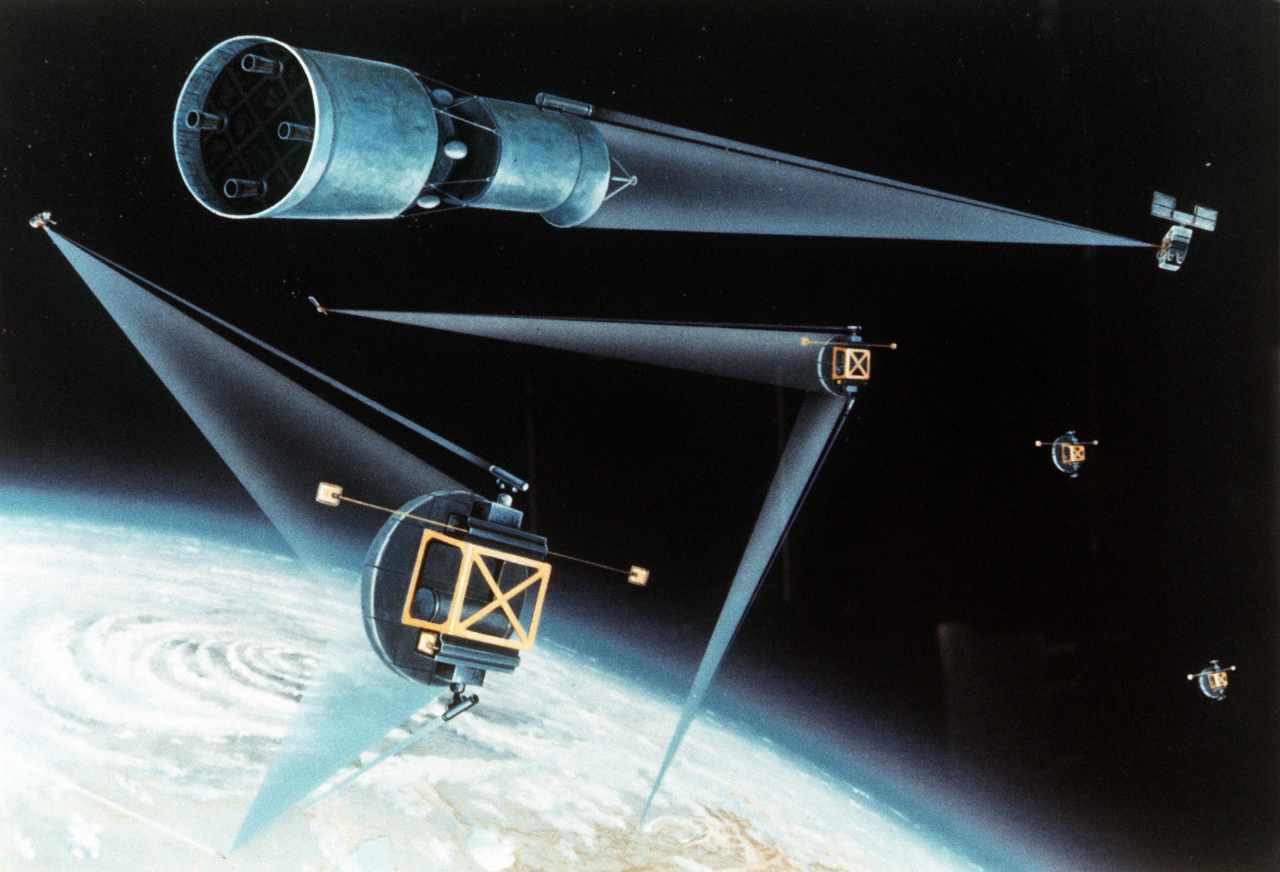
Space lasers taking aim. Image: Wikimedia Commons[/caption]
Beijing’s Surge
For years, the Chinese studied — with growing anxiety — the U.S. military, especially its invasions of Afghanistan in 2001 and Iraq in 2003. The battlefield successes were seen as rooted in space dominance. Planners noted that thousands of satellite-guided bombs and cruise missiles had rained down with devastating precision on Taliban forces and Iraqi defenses.While the Pentagon’s edge in orbital assets was clearly a threat to China, planners argued that it might also represent a liability.“They saw how the U.S. projected power,” said Todd Harrison, a space analyst at the Center for Strategic and International Studies, a Washington think tank. “And they saw that it was largely undefended.”China began its anti-satellite tests in 2005. It fired two missiles in two years and then made headlines in 2007 by shattering a derelict weather satellite. The successful test reverberated globally because it was the first such act of destruction since the Cold War.China also sought to diversify its anti-satellite force.In tests, China began firing weak laser beams at satellites and studying other ways to strike at the speed of light.Then came the new idea. Every aspect of U.S. space power was controlled from the ground by powerful computers. If penetrated, the brains of Washington’s space fleets might be degraded or destroyed. Such attacks, compared with every other anti-satellite move, were also remarkably inexpensive.In 2005, China began to incorporate cyberattacks into its military exercises, primarily in first strikes against enemy networks. Increasingly, its military doctrine called for paralyzing early attacks.In 2008, hackers seized control of a civilian imaging satellite named Terra that orbited low, like the military’s reconnaissance craft. They did so twice — first in June and again in October — roaming control circuits with seeming impunity. Remarkably, in both cases, the hackers achieved all the necessary steps to command the spacecraft but refrained from doing so, apparently to reduce their fingerprints.
Washington’s response
In its second term, the Obama administration made public what it called an “offset strategy” to respond to China and other threats by capitalizing on America’s technological edge.Just as the United States had developed, first, a vast nuclear arsenal and, second, smart weapons, this so-called third offset would seek an advantage by speeding the rise of robotics, high-speed arms and other breakthroughs that could empower the armed forces for decades.Unlike earlier offsets, officials said, the objective was to rely less on federal teams than the tech entrepreneurs who were fast transforming the civilian world.The advances in space were to be defensive: swarms of small, relatively cheap satellites and fleets of recycled launchers that would overwhelm Beijing with countless targets. For Obama, innovative leaps were to do for U.S. space forces what Steve Jobs did for terrestrial gadgets, running circles around the calcified ministries of authoritarian states.The Obama administration was already applying the commercial philosophy to NASA, turning the space agency into a major funder of entrepreneurial strides. It was pumping billions of dollars into the development of private rockets and capsules meant to carry astronauts into orbit.The military joined in. The beneficiaries included Elon Musk, the founder of Tesla, and Jeff Bezos, the founder of Amazon. Their space companies — Musk’s SpaceX and Bezos’ Blue Origin — sought to turn rocket launchers from throwaways into recyclables, slashing their cost.Military officials believed that the new system would make it possible to quickly replace satellites in times of war.The third offset also sought to shrink the size of satellites. Over decades, the big ones had grown into behemoths. Some cost $1 billion or more to design, construct, outfit, launch and keep in service. One type unfurled an antenna nearly as large as a football field. But civilians, inspired by the iPhone revolution, were building spacecraft as small as loaves of bread.Military planners saw smaller, cheaper, more numerous craft as making anti-satellite targeting vastly more difficult — in some cases impossible — for an adversary.By the end of the Obama administration, SpaceX was firing payloads into space and successfully returning booster rockets to Earth in soft landings.Two years later, Trump unveiled the Space Force, prompting jokes on Twitter and late-night television and even a Netflix sitcom. But in March, the unit said it had taken possession of its first offensive weapon, calling the event historic. Based on land, the system fires energy beams to disrupt spacecraft. Lt. Col. Steve Brogan, a space combat specialist, said the acquisition “puts the ‘force’ in Space Force and is critical for space as a war-fighting domain."William J. Broad. c.2021 The New York Times Company
