
Advertisement


Sections
How did Obama 'make it in America'? The media answers
Editorials in the US media, understandably, aren't gushing their gut out about Obama's win. The intellectual mood is sober — more warning about the close shave — than giddily euphoric about it.

This is not 2008. In feel, in spirit, or even in rhetoric. The dramatic whoosh-es from four years back have been replaced by relieved sighs. A large section of the American media had literally given this year's polls to Romney, Obama had struggled hard to defend his government in the wake of the attacks in Benghazi, Libya, which took the life of an American ambassador, Iran has been unyielding and Romney had basically, with considerable success, hauled Obama up for the gradual crumbling of the great American dream that the Democrat President had stoked when he had been elected.Editorials in the international media, understandably, aren't gushing their gut out about Obama's win. The intellectual mood is sober — more warning about the close shave — than giddily euphoric about it.[caption id="attachment_517799" align="alignleft" width="380"] Barack Obama after his win. Reuters[/caption]The Guardian captures the mood right when it says in the blurb of its opinion piece: "His victory wasn't big. It wasn't pretty. It certainly wasn't inspirational in the way that his win in 2008 was. But it was a win all the same."Though it calls Obama's win 'good for the world' it also admits that at places his victory was almost 'wafer thin'. The publication which credits Romney with almost succeeding in making Obama a 'one-time' President sums up the reasons behind Obama's victory thus:
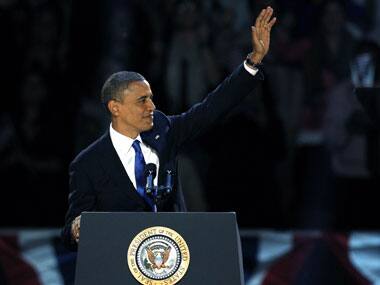 Barack Obama after his win. Reuters[/caption]The Guardian captures the mood right when it says in the blurb of its opinion piece: "His victory wasn't big. It wasn't pretty. It certainly wasn't inspirational in the way that his win in 2008 was. But it was a win all the same."Though it calls Obama's win 'good for the world' it also admits that at places his victory was almost 'wafer thin'. The publication which credits Romney with almost succeeding in making Obama a 'one-time' President sums up the reasons behind Obama's victory thus:
In the end Mr Obama owes his second term more to his vast campaign war chest and the ruthless professionalism of his get-out-the-vote machine than he did first time around, when hope and idealism did more to carry him to the White House. It is clear that the ground campaign at local level must have made the difference in the key contests yesterday.The Huffingtonpost.com too notes, how a brilliantly-knit campaign which re-focused Obama's interests as that which promote America as a 'multiracial, multi-ethnic, global in outlook' nation, clinched a second term for the American President. Howard Fineman says on the portal:
Obama reached out not only racially and ethnically, but in terms of lifestyle. Analysts made fun of, and Republicans derided, his campaign's focus on discrete demographic and social slices of the electorate, including gays and lesbians. But the message was one about the future, not the American past.The New York Times observes how, unlike in 2008, one cannot say that this was an election that brought the nation together. In fact, the voting factions were more visible in this year's poll than any. The NYT points out:
President Obama’s dramatic re-election victory was not a sign that a fractured nation had finally come together on Election Day. But it was a strong endorsement of economic policies that stress job growth, health care reform, tax increases and balanced deficit reduction — and of moderate policies on immigration, abortion and same-sex marriage.Washington Post, which has mostly been critical of Obama's governance, says that after spending four years testing waters in the politics of running a government, Obama's should finally now show all the lessons he has learnt and finally bridge the divide between ideology and practice, that they feel was apparent in his first term as a President. The publication's editorial board says:
Perhaps more important is whether Mr. Obama will demonstrate more willingness — more bravery, actually — to take on issues he ducked the first time around: reforming entitlements, particularly Medicare, and reducing the unsustainable debt.Obama in his acceptance speech acceded to the fact that the last session had been difficult and 'depressing', and Washington Post concludes echoing what is on the mind of several Americans and most America-watchers — "Mr Obama’s victory Tuesday felt less momentous, but it allows him the opportunity to fill in the blanks of a still uncertain legacy."
First Published:Nov 07, 2012, 12:40:42 IST
Advertisement
Advertisement

Nawaz Sharif wants to become prime minister of PoK — but laws framed by Pakistan disqualify him
Former Pakistani Prime Minister Nawaz Sharif has said that he would ask his brother, Prime Minister Shehbaz Sharif, to appoint him as the Prime Minister of Pakistan-occupied Jammu and Kashmir (POJK). But the Constitution bars him from making such a move.
2 min read
Fake jobs, tourist visas: Inside Russia’s vast network luring foreigners to fight Ukraine war
Russia is accused of using fake job offers, tourist visas and lucrative military contracts to recruit thousands of foreign nationals for the Ukraine war. Investigations reveal how poverty, deception and coercion have drawn people from Asia, Africa and Latin America into one of the world's deadliest conflicts
8 min read
As Pakistan eyes American dollar for Iran mediation, economists sound the alarm: ‘It can buy time, not growth’
Pakistan is reportedly seeking billions in US support after claiming a role in easing US-Iran tensions, but economists warn fresh funding would offer only temporary relief without deep structural economic reforms.
2 min read
Are Chinese UN peacekeepers spies? Trump’s UN envoy sends out a warning
US UN Envoy Mike Waltz has warned that China has been using United Nations' platforms, such as peacekeeping missions, for espionage. He accused Chinese peacekeepers of serving as the eyes and ears of the Communist Party of China.
2 min read
Why has Bangladesh’s choice of India spokespersons raised eyebrows?
Bangladesh’s appointment of journalists Md Saidur Rahman and Umme Marufa to media roles in New Delhi and Kolkata has triggered controversy over their past anti-India social media posts, many of which were later deleted, prompting diplomatic scrutiny as India and Bangladesh seek to improve bilateral ties
6 min read
Advertisement
Advertisement