


How an alleged plot to overthrow Jordan's king laid bare a growing rift between royalty, influential tribes
Though Jordan's King Abdullah II managed to thwart an alleged plot by his half brother Prince Hamza to take the throne, insiders fear that anger percolating under the surface could erupt at any moment. Hamza has a huge following among Jordan's tribes

- Years of economic crisis have frayed the historic patronage-for-loyalty bond between the king and the tribes, a bedrock of the Hashemite family's decades-long rule.
- That may have been an underlying factor in an alleged plot by the half brother of King Abdullah II to try to take a throne he was once in line to inherit. The prince has been silenced, and his purported co-conspirators are on trial behind closed doors.
- But even some government insiders fear that anger percolating under the surface could erupt at any moment, a warning bound to worry the kingdom's Western allies.
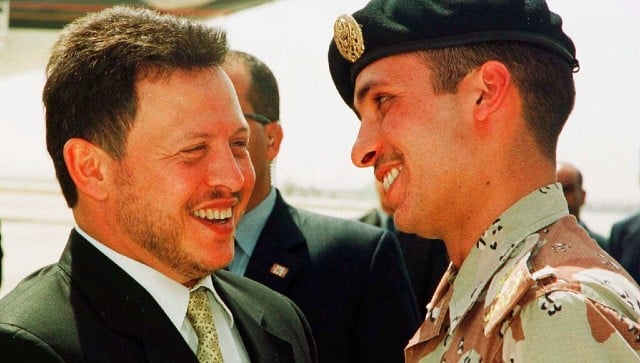
File image of Jordan's King Abdullah II (left) with his half brother Prince Hamza (right), the alleged mastermind of a plot to overthrow King Abdullah II. AP[/caption]“The issue is not Hamzah visiting these tribes,” he said. “The issue is how these tribes received Hamzah."The prince has not been charged, with the king saying the family will deal with him. But his name appears throughout the indictment against Bassem Awadallah, a former royal court chief, and Sharif Hassan bin Zaid, a distant cousin of the king.The pair allegedly worked on social media messages the prince was to post to stir discontent, and also offered to seek foreign help.Jordanian youth: educated, but joblessHope is scarce in Jordan's rural areas and provincial towns that are home to the kingdom's original Bedouin tribes. In the neglected provincial capital of Karak, downtown shops and streets were largely deserted during a recent visit. Young men hung around in small groups, smoking and chatting to pass the time. Karak's main attraction is a crusader castle, but the coronavirus pandemic halted tourism.Even before the pandemic, there weren't enough jobs for a young, rapidly growing labour force. The lives of many young Jordanians are on hold because they cannot follow the traditional path of job, marriage and children.Karak resident Mustafa Shamayleh amassed academic credentials over the past decade, hoping to find a job. He is now 30, still unemployed and living with his parents, despite his PhD in economics from a top-tier university in India.“I can’t live life,” said Shamayleh, who delivers food on a motorbike for pocket money to ease the burden on his 70-year-old father. “If I want to marry now, how? I have nothing.”Shamayleh keeps searching for work in his field even though scarce jobs tend to be awarded through personal connections, or “wasta," which he says he does not have.His father Ali, a retired ambulance driver, recalls when royal patronage provided a safety net. Tribal Jordanians had access to jobs in the security forces and the civil service. They were given preference over the descendants of Palestinian refugees, also a large segment of the population, but one seen as less loyal to the monarchy.“It's not that the king doesn't want to give them (jobs) now,” said Kamhawi, the analyst. “He doesn't have the money. The government doesn't have the money. The country doesn't have the money.”The pandemic made things worse. Officially, unemployment rose to 23.9 percent in 2020, but it's believed to be higher. More Jordanians are sinking into poverty, with the figure expected to exceed a quarter of the population soon, up from 15.7 percent three years ago. The economy contracted last year for the first time in three decades, the World Bank said.Prince Hamza accused of trying to 'destabilise Jordan'Former information minister Mohammed Momani said Hamzah tried to exploit the economic pain, accusing him of “evil coordination” with his two alleged co-conspirators. “It’s not an attempt to try to help the country,” he said. “It’s an attempt to try to destabilise the country."Momani brushed aside suggestions the economic downturn was eroding the historic bond between the king and the tribes. He said the tribes might disagree with some government policies, but that “at the end of the day, they stand by the country and the monarch".The indictment also suggested the defendants sought foreign aid, a version reinforced by Momani.Bin Zaid allegedly asked officials at an unidentified foreign embassy about their potential support, while the charge sheet played up Awadallah's Saudi ties.Awadallah holds Jordanian, US and Saudi citizenship, has business interests in the Gulf, and has been linked to Saudi Arabia's powerful crown prince. Still, Jordan stopped short of accusing Saudi Arabia, an important financial backer, of involvement in the alleged plot.Jordan king announces committe to formulate reform planIn an apparent attempt to limit the damage from the royal scandal, the king appointed a 92-member commission that is to deliver a plan for political reform by October.Momani, a member of the panel, said he expects concrete results because there's a hard deadline and the king presided over the launch to underscore its importance.Still, calls for opening the political system have largely gone unanswered over the past decade, amid fears that significant electoral reform could boost the Muslim Brotherhood, the kingdom's only organised Opposition group.Tribes shrug off reforms' committeeAtef al-Majali, a tribal leader in Karak, shrugged off the committee as an empty gesture. He said calls for reform have not been heard, adding that the tribes don't just demand a better deal for themselves, but for all Jordanians.The tribe is still upset over the arrest of two senior members, including Hamzah's chief aide, Yasser al-Majali. At the time, the prince was placed under house arrest and more than a dozen prominent tribal figures and officials were detained.All detainees were released three weeks later, but the al-Majalis took issue with security forces storming homes, saying it was insulting and that an invitation to the local police station would have sufficed.Yasser al-Majali and other members of Hamzah's staff have not been allowed to return to work, and the prince has not been heard from in public.Like others, Atef al-Majali expressed frustration with the decision-makers, saying tribal leaders are being ignored despite their traditional influence.“Our voice is loud, but no one hears us,” he said. “We try to be patient, but in the end, patience has limits.”

Epstein's model scout Daniel Siad found dead at his home near Paris amid rape case trial
South China Sea tensions rise as China claims it expelled Philippine ships
Choke terror funding, keep international shipping lanes safe: Jaishankar at Asean Regional Forum
After Australia, New Zealand signs defence pact with Papua New Guinea as China expands in Indo-Pacific
Pakistan's deep state weaponising LeT to counter Asim Munir critic Maulana Fazlur Rehman: Report