


Historic comet landing: Scientists hunt for building blocks of life
The European Space Agency has achieved a historic first — landing a washing machine-sized spacecraft on a comet.

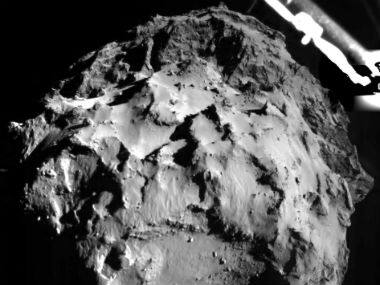
The picture released by the European Space Agency ESA on Wednesday, Nov. 12, 2014 was taken by the ROLIS instrument on Rosetta's Philae lander during descent from a distance of approximately 3 km from the 4-kilometer-wide (2.5-mile-wide) 67P/Churyumov-Gerasimenko comet. AP[/caption]Where there any problems with the landing? Several.First, the lander failed to wake up properly on Tuesday. Scientists fixed that with a trick familiar to anyone who has used a computer. They rebooted it.After the separation from Rosetta is became clear that there was a problem with Philae's downward thrusters. They were designed to press the lander onto the surface during the final touchdown, to help it get a grip using harpoons and screws. The thruster failure wouldn't have been so dramatic if the harpoons had fired, but they didn't. So Philae bounced, once, before coming to rest again on the comet.Scientists are also trying to resolve intermittent communication problems with the lander, but those shouldn't interfere too badly with the mission.What data are scientists seeking? Scientists have likened the trillion or so comets in our solar system to time capsules that remain virtually unchanged since the earliest moments of the universe. One of the things they are most excited about is the possibility that the mission might help confirm that comets brought the building blocks of life — organic matter and water — to Earth. They already know that comets contain amino acids, a key component of cells. Finding the right kind of amino acids and water would be an important hint that life on Earth did come from space.How will the lander collect the data?"The science starts the minute we get down to the ground," said Mark McCaughrean, a senior scientific adviser on the mission. Philae has ten instruments on board — including devices to measure light, electrical magnetism and heat — and flying up above the comet the Rosetta spacecraft has another 11 instruments. The Philae lander will provide plenty of images of a world no human has ever seen close up and will drill below the surface to extract a sample of the comet that will be analyzed onboard.The lander's batteries are expected to last just 64 hours — but that should be enough for scientists to gather a huge wealth of data. In addition, the lander has a solar panel that should provide an hour's worth of battery life per day for up to five months.What challenges lie ahead? The comet is on a 6 ½-year elliptical orbit around the sun. At the moment it is getting closer to our star. This makes for great science, since Philae and Rosetta will be able to observe the comet becoming more active.As 67P approaches the sun, the amount of matter it sheds will greatly increase, posing a potential risk to the lander and even to the Rosetta spacecraft flying in tandem with the comet. As the comet reaches perihelion, the closest point to the sun, the rising temperatures could also damage Philae. But the lander should remain stuck to the comet forever, even after its systems have shut down. Rosetta will continue to fly alongside the comet until the end of its useful lifetime in about two years. Scientists have suggested that a fitting end would be for it, too, to land on the comet and reunite with the lander once more.Associated Press

US set to announce new tariff plan as temporary 10% duty nears expiry
India rejects Pakistan's 'baseless' claims at Asean, says Indus Waters Treaty to remain on hold
Indian trucker arrested in US over alleged theft of $3 million worth of tungsten powder
Austria turns Hitler’s birthplace into a police station 81 years after his death: 5 things to know
Nawaz Sharif wants to become prime minister of PoK — but laws framed by Pakistan disqualify him