


Fatah and Hamas 'reconciliation' deal may be a win-win for Palestine, even as Israel seethes
The deal has got its fair share of critics, who doubt the effectiveness of the deal, citing Hamas' penchant for violence and the repeated roadblocks in the final reconciliation.

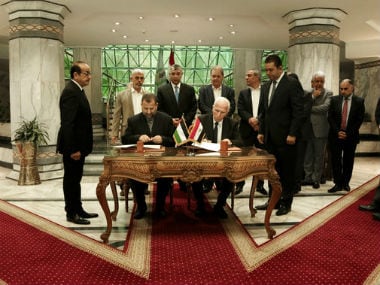
Representatives of the Fatah and Hamas sign the deal in Cairo on Thursday. AP[/caption]Hamas' tactical move?However, the situation looks better this time around. An article in the Haaretz noted that the first step towards formulating the deal might have come from the Hamas.The article stated that the Hamas wants to avoid a 2014-like situation, when the internal differences led to the indefinate delay in holding elections.Al-Jazeera reported that Hamas' for reconciliation is a well-calculated risk to come out of regional isolation.The deal is a major boost for the Hamas as it provides an opportunity to break the humanitarian crisis threatening to engulf Gaza, The New York Times noted.An united Palestinian political leadership will help "negotiating with Israel with a single voice," the report said.As Hamas is taking a lead to salvage the deal, the report said that this would have sobering effect over the militant group and even force to rethink its strategy to use violence.As an elder statesman of the Palestinian movement, the deal may be a win for Mahmoud Abbas too. According to The New York Times, the deal could be a "legacy-saving moment" for the 82-year-old leader, who took over from Yasser Arafat in 2004.Israel opposes any deal involving HamasWhile the deal is being celebrated by locals, who hope to live in peace after a decade of tensions between the two diseparate territories, Israel, the other big stakeholder in the factional conflict, is not happy.Reacting sharply to the deal, Israel prime minister Benjamin Netanyahu tweeted that any agreement with a terrorist organisation like Hamas is unacceptable."Reconciling with mass murderers is part of the problem, not part of the solution," Netanyahu said in a statement.
Israel's reluctance can be seen from the prism of its long-standing animosity with the Hamas.Having fought three wars with Gaza since 2005, Israel fears Hamas taking over the reins of the West Bank too in the next elections — if the deal is implemented in spirit.An article in Jerusalem Post, a right-wing newspaper in Israel, stated that the Hamas will never change its tactics and will continue to control a militia which will threaten Israel. Comparing Hamas' urge to maintain an active militia to Hezbollah, the report said that Israel must stop Gaza from becoming another Lebanon.On the other hand, Fatah and Israel have had tense but comparatively better relations, as the Jewish state recognises Fatah as the sole representative of the Palestinians.Hamas has been advocating for an Islamist state, which encompasses all of Israel as well as the Palestinian territories. On the other hand, the Fatah and the larger PLO envisages an Arab nationalist-cum-socialist state. Israel's opposition, thus, stems from the existential crisis that it may have to face if the deal succeeds.With inputs from AFP
No premium queues, 30-minute target: What changes for Indian passport applicants in UAE
'We don't need straits': Trump says Iran war isn't about Hormuz as US strikes for 12th night
Iran claims to stop three oil tankers transiting Strait of Hormuz
Globe at a glance: From Houthis striking Saudi tankers in Red Sea to wildfires in Europe
Houthis claim responsibility for attack on two Saudi oil tankers in Red Sea as a new chokepoint emerges