


Donald Trump impeachment trial: Republicans move to block witnesses, driving case towards acquittal
The White House and Senate Republicans worked aggressively on Wednesday to discount damaging revelations from John R Bolton and line up the votes to block new witnesses from testifying in President Donald Trump’s impeachment trial, in a push to bring the proceeding to a swift close

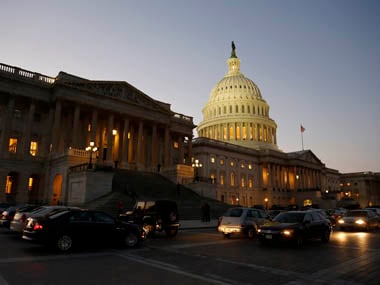
Representational image. Reuters[/caption]“Every public official I know believes that his election is in the public interest,” said Alan M Dershowitz, the celebrity defence lawyer and constitutional scholar who is part of the Trump’s legal team. “Mostly, you’re right.”“If the president does something which he believes will help him get elected, in the public interest, that cannot be the kind of quid pro quo that results in impeachment,” he said.Many of the arguments and much the day was tailored to convincing a few Republicans who remained holdouts on the question of whether to call witnesses. McConnell gave his party’s first question on Wednesday to Senators Mitt Romney of Utah, Susan Collins of Maine and Lisa Murkowski of Alaska in an effort to allay the concerns of the three lawmakers, Republican moderates who are swing votes on the issue. The trio teamed up to ask Trump’s lawyers how they should judge the president if they conclude he acted in the Ukraine matter with both political and policy motives.The selection of Collins, who is facing the toughest reelection campaign in her long Senate career, was revealing: It suggested that McConnell was keenly focused on giving her every opportunity to have her voice heard before moving forward. When she rose to announce herself, she became the first senator other than the two leaders to have a speaking role in the trial.Notably absent from the group was the fourth Republican who had expressed interest in witnesses: Senator Lamar Alexander of Tennessee, a close friend of McConnell’s who has said he will not decide whether to support witnesses until after the question period has closed.On Tuesday, McConnell had privately warned his rank-and-file members that he did not currently have the votes to stop Democrats from summoning witnesses. One after the other on Wednesday, in statements and interviews in the Capitol, they made clear they would side with their leader.Senator Patrick Toomey of Pennsylvania, who had previously floated the idea of a witness deal, said Wednesday that he was “very, very skeptical” of new witnesses. Senator Cory Gardner of Colorado, facing a tough reelection in a swing state, issued a statement saying that he had heard enough and would vote against hearing from anyone else.McConnell summoned Murkowski to his office on Wednesday morning for a private meeting before the trial began, and she emerged refusing to answer questions about whether she would ultimately support the call for witnesses.“We still got some folks who are, like I said, assessing,” said Senator John Thune of South Dakota, the second-ranking Senate Republican. But the leaders were planning as if the defeat of a bid for witnesses was a certainty; Thune said it was likely that if it did fail, Republicans would move swiftly for an acquittal.Democrats would need the votes of four Republicans to compel the Senate to subpoena witnesses and new documents. But it seems increasingly likely that Alexander, who is retiring from the Senate and is thus free to do as he chooses, would break from his party.Trump is charged with abusing his power and obstructing Congress by pressuring Ukraine to investigate his political rivals, including Biden and his son Hunter Biden, and concealing evidence of it from lawmakers who were investigating.In the first hint of a possible crack in Democratic unity, Senator Doug Jones of Alabama suggested Wednesday that he might vote to acquit Trump on the charge of obstruction of Congress, though he said that the president’s own behaviour was strengthening the case against him. And Senator Joe Manchin of West Virginia said he thought that Hunter Biden might be a relevant witness.“I’m still looking at that very closely; there are some things that trouble me about it,” Jones said, without elaborating. “But I will tell you this about the obstruction charge: The more I see the President of the United States attacking witnesses, the stronger that case gets.”Fielding friendly questions from Democratic senators, House managers reiterated the heart of their case and accused Trump’s lawyers of falsely stating that there was no evidence that Trump linked security assistance to investigations. Representative Adam Schiff of California, the lead House impeachment manager, responded to Dershowitz’s argument that a president who believed his reelection was in the national interest could demand a quid pro quo to help himself politically without consequence was “very odd.”“If you say you can’t hold a president accountable in an election year where they’re trying to cheat in that election, then you are giving them carte blanche,” Schiff said. “All quid pro quos are not the same. Some are legitimate and some are corrupt.”Democrats have argued that Trump’s pressure campaign on Ukraine was precisely the kind of corrupt scheme that the nation’s founders had in mind when they created impeachment, fearing that an out-of-control president would abuse his power for personal gain. But throughout the day, lawyers for Trump argued that all elected officials make policy decisions to help themselves get reelected.Answering the question from the three Republican moderates, Patrick Philbin, a deputy White House counsel, said a president could not be removed for a “mixed-motive situation” in which he is acting out of both personal and policy concerns.“There’s always some personal interest in the electoral outcome of policy decisions and there’s nothing wrong with that,” Philbin told senators. “That’s part of representative democracy.”In one case, White House lawyers struggled to answer a question from Collins and Murkowski, admitting that they had no evidence to counter Democratic arguments that Trump became interested in investigations of Joe Biden in 2019 only after Biden became a candidate for president.Trump’s legal team also argued that the House needed to prove its case “beyond a reasonable doubt” — a standard of proof that legal experts say has no basis in either the Constitution or the rules of the Senate. And the legal team said that the case was merely “based on a policy difference” between the president and the career diplomats who sounded the alarm on his pressure campaign in Ukraine.Senator Rand Paul, R-Kentucky, sought unsuccessfully to ask a question about the origins of the impeachment inquiry that named the CIA whistleblower who filed the complaint that spurred it, according to a person familiar with the debate. But the query was rejected repeatedly.White House lawyers had help making sure their speakers stayed within a five-minute time limit that Roberts strictly enforced, and he occasionally cut off speakers midsentence. Staff for the lawyers held up small white cue cards showing when the clock was about to run out; the Democratic House managers did not appear to have such a system.Sheryl Gay Stolberg and Michael D Shear c.2020 The New York Times Company

US set to announce new tariff plan as temporary 10% duty nears expiry
India rejects Pakistan's 'baseless' claims at Asean, says Indus Waters Treaty to remain on hold
Indian trucker arrested in US over alleged theft of $3 million worth of tungsten powder
Austria turns Hitler’s birthplace into a police station 81 years after his death: 5 things to know
Nawaz Sharif wants to become prime minister of PoK — but laws framed by Pakistan disqualify him