


China's new policy on two children leading to job discrimination for women
China's new policy to permit two children, ending the one child policy this year is resulting in discrimination of women in job market as employers prefer male workers to avoid lengthy maternity leave, official media reported.

Beijing: China's new policy to permit two children, ending the one child policy this year is resulting in discrimination of women in job market as employers prefer male workers to avoid lengthy maternity leave, official media reported.State-run People's Daily which highlighted the problem quoted Zhao, a lady PHD scholar from Communication University of China that she is visibly frustrated to find during her job hunt that employers prefer male applicants and sometimes even choose a male only with a bachelor's degree over her doctorate.[caption id="attachment_2949470" align="alignleft" width="380"]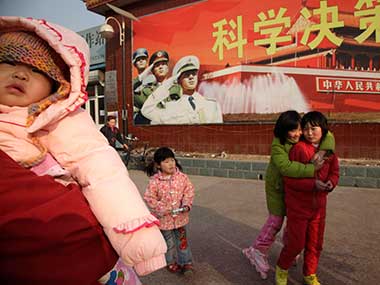 Representational image. AP[/caption]She said that in her job interviews questions always included about when she plans to marry and have a child, and even about whether she plans to have a second baby.China this year will see 7.65 million students graduate from universities and colleges. This summer is also the firstemployment season after the universal two-child policy came into effect.The two child policy is being implemented from January this year in a bid to deal with the growing demographic crisisresulting in steady depletion of the work force due to over three and half decades old one child policy.As a result, female graduates are facing more severe competition and pressure in job hunting, the daily report.Overt and covert gender discrimination floods recruitment notices.Examples of more explicit discrimination include: "only male," "male preferred," "married mother preferred," "higher educational background for female candidates," "appearance and height required" and "obligations of no marriage and noreproduction in certain years," the report said.However, even covert discrimination can be quite obvious, such as when employers inquire about female applicants' marital status and thoughts on family planning, or stress that the position requires frequent overtime and is therefore moresuitable for men.According to a 2014 survey conducted by the Women's Studies Institute of China (WSIC), 86.18 percent of female graduates in Beijing, Hebei and Shandong say they have experienced gender discrimination while job hunting.Marriage, childbearing and employment are all women's rights, and are protected by law, explained Ma Yan, a researcher with WSIC told the daily.However, Ma said, childbearing does increase costs to employers. For instance, in the wake of the universal two-child policy, many local governments have extend mandated maternity from one month to three.Guo Ruilin, who works in human resources at a private pharmaceutical company, complained, "Normally, maternity impacts a woman's work for a year or two, but the company still pays them a salary and offers social security. A second child will double the costs."A number of experts believe the government should get involved in reducing the stigma and discrimination wrought by the two-child policy.

After Australia, New Zealand signs defence pact with Papua New Guinea as China expands in Indo-Pacific
Pakistan's deep state weaponising LeT to counter Asim Munir critic Maulana Fazlur Rehman: Report
No premium queues, 30-minute target: What changes for Indian passport applicants in UAE
'We don't need straits': Trump says Iran war isn't about Hormuz as US strikes for 12th night
Iran claims to stop three oil tankers transiting Strait of Hormuz