


As Riyadh raises the stakes, are Saudis betting their barrels on a Shia-Sunni divide?
The purpose of current aggravation by Riyadh is two-fold: To throw a smokescreen on its precarious internal situation, and to give the Israel lobby in the US one more card to play against the rise of Iran

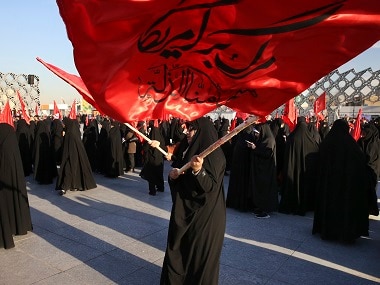
Iranian women wave flags that read, "Death to America and we shall never accept humiliation," during a rally to protest the execution by Saudi Arabia last week of Sheikh Nimr al-Nimr. AP[/caption]Internal dangers may be peaking today but they are not of recent origin. The year 1979 will be etched in minds of the Saudi ruling elite for two earthshaking events: The Islamic Revolution which brought the Ayatollahs to power in Tehran and the siege of the great mosque in Mecca.It was the latter event which shook the Saudi regime because the uprising was a massive expression of discontent against the Saudi “monarchy”. The concept of “kings” is anathema in Islam. This explains why to keep himself above opprobrium after the Mecca uprising and the Iranian Revolution, the anxious Saudi monarch labelled himself “the Keeper of the Holy Shrines”.The leader of the Mecca uprising, Juhayman al-Otaybi, would have been at the head of the Islamic State directed against Riyadh had he been around today. Just as Riyadh blamed Iranian collusion in 1979, it has turned upon the Shia threat today.More recently, the Saudis started paying a heavy price for helping create extremist insurgencies in Syria and Iraq when in December 2014 the Kingdom’s northern border with Iraq was breached by Islamic State elements. Saudi General Oudah al Belawi was killed in the operation. Would this level of success across a border so heavily protected be possible without “inside” help? This is the kind of speculation which frightens the regime.It cannot be disputed that Sunnis constitute an overwhelming majority of the world’s Muslims. But this overarching fact obscures nuances which cannot be wished away.If the Sunni world of the Saudi dream is so coherent, why did Riyadh bankroll Abdel Fattah el-Sisi’s military to topple a thoroughbred Sunni Prime Minister, Mohammad Morsi? Because Riyadh is more scared of Muslim Brotherhood than it is even of the Shias. “Brothers” represent a strong anti-monarchy, political Islam, with a silent following in the Kingdom itself which has often erupted in the social media.Turkish President Tayyip Erdogan, another candidate for the Sunni alliance, donned the cloak of the Justice and Development only after Turkey’s secular constitution stopped his Guru, Necmettin Erbakan from holding Prime Minister’s office because the Refah Party he led was avowedly Islamist.If Morsi as a Brother was unacceptable to the Saudis, how is Erdogan kosher for a Wahabi monarchy.Riyadh has listed Sudan in its Sunni coalition. Records of the Mahdi’s war with the British from 1881 to 1899 describe the charismatic Mahdi as a “Sufi”. There are many question marks on the validity of Riyadh’s coalition.How does the Sunni coalition compare with the Shia axis sketched by Riyadh? The Kingdom’s list of a Sunni alliance consists of heads of governments, not the people. A Shia alliance, if it were ever announced, would have people’s support.There is no available declaration by Tehran of a Shia axis or a coalition. Tehran and Bahrain are overwhelmingly Shia. Over 65 percent of Iraq is Shia. Lebanon, Kuwait, Saudi Arabia, Syria, the Emirates, Egypt, Turkey, Sudan, Pakistan, all have substantial or influential Shia populations. Not long ago, a saying in the sophisticated circles of Cairo was: “Sunna bil deen; Shia bil hawa” – Sunni by faith but Shia by culture. This because of 200 years of Fatamids in the region.The puzzle for most observers of West Asia is the composition of Yemen. Former Yemen strongman Abdullah Saleh is a Sunni but also a Zaidi like a majority of Yemenis?The Ottoman Caliphate ended in 1924 but an Imamate, a system in which the Imam is the supreme leader, ended in Yemen only in 1962. The Imam as leader of the faith should not be mixed up with the Imam as keeper of a mosque like Delhi’s Jama Masjid.After the battle of Karbala in 680 AD, one of Imam Hussain’s grandsons Zaid ibn Ali, crossed over to Yemen to continue the war against those who martyred Imam Hussain at Karbala. The appellation, Shia, did not reach Yemen until much later. This explains the Houthis becoming Shias later. In this framework, do Yemenis qualify as Sunnis in Riyadh’s sectarian coalition?Looking for details in the Shia-Sunni divide is as difficult as looking for needle in a haystack.The purpose of current aggravation by Riyadh is two-fold: To throw a smokescreen on its precarious internal situation, and to give the Israel lobby in the US one more card to play against the rise of Iran. This is a common aim of Riyadh and Jerusalem. The job of the lobby is to give the sectarian divide traction in the US Presidential campaign, tilting the argument in favour of Saudis who may be persuaded to bankroll many undeclared projects. They could, for instance, finance Islamic militancy in the Caucasus as one more way to get at Vladimir Putin.

US set to announce new tariff plan as temporary 10% duty nears expiry
India rejects Pakistan's 'baseless' claims at Asean, says Indus Waters Treaty to remain on hold
Indian trucker arrested in US over alleged theft of $3 million worth of tungsten powder
Austria turns Hitler’s birthplace into a police station 81 years after his death: 5 things to know
Nawaz Sharif wants to become prime minister of PoK — but laws framed by Pakistan disqualify him