


After the 'final' Nuclear Security Summit, international community must review all other mechanisms
The Nuclear Security Summit process, which had been started in 2010 in Washington, ended in Washington with a meeting organised from 31 March to 1 April

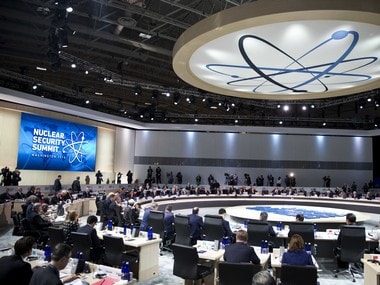
A session of the Nuclear Security Summit in Washington on 1 April. AP[/caption]The Nuclear Industry Summit had some of the unusual enthusiasm — although it had a depressing global nuclear business environment to confront. It seems the joint endeavour with the NGOs coalition in a couple of sessions generated extra energy. The awards ceremony was an exceptionally colourful event. Though all the awards had been announced much in advance, there was an element of excitement among some participants.However, the end of the summit process should not mean the end of the challenge it sought to address. The spectre of nuclear terrorism very much exists as it did at the beginning of the summit process, and frankly speaking, even before that. President Barack Obama’s mission to secure vulnerable nuclear material remains unfulfilled. It has not just missed the original target of securing these materials in four years, but also the extended deadline. Needless to say, the effort needs to be continued.The question arises: Will this effort require the reopening of the summit process?The summit process was an informal voluntary initiative; so, the announcement of the end of the process in the communiqué does not mean a formal legal termination of the process. If a group of countries feels that the process needs to be restarted and some countries take the responsibility of hosting a summit or a series of summits, it can be started at any time with or without the same enthusiasm. As no country came forward to host the summit beyond 2016, it may be inferred that for the time being, the international community may have to rely on mechanisms other than the summit in the fight against nuclear terrorism.During different meetings, other than official summit, the idea of alternative mechanisms was fully explored, and in the all likelihood, it will be fully explored in the coming days and months. For the last few years, when there was a sense that the summit process would end, many were proposing the idea of holding it every fourth year instead of the current format of every second year. However, the most popular format that is finding wider acceptance is ministerial-level meetings. The format has already been tried at the IAEA.Quite obviously, the direct involvement of the IAEA will have more countries participating in it than the current summit process.Closely related is the idea that a contact group may be built. The contact group could be at the ministerial level and it could have the participants of the summit process plus a few more significant countries left out by the process. For sure, the countries and the policy communities, including NGOs will be active in some formats in the future.The international community in general — and India in particular — needs to review all the initiatives and mechanisms to fight nuclear terrorism and to strengthen nuclear security. The international community should work to consolidate the gains the summit process has made. The global policy community is facing a dilemma: To universalise the two nuclear security conventions or work towards a new convention.As of now, the two conventions supporting nuclear security are the Convention on the Physical Protection of Nuclear Material and its amendment and the International Convention for the Suppression of Acts of Nuclear Terrorism. Interestingly, several countries that have been leading the campaign for nuclear security, ratified the two key treaties very late. The amendment to the Convention on the Physical Protection of Nuclear Material, which had come after the 11 September, 2001 attacks, struggled to enter into force. Interestingly, in March 2016, six countries, including Pakistan and New Zealand ratified the amendment of the Convention and on 1 April, 2016, three countries submitted their instruments of ratification.Now, the amendment is just two ratifications away from becoming operational.The world will also have to be very cautious of broadening the scope of the summit process. When the process was started securing of nuclear materials, basically used in the civil nuclear programme, became the focus. Later, radiological materials found the place in the 2012 Seoul Summit. Many countries and members of the civil society were against the inclusion of radiological materials because of the impracticability of control as well as the fear that health centers might be adversely affected. Now it seems the global community has taken up the challenge to manage the difficult task of securing radiological materials which may be used for building dirty bombs.A section of the non-proliferation community is also trying to bring their agenda from the back-door. The summit process had nothing to do with non-proliferation. In fact, it was an attempt to bridge the existing gaps, including the gap created by the non-proliferation treaty. Unfortunately, some non-proliferationists and a couple of leading countries like the United States were trying to push military nuclear materials into the summit process and the nuclear security paradigm. This, at many times, threatened to scuttle the summit process.Indeed, the two tracks should not be merged. The concerned section of the international community is well aware of the fact that not all nuclear materials are bomb-grade materials. For bomb-grade materials, conclusion of a Fissile Material Cut-off Treaty to be negotiated under the Shannon mandate is the best solution. The Conference of Disarmament is the most appropriate body for it.In the post-summit scenario, the centrality of the IAEA is key to securing nuclear materials. True, other institutions are also performing the task of strengthening nuclear security. The centres of excellence like India’s Global Center for Nuclear Energy Partnership may fill the institutional gap and play a complementary role.However, the world will have to remain alert keeping in mind old concerns like Pakistan and the new concerns like the Islamic State. By remaining vigilant, the world may easily prevent nuclear terrorism. For this purpose, the international community will have to remain focused on the real threat, not politically-motivated imaginary threats pushed by the old non-proliferation paradigm.

'We don't need straits': Trump says Iran war isn't about Hormuz as US strikes for 12th night
Iran claims to stop three oil tankers transiting Strait of Hormuz
Globe at a glance: From Houthis striking Saudi tankers in Red Sea to wildfires in Europe
Houthis claim responsibility for attack on two Saudi oil tankers in Red Sea as a new chokepoint emerges
Air India to cut Delhi-Toronto flight time by 3 hours, resume non-stop services from August 1