


Telangana

Telangana - which means the land of the Telugu - is a region consisting of 10 districts in Andhra Pradesh that have borders with Maharashtra, Karnataka, Chhattisgarh and Orissa. It was a separate state till 1956, after which it was merged with the erstwhile Andhra.The Telangana movement is a statehood movement that is all about carving out a separate state comprising the nine Telugu-speaking areas of the erstwhile princely state of Hyderabad from Andhra Pradesh.[caption id="attachment_52589" align="alignleft" width="380" caption="Reuters"]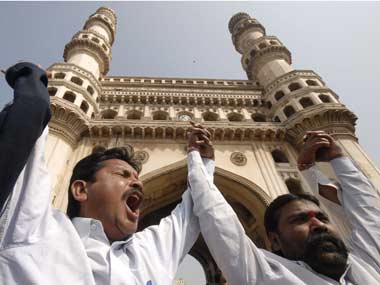 [/caption]The seeds of the agitation were sown in 1947, when India got partitioned. The Nizam of Hyderabad refused to be part of either India or Pakistan, who pressed for a separate kingdom within the British Commonwealth. But thousands of peasants in Hyderabad, propped up by the Communist Party of India, revolted. Finally, the government of India annexed Hyderabad state on 17 September, 1948, in an Army operation that was overseen by Sardar Vallabh Bhai Patel and made it a separate state of the Indian Union.Emboldened by the move, leaders from the neighbouring Andhra region, then part of Madras, stepped up pressure for a separate Telangana state that would include all Telugu speakers living in parts of Hyderabad, Madras and the France-controlled Yanam. They put forward the demand in 1950. In 1952, Potti Sriramulu's death over the issue after a fast led to violence breaking out in parts of Madras' Andhra region. The Government of India gave in and declared Andhra a state on 19 December 1952 on linguistic lines.Other regions lost no time and put in similar demand. In 1953, the Centre constituted the State Reorganisation Committee (SRC) to make recommendations on reorganising states on a linguistic basis.A report was submitted in 1955, wherein the SRC mentioned that 8 Telugu-speaking districts of Telangana be converted into a separate state called Hyderabad, and if it wanted to be part of a United Telugu state, it needed to vote with a two-third majority in the Assembly in 1961.Despite that, on 1 November 1956, the state of Andhra Pradesh was formed merging Telangana and the Andhra state. A Gentleman's Agreement was to assure a fair bargain to Telangana in terms of education and employment opportunities and revenue allocation.Other considerations were that at least two key ministries — home, finance, revenue, planning and development, industries, apart from the post of the CM or deputy CM — should be given to Telangana ministers. But the very day the AP government was formed in November 1956, both the posts of the CM and the deputy CM were denied to Telangana leaders. Neither was the Gentelmen's Agreement honoured.The Telangana people felt betrayed and felt that the best jobs were being given to people from the Andhra region. Surplus funds from Telangana were being diverted to the Andhra region. Resentment grew and culminated in the Jai Telangana movement in 1968-69 in Osmania University and spread rapidly. It was led by political leaders like Sri Konda Laxman Bapuji, Madan Mohan, Mallikarjun, VB Raju and Puli Veeranna.The struggle went on for nine months leading to a loss of some 400 lives. The movement was forcefully quelled by K Brahmananda Reddy, the then CM. At the peak of the movement, an all-party accord was reached, but was discarded within six months.When the movement ended, the people of Telangana demanded a separate state by way of ballot in 1971. The general election saw the victory of 11 MPs out of the 14 seats in the region. Lured by the prospect of power, a number of party leaders gave up their agitations and switched their party loyalty.But election of PV Narasimha Rao from Telangana as CM in 1971 and SC's upholding of educational reservation in Telangana for its people, left the Andhra camp bristling. This led to a counter movement called ‘Jai Andhra’, where the Andhra people pitched for a separate state.The result: the Telangana Regional Committee was cancelled and the government stopped maintaining separate accounts for the two areas. Additionally, people from Andhra could now buy land in Telangana. The conflict over powers and resources and opportunities has been on ever since.The reasons cited by separatists, apart from a sense of neglect, are:• People of Telangana want self-governance. Since AP was formed, Telangana CMs have only ruled for 6 years.• Though Telugu is spoken in both regions, the dialect is different.• In terms of area, Telangana is much bigger than most Indian states.K Chandrashekar Rao, who formed the Telangana Rashtra Samithi (TRS), began a hunger strike on 29 November, 2009, demanding a statehood for Telangana. Eleven days later, the Indian government announced that the "process of formation of the state of Telangana would be initiated after a consensus is reached by all stakeholders".In January 2011, the Justice Srikrishna Committee, 11 months after holding consultations on demand for a separate state of Telangana and for keeping AP intact, suggested 6 options:1. Maintain the status quo2. Bifurcation of the state into Seemandhra and Telangana, with Hyderabad as a Union Territory and the two states developing their own capitals in due course of time3. Bifurcation of state into Rayala-Telangana and coastal Andhra regions with Hyderabad being an integral part of Rayala-Telangana4. Bifurcation of Andhra Pradesh into Seemandhra and Telangana with enlarged Hyderabad Metropolis as a separate Union Territory5. Bifurcation of the state into Telangana and Seemandhra as per existing boundaries with Hyderabad as the capital of Telangana and Seemandhra to have a new capital6. Keeping the state united by simultaneously providing certain definite constitutional/statutory measures for socio-economic development and political empowerment of Telangana region -creation of a statutorily empowered Telangana Regional CouncilRead complete report here.

Holy Cow has become less holy in the Cow Belt
Djokovic vs Nadal: Who will create history today?
Muammar Gaddafi