
Advertisement


Sections
Fasting

Some fasts last forever, some die a fast death, some continue intermittently. Personal denial used to be a potent moral force, as Gandhi showed again and again since he first fasted against racial laws in South Africa in 1914.Anna Hazare’s 5-day fast against corruption and Baba Ramdev’s 9-day debacle marks almost a century of political fasts. As a political tool, however, fasting has made governments weary more than wary. Majority-elected governments do not concede to this ‘counter-constitution and anti-democracy’ blackmail easily, anymore. That’s because, fasts have gone from being an instrument of dissent of the civil society to self-indulgent popularity fests with sure political ramifications.TR Raghunandan, co-ordinator, ipaidabribe.com, lists five pre-conditions for a Satyagraha that justified the use of fasting as a political weapon. [/caption]From Gandhi to Irom Chanu Sharmila to Mamata Banerjee and Baba Ramdev, the change is self-evident.“Television has changed the very idea of the measure,” says the Facebook page of Economics and Political Weekly.
• Fasts could only be undertaken against those people one loved. • Fasts ought to have a concrete and specific goal, not abstract aims. • The fast must be morally defensible in the eyes of the target. • The fast must in no way serve the own interests of the Satyagrahi. • The fast must not ask people to do something they were incapable of, or cause great hardship to them.[caption id="attachment_25421" align="alignleft" width="380" caption="In October 2008, Trinamool Congress leader Mamata Banerjee went on a hunger strike for 26 days, successfully cornering the left. AFP Photo"]
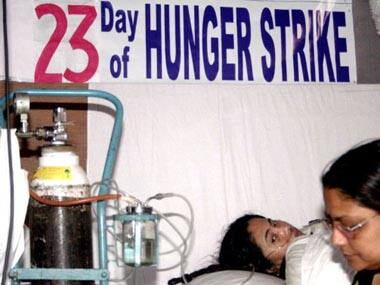 [/caption]From Gandhi to Irom Chanu Sharmila to Mamata Banerjee and Baba Ramdev, the change is self-evident.“Television has changed the very idea of the measure,” says the Facebook page of Economics and Political Weekly.
“Gandhi’s fasts were, at least in his own understanding, inward-looking measures making demands on oneself, rather than on the other. In contrast, hunger strikes, as they were eventually termed to differentiate the political fast from the religious form, were used to force the hand of the opponent by raising the political stakes to a theoretically unacceptable moral limit. Over the past century, political fasts have lost the initial Gandhian feature of being directed inward and have ceased to be a dialogue with oneself.”A list of historic fasts:• Freedon flighter Jatin Das’ fast in a Lahore jail in 1929 led to his death after 69 days. He was protesting inhuman torture of Indian freedom fighters in British prisons.• On October 19, 1952, Indian revolutinary Potti Sreeramulu went on a fast-unto-death for achieving the state of Andhra Pradesh. The 82-day fast took his life but eventually led to the reorganisation of the non-Hindi speaking regions of India into linguistic states.• In August 1969, Darshan Singh Pheruman, a Sikh leader began his fast on issues like Chandigarh and Bhakra Nangal water and died on 27 October, the 74th day of his hunger strike.• On April 3, 1972, Pedro Luis Boitel, imprisoned Cuban poet, went on a 53-day hunger strike. He died of starvation 52 days later.• In 1981, Irish volunteer Bobby Sands died in a prison hospital after 66 days of hunger strike to protest the British government’s withdrawal of Special Catagory Status for convicted paramilitary prisoners in 1976.• On 15 September, 1987 Thileepan, a young LTTE member fasted at the Nallur Murugan Temple to bring awareness and action to a list of public demands made by the Tamil Tigers. He died on the 12th day of the fast.• Beginning in July 1988, Hugo Chavez undertook his longest fast ever, 36 days, to raise public awareness of pesticide use.• On November 4, 2000, Irom Sharmila Chanu, the Iron Lady of Manipur, went on a political fast demanding the Government of India to withdraw the Armed Forces Special Protection Act 1958 (AFSPA) from India’s north-east. After 10 years, her fast continues.• In October 2008, Trinamool Congress leader Mamata Banerjee went on a hunger strike for 26 days, successfully cornering the left to have it release 400 acres of land leased to the Tata Nano project. Her fast made the Tatas take their project out of Singur.• On April 5, 2011 Indian social activist Anna Hazare began fasting to push for the Jan Lokpal Bill that ended 96-hours later after the Indian government agreed to his demands.
First Published:Jun 14, 2011, 15:33:27 IST
Advertisement
Advertisement

Holy Cow has become less holy in the Cow Belt
Fresh stats show that the cow belt is abandoning cows in favour of buffaloes faster than the rest of the country.
Djokovic vs Nadal: Who will create history today?
Tough to imagine someone so close to such a historic achievement of winning a grandslam being an underdog, yet that's exactly what Djokovic is.
Muammar Gaddafi
Advertisement
Advertisement