


Today's Google Doodle sums up scientist CV Raman's biggest achievement
On today's date - 7 November, the 125th birth anniversary of CV Raman, one of India's most prominent scientists with a prolific list of achievements - Google has explained one of his scientific legacies, the Raman effect, on their homepage doodle.

A scientific theory is hard enough to sum up in one word - summing it up in the word 'Google' was probably an even more difficult task.But the art department at Google Inc was clearly up for the challenge. On today's date - 7 November, the 125th birth anniversary of CV Raman, one of India's most prominent scientists with a prolific list of achievements - Google has explained one of his scientific legacies, the Raman effect, on their homepage doodle.[caption id="attachment_1215853" align="alignleft" width="380"]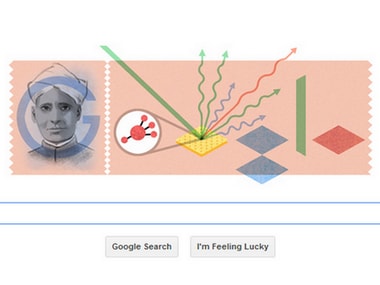 The CV Raman Google Doodle. Image courtesy Google[/caption]The style of the Google Doodle, with its perforated edges and pale pink colour might remind you of a postage stamp. CV Raman looks out benignly from behind the 'G' of the logo, and the rest of the letters explain the Raman effect.It was in 1928 that the scientist discovered the phenomenon now called Raman scattering that is the result of the Raman effect.According to Britannica.com:"Raman effect is the change in the wavelength of light that occurs when a light beam is deflected by molecules. When a beam of light traverses a dust-free, transparent sample of a chemical compound, a small fraction of the light emerges in directions other than that of the incident (incoming) beam. Most of this scattered light is of unchanged wavelength. A small part, however, has wavelengths different from that of the incident light; its presence is a result of the Raman effect."Raman was the recipient of the Nobel Prize for Physics in 1930 for this discovery.

Apple Maps to power navigation and hands-free driving in Ford's 2027 EVs
Project Lighthouse: Bezos-led Prime Video overhaul puts AI front and centre
AMD doubles down on AI infrastructure with Helios launch to rival Nvidia
Google burns cash for first time as AI spending pushes 2026 capex to $205 billion
Tesla sells more cars but makes less money: Why Musk’s AI pivot is squeezing profits