
Advertisement


Sections
When and where you can catch SpaceX's third Falcon Heavy launch live
The mission will last 6 hrs and is carrying 24 payloads which are to be deployed in multiple orbits.

SpaceX is going to launch its self-admitted 'most challenging' rocket launch on 24 June 11.30 am EST in the USA and 25 June in the wee hours of the morning in India. The launch window will be from 8.30 pm IST and if there are any obstacles, the launch will be postponed to 25 June. This will be the first time that the rocket will lift off at night and is the third Falcon Heavy launch.They rocket will be launching 24 payloads at three different orbits and the mission will last a total of six hours. It will also involve four separate upper stage engine burns.The mission is for the US Department of Defense’s (DOD) Space Test Program-2 (STP-2). It will include payloads from NASA, DOD, the National Oceanic and Atmospheric Administration (NOAA) and experiments of several universities. There is also a solar sail called Lightsail 2 and a Deep Space Atomic clock, which is the smallest of its kind.[caption id="attachment_6434591" align="alignnone" width="1280"]![The Falcon 9 Heavy lifting off from the historic Pad 39A at NASA's Kennedy Space Centre.]() The mission is also carrying 152 metal capsules packed with human ashes. This has been arranged by a company called as Celestis which charges upwards of $5,000 for putting 1 gram of ash into outer space. Ashes of Apollo 11 support astronaut Bill Pogue will also be launched into space. The canisters will orbit the planet and eventually enter the Earth’s atmosphere and burn up.This will also be the first time that the side boosters of the Falcon Heavy are reused. SpaceX will also attempt to land the side boosters again on the ground landing zones, and the centre core will land on the Of Course I Still Love You drone ship in the Atlantic Ocean.The last time they tried to capture the core centre was not all that successful. The core landed but they lost it to the rough seas. This time the core will be landing 768 miles away from shore, which is the furthest it has ever been. While the core stage is identical to the side stages, it separates from the payload at a much higher altitude, which means it's returning to the Earth at a much higher speed than the boosters.The Falcon Heavy is the most capable heavy lift launch vehicle in service anywhere in the world at this time.Also Read: SpaceX's Falcon Heavy all set to launch 24 satellites into space on 24 June
The mission is also carrying 152 metal capsules packed with human ashes. This has been arranged by a company called as Celestis which charges upwards of $5,000 for putting 1 gram of ash into outer space. Ashes of Apollo 11 support astronaut Bill Pogue will also be launched into space. The canisters will orbit the planet and eventually enter the Earth’s atmosphere and burn up.This will also be the first time that the side boosters of the Falcon Heavy are reused. SpaceX will also attempt to land the side boosters again on the ground landing zones, and the centre core will land on the Of Course I Still Love You drone ship in the Atlantic Ocean.The last time they tried to capture the core centre was not all that successful. The core landed but they lost it to the rough seas. This time the core will be landing 768 miles away from shore, which is the furthest it has ever been. While the core stage is identical to the side stages, it separates from the payload at a much higher altitude, which means it's returning to the Earth at a much higher speed than the boosters.The Falcon Heavy is the most capable heavy lift launch vehicle in service anywhere in the world at this time.Also Read: SpaceX's Falcon Heavy all set to launch 24 satellites into space on 24 June
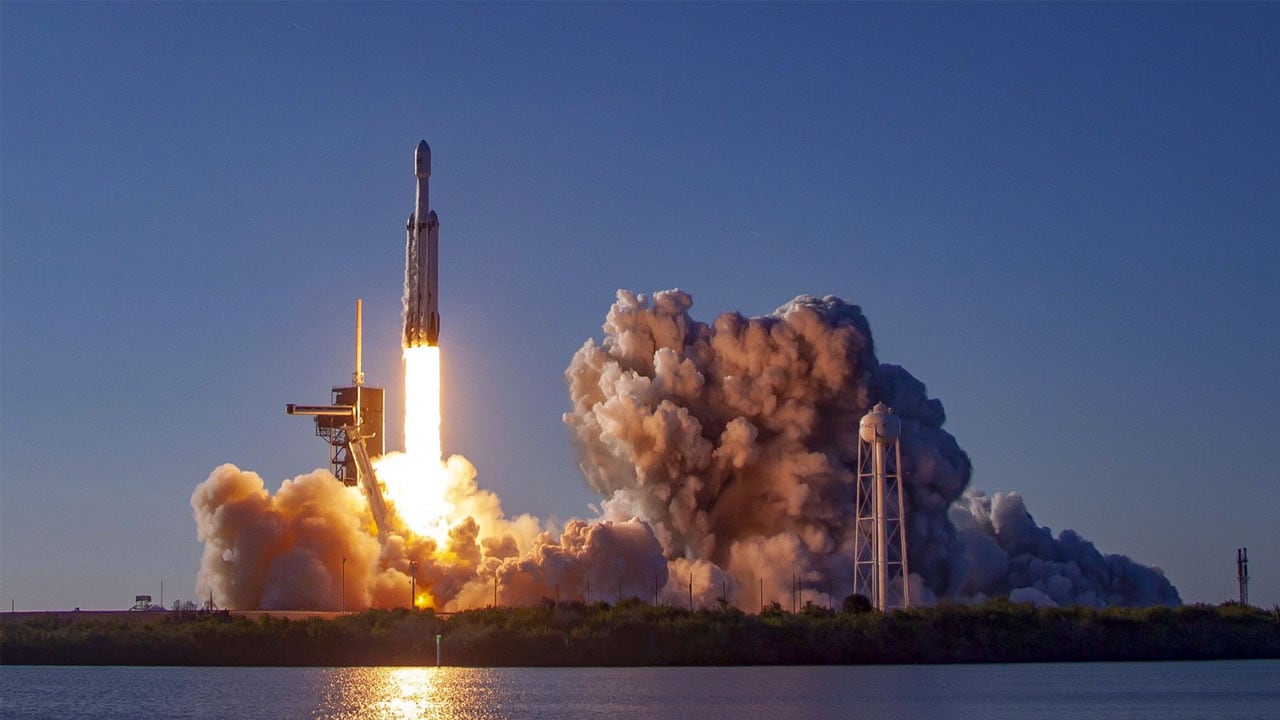
The Falcon 9 Heavy lifting off from the historic Pad 39A at NASA's Kennedy Space Centre.[/caption]Since NASA has a few payloads on the rocket, they will be live streaming the launch here.
First Published:Jun 24, 2019, 17:22:22 IST
Advertisement
Advertisement

Careless Whispers: Scientists discover that plants can 'talk' to each other using smells
Japanese scientists have recorded a video that shows plants, in certain conditions, communicate with each other using mists that carry smells. The discovery, reveals that plants release a fine mist of airborne compounds, to warn nearby plants of potential dangers
Life on Mars? European Space Agency’s Orbiter discovers ice water deposits at equator
European Space Agency's Mars Express Orbiter has identified massive ice and ice water deposits beneath the surface of Mars. The Mars Express orbiter was also the first to confirmed the presence of ice on Mars in 2004
Microsoft briefly overtakes Apple as the most valuable company, Apple back on top again
At its peak during the session, Microsoft's value reached $2.903 trillion, with a 2% surge. As of writing this article, Apple closed at $2.89 trillion, whereas Microsoft closed at $2.86 trillion
Even NASA is facing a tough time, starts layoffs following major budget cuts
NASA is facing some massive budget cuts, because of which, it has been forced to postpone some upcoming missions. NASA's Jet Propulsion Laboratory has been hit hard by recent federal budget cuts, resulting in the layoff of 100 contractors last week
ISRO, NASA's NISAR satellite to get ready by Jan-end, will monitor Earth's snow-covered regions
The NISAR satellite which has been developed jointly ISRO and NASA, should be ready for launch by the end of January 2024. The collaboration between NASA and ISRO on NISAR is the first time the two agencies have cooperated on hardware development for an Earth-observing mission
Advertisement
Advertisement