


Volcanic eruptions may help better predict Indian monsoons, claims Indo-German research team
There is evidence to suggest that massive volcanic eruptions could lead to improved monsoon prediction in subsequent years.

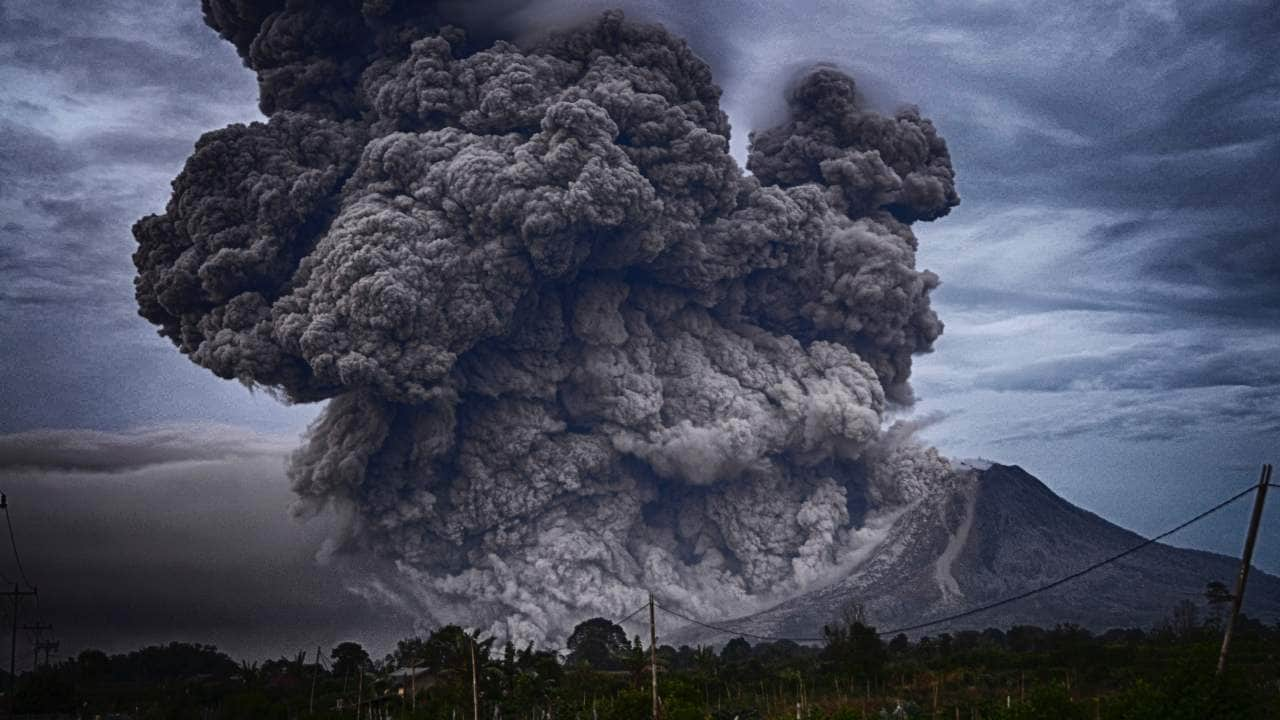
Volcanic eruptions could help better predict Indian monsoon, a recent study suggest. Image: Yosh Ginsu/Unsplash[/caption]It is imperative that we explore and study this link better, to understand the direction (weak or strong) of Indian Monsoon with a reasonable probability. However, for the cases the association breaks down, the inference can be misleading. The Indo-German team of researchers has used novel statistical techniques to exactly underpin when the relationship exists or not. They have found that the ENSO and Indian Monsoon systems are akin to two pendulums oscillating with a particular frequency, where ENSO is the slower pendulum and the Indian monsoon, the faster one. In the study, the researchers establish that the increase in ENSO oscillations in the years that follow a large volcanic eruption can lead to enhanced coupling between the two systems; and eventually, and lend to models predicting the Indian monsoon.The study tests their hypothesis using more than 250 combinations of various paleoclimate proxy datasets from the last 1,000 years. The physical mechanism underlying this natural phenomenon is also shown using big data analysis from the IITM Earth System Model. The amount of data analysed in this research exceeds 100 Terabytes."Volcanoes are in general potentially harmful but the study shows that in the years following the eruptions the Indian Monsoon becomes more predictable," Manmeet Singh, from the Centre for Climate Change Research at the Indian Institute of Tropical Meteorology, says.This work allays the fears that the ENSO and Indian Monsoon relationship might be breaking, which may further make the task of predicting Indian Monsoons more difficult. The epochal nature of the volcanically forced coupling between ENSO and Indian Monsoon as hypothesized by Maraun and Kurths in 2005 and established by this work can help in improving the climate models of the future.

Careless Whispers: Scientists discover that plants can 'talk' to each other using smells
Life on Mars? European Space Agency’s Orbiter discovers ice water deposits at equator
Microsoft briefly overtakes Apple as the most valuable company, Apple back on top again
Even NASA is facing a tough time, starts layoffs following major budget cuts
ISRO, NASA's NISAR satellite to get ready by Jan-end, will monitor Earth's snow-covered regions