


Understanding exoplanets: Unraveling the mysteries of planets that are hotter than stars
Kelt-9 b might've formed away from its parent star and had a violent past with collisions happening as it migrated inwards.

Until the early 2000s, the only known planets were located in our own neighbourhood, the Solar System. They broadly form two categories: the small rocky planets in the inner Solar System and the cold gaseous planets located in the outer part. With the discovery of exoplanets, planets orbiting stars other than the Sun, additional classes of planets were discovered and a new picture started to emerge. Our Solar System is by no means typical. For example, data from the Kepler mission has shown that large, gaseous exoplanets can orbit very close to their star – rather than far away from it, as is the case in our Solar System, causing them to reach temperatures exceeding 1,000K (727°C). These have been dubbed “hot” or “ultra-hot” Jupiters. And while most other exoplanets are smaller, between the size of Neptune and Earth, we don’t know much about their composition.
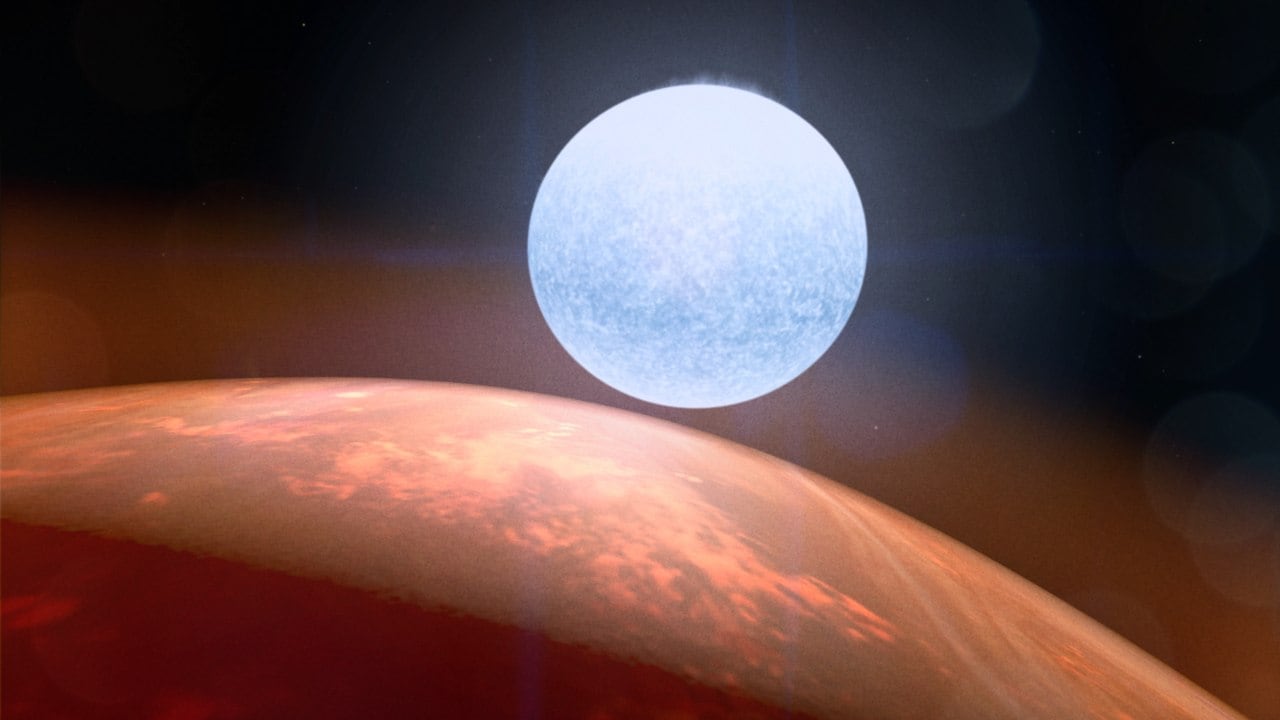
Kelt-9 b
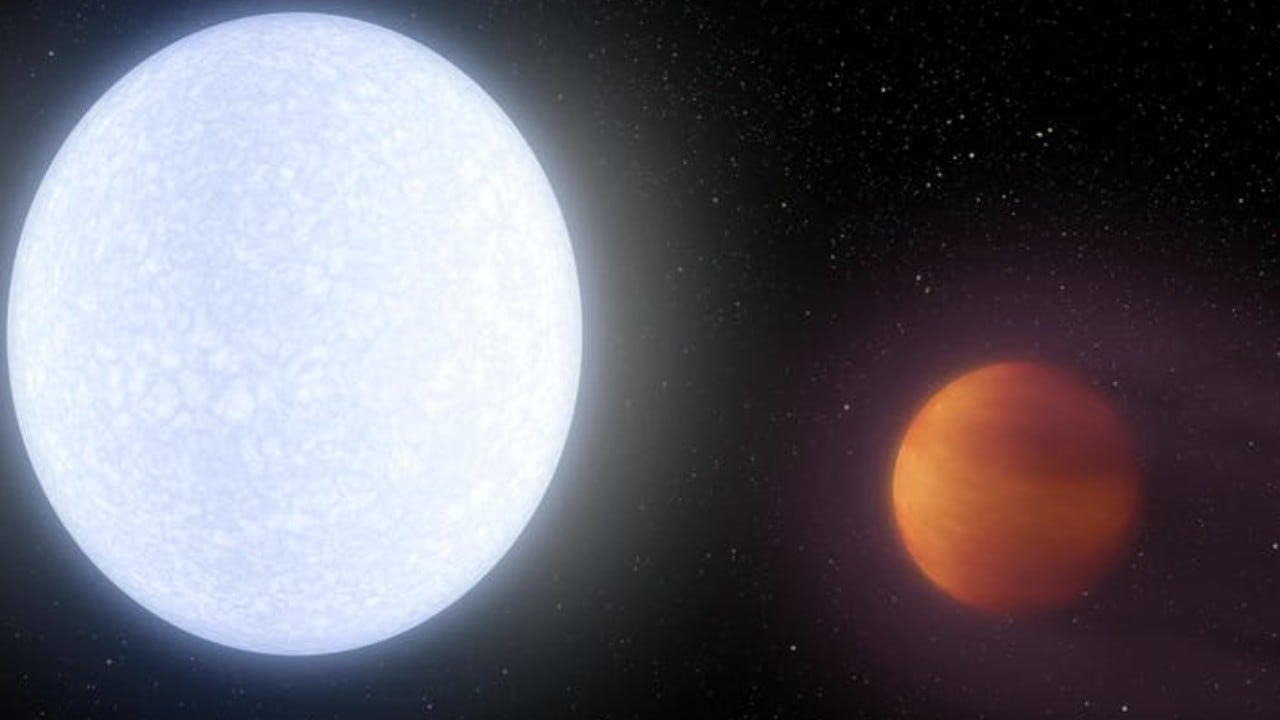
The hottest exoplanet known so far is Kelt-9 b, which was discovered in 2016. Kelt-9 b orbits a star that is twice as hot as our Sun, at a distance ten times closer than Mercury orbits our star. It is a large gaseous exoplanet, with a radius 1.8 times that of Jupiter and temperatures reaching 5,000K. For comparison, this is hotter than 80% of all the stars in the universe and a similar temperature to our Sun.In essence, hot Jupiters are a window into extreme physical and chemical processes. They offer an incredible opportunity to study physics in environmental conditions that are near impossible to reproduce on Earth. Studying them enhances our understanding of chemical and thermal processes, atmospheric dynamics and cloud formation. Understanding their origins can also help us improve planetary formation and evolution models.We are still struggling to explain how planets form and how elements, such as water, were delivered to our own Solar System. To find out, we need to learn more about exoplanet compositions by observing their atmospheres.
Observing atmospheres
There are two main methods to study exoplanet atmospheres. In the transit method, we can pick up stellar light that is filtered through the exoplanet’s atmosphere when it passes in front of its star, revealing the fingerprints of any chemical elements that exist there.The other method to investigate a planet is during an “eclipse” when it passes behind its host star. Planets also emit and reflect a small fraction of light, so by comparing the small changes in the total light when the planet is hidden and visible, we can extract the light coming from the planet.Both types of observations are performed at different wavelengths or colours, and since chemical elements and compounds absorb and emit at very specific wavelengths, a spectrum (light broken down by wavelength) can be produced for the planet to infer the composition of its atmosphere.
 More from Science
The secrets of Kelt-9 b
In our study, we used publicly available data, taken by the Hubble Space Telescope, to obtain the eclipse spectrum of this planet.We then used open-source software to extract the presence of molecules and found there were plenty of metals (made from molecules). This discovery is interesting as it was previously thought that these molecules would not be present at such extreme temperatures – they would be broken apart into smaller compounds.
Future missions
Observatories, such as the Hubble Space Telescope, were not designed to study exoplanet atmospheres. The next generation of space telescopes, such as the James Webb Space Telescope and the Ariel mission, will have much better capabilities and instruments specifically tailored for the rigorous observation of exoplanet atmospheres. They will allow us to answer many of the fundamental questions raised by the extremely hot-Jupiter planet class, but they will not stop there.This new generation of telescopes will also probe the atmosphere of small worlds, a category that current instruments struggle to reach. In particular, Ariel, which is expected to launch in 2029, will observe about 1,000 exoplanets to tackle some of the most fundamental questions in exoplanet science.Ariel will also be the first space mission to look in details at the atmosphere of these worlds. It should finally tell us what these exoplanets are made of and how they formed and evolved. This will be a true revolution. Quentin Changeat, Postdoctoral Research Fellow in Astronomy, UCL and Billy Edwards, Project Scientist of the Twinkle Space Mission, Research Fellow of Astronomy, UCLThis article is republished from The Conversation under a Creative Commons license. Read the original article.

Careless Whispers: Scientists discover that plants can 'talk' to each other using smells
Life on Mars? European Space Agency’s Orbiter discovers ice water deposits at equator
Microsoft briefly overtakes Apple as the most valuable company, Apple back on top again
Even NASA is facing a tough time, starts layoffs following major budget cuts
ISRO, NASA's NISAR satellite to get ready by Jan-end, will monitor Earth's snow-covered regions